HomeBlogFall 2026 AI Model Release Outlook: OpenAI GPT-6, Google Gemini and Anthropic Claude
AI
Fall 2026 AI Model Release Outlook: OpenAI GPT-6, Google Gemini and Anthropic Claude
Asim Ansari
September 4, 2026
26 min read
Explore the Fall 2026 AI model release outlook covering OpenAI GPT-6 Astra, Google Gemini 3.7 Flash, Anthropic Claude Fable 5.1, model routing, enterprise AI governance, cost, safety and adoption strategy.
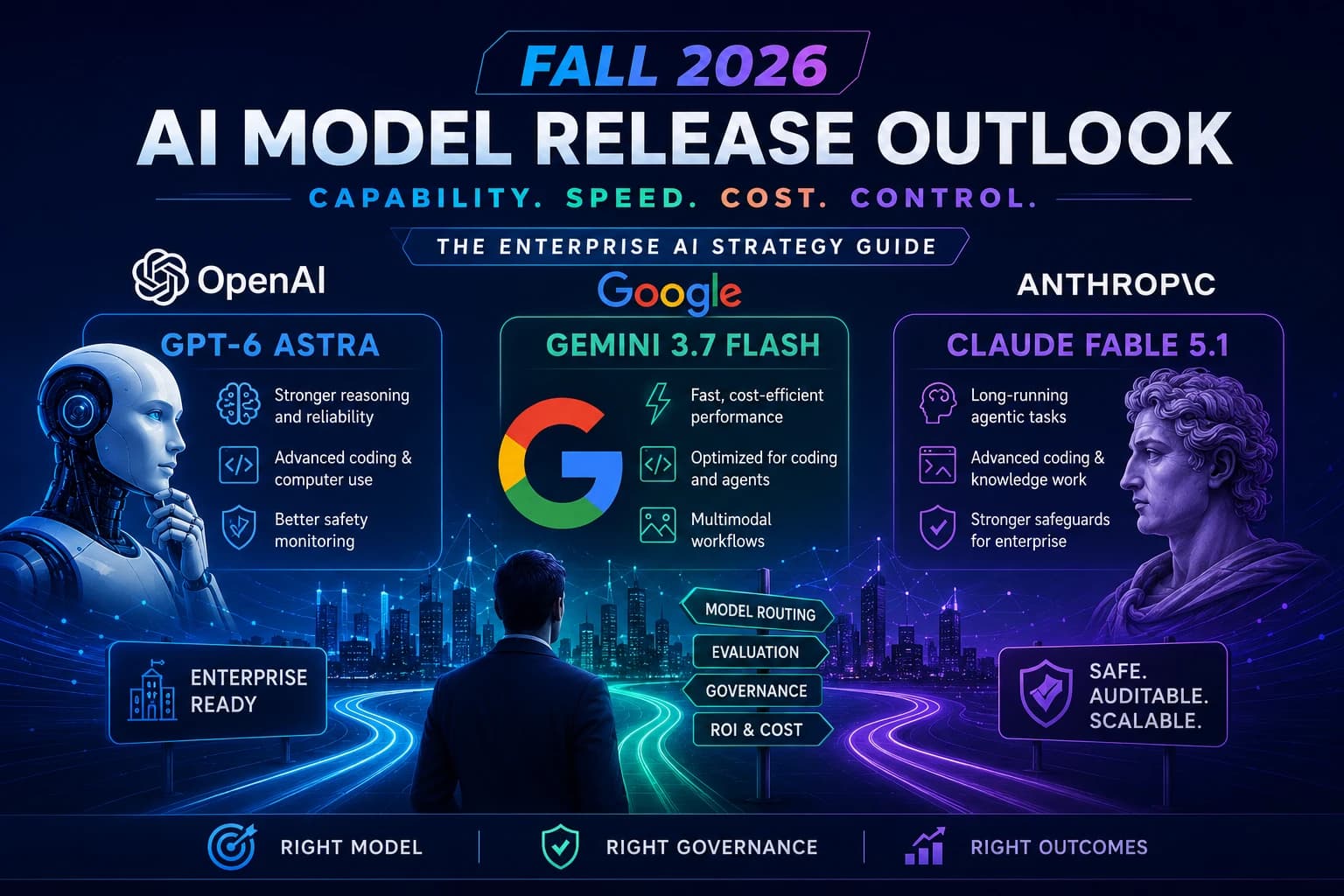
Direct Answer: The Fall 2026 AI model release cycle marks a definitive transition from theoretical benchmark supremacy to practical enterprise deployment capability. With OpenAI initiating the rollout of GPT-6 Astra following its GPT-5.6 modular tiering, Google scaling Gemini 3.7 Flash as an ultra-fast multimodal workhorse, and Anthropic deploying Claude Fable 5.1 and Claude Mythos 5.1 for long-running agent workflows and frontier safeguards, enterprise buyers must look beyond vendor lock-in. Sustainable ROI in Q3/Q4 2026 belongs to organizations implementing dynamic model routing, rigorous cost-latency optimization, and verifiable governance frameworks compliant with the enforced EU AI Act.
The frontier AI landscape in the second half of 2026 is no longer defined by speculative parameter counts or synthetic leaderboard bragging rights. The conversation in executive boardrooms, engineering standups, and enterprise architecture reviews has pivoted decisively:
"In Fall 2026, the winning AI model is not merely the one that produces the cleverest single response. The winner is the model—or combination of models—that executes real business workflows with sub-second latency, deterministic tool integration, predictable per-task economics, and ironclad regulatory auditability."
Between late August and early September 2026, the three major frontier AI labs made their strategic moves:
OpenAI announced its next-generation GPT-6 Astra on September 3, 2026, while operationalizing its GPT-5.6 family (Sol, Terra, and Luna) into commercial routing tiers.
Google pushed Gemini 3.7 Flash (released August 13, 2026) to the forefront as an enterprise workhorse engine optimized for 1M+ context window ingestion, developer agents, and multimodal reasoning.
Anthropic unveiled Claude Fable 5.1 and the specialized Claude Mythos 5.1 on September 1, 2026, focusing on persistent coding harnesses, recursive agentic stability, and customer-isolated frontier safety controls.
Global Regulators shifted the compliance baseline with the formal enforcement kickoff of the EU AI Act on August 2, 2026, making governance, data provenance, and risk documentation non-negotiable.
This guide moves past the consumer hype cycle. It provides an enterprise-level release outlook, compares confirmed technological signals across OpenAI, Google, and Anthropic, details an actionable model evaluation framework, and explains how to architect a modern multi-model routing pipeline.
Quick Take: OpenAI, Google and Anthropic
To make strategic infrastructure decisions, engineering leaders need verified facts separated from marketing buzz. Below is the confirmed operational status of the primary frontier ecosystems as of early September 2026:
Provider / Domain
Confirmed Signal
Enterprise Operational Meaning
OpenAI
GPT-6 Astra announced (Sep 3, 2026); GPT-5.6 modular family (Sol, Terra, Luna) general availability
Advanced autonomous computer interaction, native cyber defense reasoning, and multi-agent coordination with specialized routing tiers.
Google
Gemini 3.7 Flash deployed (Aug 13, 2026) across AI Studio, Vertex AI & Workspace
Low-latency, high-throughput multimodal engine with a 1M+ context window; built for cost-efficient bulk ingestion, automated triage, and developer tool chains.
Anthropic
Claude Fable 5.1 & Claude Mythos 5.1 unveiled (Sep 1, 2026)
Focus on multi-hour persistent agent harnesses, deep code refactoring, contextual cache cost reductions (up to 90%), and vetted research environments.
EU Market
EU AI Act enforcement commenced (Aug 2, 2026)
Strict risk classifications, transparency requirements, mandatory model card audits, and supply chain accountability for GPAI deployments.
Enterprise Buyers
Token economics, sub-second SLAs, and security sandboxing supersede single-vendor loyalty
Shift from single-foundation vendor lock-in toward dynamic orchestration layers and multi-model routing gateways.
OpenAI Outlook: GPT-6 Astra and GPT-5.6 Model Family
FrontierGPT-6 Astra
Multi-agent orchestration, native OS computer use, autonomous tool-loop stability, and proactive cyber defense verification.
Heavy ReasoningGPT-5.6 Sol
Complex algorithmic synthesis, multi-file codebase refactoring, mathematical logic, and deep financial contract analysis.
Balanced WorkhorseGPT-5.6 Terra
Production foundation for enterprise SaaS, CRM updates, customer care workflows, and automated document processing.
Low LatencyGPT-5.6 Luna
High-frequency sub-100ms inference for live voice interaction, conversational triage, and real-time streaming filters.
On September 3, 2026, OpenAI formally announced GPT-6 Astra, marking its transition to an architecture specifically trained for multi-turn autonomous systems rather than single-turn textual completions.
1. Key Architectural Developments in GPT-6 Astra
Native Multi-Agent Orchestrator: GPT-6 Astra is designed from the weights up to act as a primary controller that can spawn, monitor, evaluate, and terminate sub-agent loops without losing state or getting caught in recursive hallucinations.
Deterministic Programmatic Tool Execution: Rather than treating tool calling as standard JSON text generation, Astra integrates strict schema compilation and sandboxed execution validation before returning output to the application runtime.
Cyber Defense & Threat Verification: According to OpenAI’s initial safety disclosures, Astra includes proactive vulnerability modeling, identifying logic flaws in generated software before execution in enterprise staging environments.
2. The GPT-5.6 Family as the Commercial Foundation
While Astra undergoes controlled enterprise access, OpenAI’s GPT-5.6 family has established itself as a multi-tier production workhorse:
Sol: Tuned for complex algorithmic synthesis, mathematical modeling, and multi-file codebases.
Terra: The balanced middle tier powering day-to-day enterprise SaaS integrations, automated CRM updates, and structured document processing.
Luna: A distilled, high-frequency model designed for sub-100ms latency applications such as live voice agents and semantic filtering.
3. OpenAI Enterprise Implementation Takeaways
For engineering leaders building on OpenAI:
Evaluate for Complex Workflows: Astra and GPT-5.6 Sol excel in tasks requiring multi-step verification, such as automated legacy codebase migrations or multi-system ERP reconciliations.
Implement Guardrails Against Context Bloat: Despite expanded window sizes, multi-agent loops can rapidly inflate token consumption. Establish hard recursion limits and token budgets per session.
Reference Implementations: Review our detailed guide on integrate-salesforce-chatgpt-openai to see how OpenAI models interface safely with enterprise CRM schemas.
Google’s strategy with the August 13, 2026 launch of Gemini 3.7 Flash illustrates a clear philosophy: win the daily operational volume of global enterprise computing.
1. The High-Throughput Workhorse
Rather than competing purely on extreme-parameter reasoning where latency and cost become prohibitive for high-volume transactions, Gemini 3.7 Flash optimizes the Pareto frontier:
1 Million+ Token Native Context Window: Capable of ingesting comprehensive quarterly financial reports, full enterprise API specifications, or hours of raw operational audio/video in a single call.
Aggressive Token Pricing & Concurrency: Engineered to operate at a fraction of frontier reasoning costs, making high-volume automated triage and semantic data extraction economically viable.
Multimodal by Design: Unmatched speed in processing combined text, UI screen recordings, architectural diagrams, and structured database exports.
2. The Google Cloud & Workspace Flywheel
Google’s decisive competitive moat remains its native presence inside enterprise workflows. With Gemini 3.7 Flash embedded directly across Google Cloud Vertex AI, BigQuery vector engines, and Google Workspace, organizations with existing GCP infrastructure can bypass complex third-party API configurations while maintaining private VPC network isolation.
3. Google Gemini Enterprise Implementation Takeaways
High-Volume Data Ingestion: Use Gemini 3.7 Flash as your front-line ingestion and summarization engine for raw telemetry, customer support chat streams, and technical documentation indexing.
Knowledge Graph Construction: Leverage the 1M+ context window to extract structured entity relationships from unstructured data silos. For deep architectural patterns, explore our guide on creating-knowledge-graphs-for-ai.
Anthropic Outlook: Claude Fable 5.1, Mythos 5.1 and Enterprise Safeguards
Flagship AgentClaude Fable 5.1
Built for continuous multi-hour coding harnesses, persistent prompt caching (reducing recurring context costs by up to 90%), and complex legal/financial knowledge synthesis.
Vetted Frontier TierClaude Mythos 5.1
Restricted, KYC-verified access tier engineered for extreme high-stakes safety, formal algorithmic verification, and sensitive defense/biomedical research environments.
Anthropic’s September 1, 2026 announcements of Claude Fable 5.1 and Claude Mythos 5.1 represent the gold standard for organizations where code quality, contextual stability, and rigorous safety guarantees take precedence over raw speed.
1. Claude Fable 5.1: Engineered for Long-Running Coding & Agents
Fable 5.1 addresses the primary limitation of earlier conversational models: degradation over extended, multi-hour coding tasks.
Persistent Agentic Stability: Works seamlessly with recursive language harnesses and developer environments, maintaining strict adherence to complex system prompts over hundreds of sequential execution steps.
Prompt Caching Efficiency: Anthropic’s enhanced caching architecture allows teams to cache massive code repositories and technical manuals in memory, lowering recurring token costs by up to 90%.
Deep Intent Translation: Outstanding capability in converting ambiguous stakeholder requirements into deterministic architectural specifications. Read more on how this impacts enterprise systems in intent-driven-software-development-salesforce-apex.
2. Claude Mythos 5.1: The Vetted Frontier Tier
For highly regulated industries—including sovereign defense contractors, pharmaceutical research facilities, and global financial clearers—Anthropic introduced Claude Mythos 5.1. Operating under restricted, KYC-verified access, Mythos 5.1 is subjected to rigorous formal verification pipelines to prevent emergent vulnerability generation and uncontrolled autonomous tool escalation.
3. Anthropic Enterprise Frontier Safeguards
Anthropic continues to lead in compliance-first infrastructure:
Customer-controlled cryptographic key management for stored cached context.
Verifiable zero-data retention policies guaranteed through enterprise Service Level Agreements (SLAs).
Built-in circuit breakers that halt autonomous execution if prompt injection or jailbreak indicators are detected in third-party API payloads.
The New AI Competition: Capability, Speed, Cost and Control
The days of evaluating AI vendors on a single benchmark (such as MMLU or HumanEval) are over. In Fall 2026, enterprise buyers assess models across four operational vectors:
1. Capability (The Reasoning Ceiling)
Handles multi-step reasoning, ambiguous system requirements, and complex tool calling without human intervention.
Frontrunners: OpenAI GPT-6 Astra, Claude Fable 5.1
2. Speed (Latency & UX)
Sub-second time-to-first-token (TTFT) and rapid answer completion for customer portals, live voice, and IDEs.
Frontrunners: Gemini 3.7 Flash, GPT-5.6 Luna
3. Cost (Unit Economics)
Fully loaded cost per business transaction including tokens, prompt caching, tool invocations, and error retries.
Frontrunners: Gemini 3.7 Flash, Claude Fable 5.1 (cached)
4. Control (Governance & Safety)
Auditable execution logs, role-based controls, and compliance with the EU AI Act, NIST AI RMF, and SOC2.
Frontrunners: Claude Mythos 5.1, Vertex AI Private VPC
Why Benchmarks Are Not Enough for Businesses
Relying on public leaderboards to select enterprise AI models is one of the most expensive mistakes an IT organization can make in 2026. Standard benchmarks suffer from three fundamental enterprise blindspots:
Benchmark Contamination & Overfitting: Public test datasets often leak into frontier pre-training corpuses, inflating scores without reflecting real-world performance on proprietary enterprise data.
Ignorance of Tool Call Fragility: A model might write an elegant Python script in a zero-shot benchmark, yet fail completely when attempting to execute a real-world multi-table SQL update across a rate-limited REST API.
Absence of Cost & Latency Penalties: Leaderboards rank pure accuracy. In production, a model that is 2% more accurate but costs 15x more and takes 8 seconds longer is an operational failure for customer-facing applications.
To understand how hallucination risks and uncontrolled model outputs can directly damage corporate reputation, see our comprehensive analysis on ai-hallucinations-brand-risk.
Model Routing: Why One Model Is Not Enough
Enterprise AI maturity is defined by the elimination of single-model dependencies. High-performing engineering teams build Intelligent Model Routing Gateways that dynamically dispatch queries based on complexity, security classification, latency requirements, and cost thresholds.
Step 1: Ingestion & Inspection
Incoming User / Agent Request → Intelligent Routing Proxy
By decoupling application logic from individual model APIs, organizations gain immediate advantages:
Zero Downtime Vendor Failover: If one provider suffers an outage or API degradation, traffic shifts seamlessly to alternative providers.
Cost Reduction: Offloading 70% of routine requests to models like Gemini 3.7 Flash or GPT-5.6 Luna cuts cloud AI spend by up to 60%.
Optimal Task Specialization: Leveraging Anthropic for multi-turn code refactoring and Google for bulk multimodal ingestion unlocks peak performance across every business unit.
Crucial for SOC2, HIPAA, ISO 42001, and regulatory compliance audits.
6. Security & Vulnerability
Resistance to direct/indirect prompt injection, data exfiltration risks, and excessive autonomous agency limits.
AI models integrated with enterprise databases and tools represent prime targets for adversaries.
7. System Integration Fit
Native connectors for Salesforce, AWS/GCP/Azure, GitHub, ERPs, and CI/CD automation pipelines.
The best model is meaningless if it requires months of custom middleware development to integrate.
Governance, EU AI Act and Security Risks
The regulatory and security landscape in the second half of 2026 has introduced mandatory constraints that every CTO and CISO must address.
EU AI Act (Aug 2, 2026)
Mandatory GPAI Compliance
High-risk system conformity assessments, technical transparency logs, and copyright provenance documentation.
OWASP Top 10 for LLMs
Agency & Injection Defense
Guardrails for prompt injection, sensitive data leakage, and excessive autonomous tool authorization.
NIST AI RMF 1.0
Enterprise Risk Management
Structured framework to govern, map, measure, and manage algorithmic behaviors with continuous red-teaming.
1. EU AI Act Enforcement (August 2, 2026)
The European Commission's enforcement of the EU AI Act marks the end of unregulated frontier deployments. Enterprise applications touching European citizens or deployed by global multinationals must demonstrate:
Comprehensive technical documentation outlining data training sources and model capabilities.
Mandatory logging of all automated decision-making processes for high-risk categories (including hiring, credit scoring, critical infrastructure, and biometric verification).
Robust cyber-resilience against adversarial perturbation and evasion attacks.
2. Guarding Against Excessive Agency (OWASP LLM08)
As models like GPT-6 Astra and Claude Fable 5.1 gain computer use and autonomous tool capabilities, excessive agency has become the number one vulnerability vector in enterprise AI architectures.
To mitigate risks:
Never grant frontier models direct, unmonitored write access to production databases.
Require cryptographically signed human-in-the-loop approvals for destructive operations (e.g., table drops, bulk record deletions, fund transfers).
Sandbox tool execution in isolated ephemeral micro-containers.
What SMEs and Startups Should Do Next
For small-to-medium enterprises and fast-moving startups, the Fall 2026 model release cycle provides an unprecedented opportunity to out-innovate larger, slower competitors—if approached with disciplined execution.
Phase 1 (Weeks 1-2)
Inventory & Cost Audit
Calculate true per-task cost across existing LLM calls and identify single-vendor bottlenecks.
Discovery
Phase 2 (Weeks 3-4)
Deploy Routing Gateway
Shift 60%+ of routine triage and document ingestion to Gemini 3.7 Flash or GPT-5.6 Luna.
Cost Optimization
Phase 3 (Weeks 5-6)
Upgrade Reasoning & Coding Agents
Implement Claude Fable 5.1 and GPT-6 Astra with persistent prompt caching for complex pipelines.
Performance
Phase 4 (Weeks 7-8)
Enforce Governance & AEO Readiness
Establish audit logs, tool permissions, and optimize content for answer engines like Gemini and ChatGPT.
Governance
Conduct a Vendor Dependency Audit: Identify where your application relies exclusively on a single proprietary API. Abstract these calls behind an internal routing gateway.
Implement Aggressive Prompt Caching: If using Anthropic or OpenAI for repetitive tasks (e.g., codebase reviews, customer FAQ classification), structure prompts to take maximum advantage of persistent caching tiers.
Benchmark on Your Own Data: Build a golden test set of 100 representative business prompts with human-graded acceptance criteria. Run GPT-6 Astra, Gemini 3.7 Flash, and Claude Fable 5.1 against this exact dataset to calculate true task ROI.
Prepare for AI Search Optimization (AEO/GEO): As consumer search shifts toward generative answer engines powered by these frontier models, optimize your digital footprint. Read our guides on what-is-answer-engine-optimization-aeo and role-of-eeat-in-aeo.
How IntellectualClouds Helps Teams Adopt AI Models Safely
Navigating the rapid evolution of frontier AI models requires more than chasing release headlines. It requires sound architectural strategy, robust data pipelines, and enterprise-grade governance.
Build an Enterprise AI Model Strategy Before the Next Release Cycle
IntellectualClouds helps engineering teams, enterprise IT leaders, and fast-growing organizations evaluate, integrate, and govern AI models across mission-critical workflows. Instead of locking your business into a single vendor or reacting impulsively to every new model launch, we help you build a repeatable, cost-efficient, and secure AI delivery engine.
✓Intelligent Model Routing: Dynamic multi-model gateways optimizing cost, speed, and accuracy.
✓AI-Accelerated Salesforce & CRM: Custom AI agents integrated with enterprise schemas.
✓AI SEO & Answer Engine Optimization: Maximizing visibility across Gemini, ChatGPT, and Perplexity.
✓Governance & Compliance: EU AI Act, NIST AI RMF, and OWASP security frameworks.
What are the biggest AI model releases to watch in Fall 2026?
The Fall 2026 frontier landscape is defined by OpenAI's GPT-6 Astra alongside the modular GPT-5.6 family, Google's Gemini 3.7 Flash high-throughput multimodal engine, and Anthropic's Claude Fable 5.1 and Mythos 5.1 agent frameworks. The competitive emphasis has shifted from raw zero-shot benchmarks to deployment economics, multi-agent orchestration, and governance compliance.
What is OpenAI GPT-6 Astra?
Announced on September 3, 2026, GPT-6 Astra is OpenAI's next-generation architecture built specifically for multi-agent orchestration, persistent computer use, autonomous tool calling, and deep cyber defense reasoning. It is rolled out in controlled phases to enterprise partners.
What is Google Gemini 3.7 Flash?
Released on August 13, 2026, Gemini 3.7 Flash is Google's enterprise workhorse model. Featuring a 1M+ token context window, native multimodal video/audio parsing, and industry-leading latency-per-dollar economics, it is built for high-throughput daily operations and automated developer pipelines.
What is Claude Fable 5.1?
Announced on September 1, 2026, Claude Fable 5.1 is Anthropic's flagship model for long-running autonomous coding, software architecture, and multi-turn knowledge work. It features persistent prompt caching that reduces recurring context costs by up to 90%, customer-isolated data controls, and companion access to Claude Mythos 5.1 for vetted high-risk environments.
Should businesses switch AI models every time a new model launches?
No. Chasing benchmark releases creates severe technical debt, fragile integrations, and unpredictable operational costs. The superior approach is deploying an intelligent model routing gateway that dispatches tasks to the best-fit model based on deterministic criteria (accuracy, cost, latency, and compliance).
What is model routing?
Model routing is an architectural pattern in which an orchestration layer evaluates an incoming prompt or task, assesses its complexity, privacy tier, and SLA requirements, and forwards it to the optimal foundation model. This prevents overpaying for frontier reasoning on simple tasks while ensuring complex tasks receive maximum capability.
How should enterprises evaluate AI models?
Enterprises should evaluate models across seven operational pillars: Accuracy on proprietary human-reviewed test sets, Fully Loaded Cost of Ownership (tokens, caches, retries), Latency & TTFT, Tool Calling Action Surface Reliability, Governance & Auditability, Security & Prompt Injection Resilience, and Ecosystem Integration Fit.
Why does AI governance matter in 2026?
With autonomous AI agents executing real database writes, calling external APIs, and modifying source code, unmonitored deployments create critical data breach, liability, and regulatory risks. Structured governance provides audit logs, permission boundaries, and human review gates to ensure safe, lawful operation.
How does the EU AI Act affect AI model adoption?
With mandatory enforcement starting August 2, 2026, the EU AI Act requires General Purpose AI (GPAI) providers and deploying enterprises to maintain detailed technical documentation, conform to strict copyright and transparency rules, and assess systemic risks in automated decision systems.
How can IntellectualClouds help with enterprise AI adoption?
IntellectualClouds helps organizations build repeatable model evaluation frameworks, deploy resilient multi-model routing architectures, design custom Salesforce and cloud AI agents, and implement enterprise-grade governance controls. Learn more at intellectualclouds.com/services/ai-seo.
Asim Ansari is the Founder of Intellectual Clouds and a Certified Salesforce Administrator and Pardot Specialist with 17+ years of experience across Salesforce CRM, AI automation, cloud infrastructure (AWS), and digital transformation. He writes on AI agents, Salesforce delivery, Answer Engine Optimisation (AEO), and AI-accelerated business operations.