HomeBlogPrime Agent Explained: How Self-Improving AI Coding Agents Are Changing Software Development
AI
Prime Agent Explained: How Self-Improving AI Coding Agents Are Changing Software Development
Asim Ansari
August 12, 2026
31 min read
Learn what Prime Agent is, how self-improving AI coding agents work, what RLM and Continual Harness mean, and why long-running agent workflows matter for software teams.
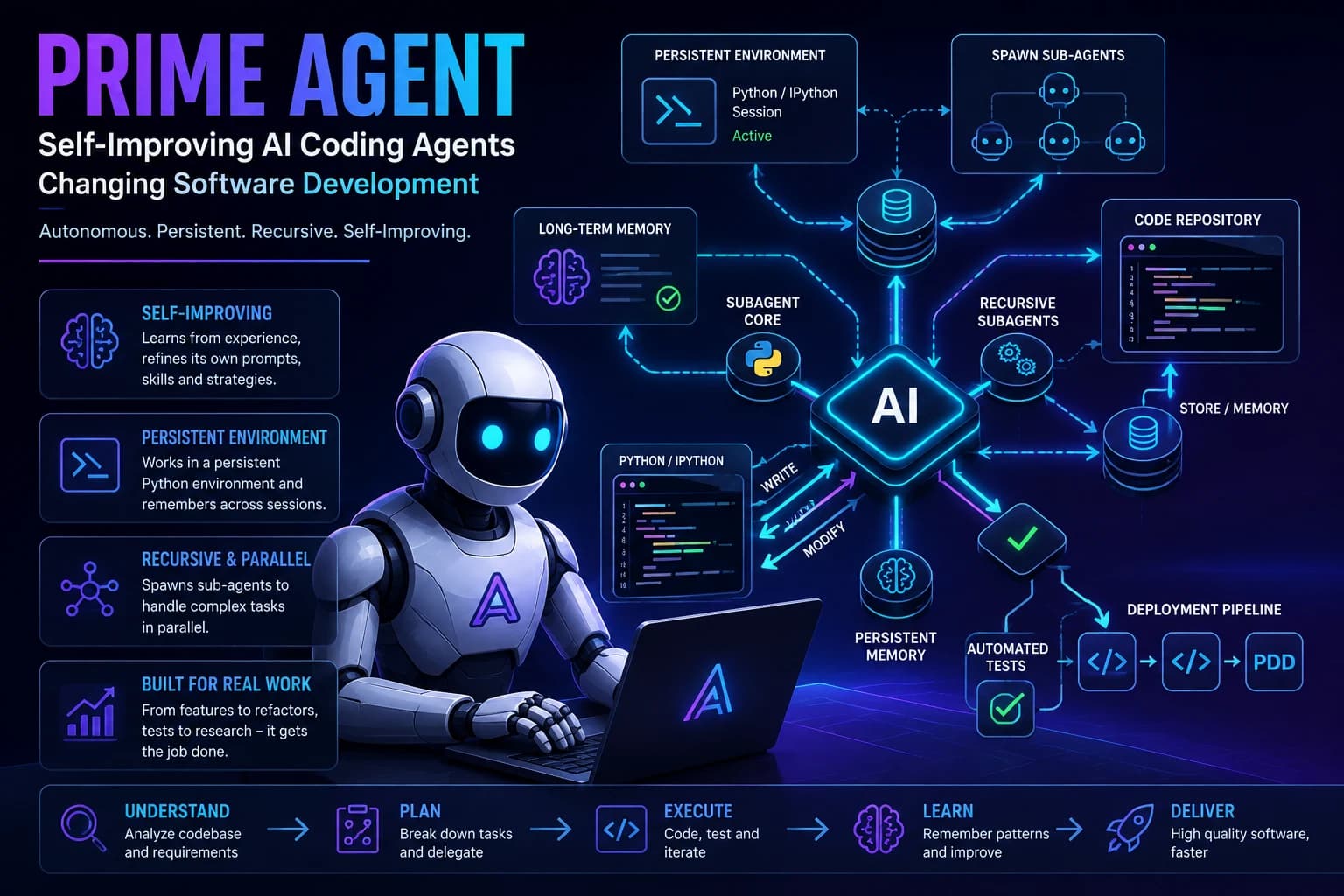
Quick Answer: Prime Agent is an open-source AI coding and research agent from Prime Intellect. It is designed around Recursive Language Models and a Continual Harness, allowing the agent to use a persistent Python environment, spawn sub-agents, remember useful patterns, refine its own harness state, and continue long-running coding or research tasks across sessions. This makes it fundamentally different from traditional coding assistants — it is not a chat tool, it is an autonomous software development collaborator.
By Asim Ansari|Last Updated: August 12, 2026|22 min read
Something is shifting in how software gets built. Not at the edges — at the center.
For the past few years, AI coding tools have operated inside a familiar frame: you open a chat window, describe what you want, and an AI generates a suggestion. You copy it, edit it, test it, and move on. The AI assists. The developer leads.
Prime Agent is a direct challenge to that model. Released by Prime Intellect in August 2026, it is not a chat-based coding assistant. It is a self-improving AI coding and research agent — one designed to execute long, complex software tasks autonomously, spawn child agents for parallel work, accumulate memory across sessions, and refine its own behavior based on what it learns.
This is not an incremental improvement to GitHub Copilot. It is a different category of tool, built on a different set of ideas about what AI-assisted software development should look like.
This article breaks down exactly what Prime Agent is, how Recursive Language Models and the Continual Harness work, what this architecture means for software teams, and what enterprise organizations need to consider before adopting agentic development workflows.
1. What Is Prime Agent?
Prime Agent is an open-source AI coding and research agent developed by Prime Intellect, an AI research organization. It was publicly announced in August 2026 and is available on GitHub.
At its core, Prime Agent is built around two key technical ideas:
Recursive Language Models (RLMs) — a programming model where the AI can programmatically manage its own context, delegate to subagents, and handle tasks that exceed a single context window.
Continual Harness — a mechanism that allows the agent to update its own prompts, skills, memory, and subagent behaviors based on what it learns across task trajectories.
The practical result is an agent that can:
Maintain a persistent Python/IPython environment across a long task
Spawn and manage recursive subagents for parallel or specialized work
Accumulate memory that persists beyond a single session
Refine its own prompts and skills when it recognizes repeated patterns or failures
Execute long-running software tasks — coding, research, evaluation, migration planning, and more — with continuity that chat-based tools cannot provide
Prime Agent is positioned not as a developer productivity add-on, but as the beginning of a new class of software development infrastructure: the self-improving agent harness.
2. Why Prime Agent Matters in 2026
The announcement of Prime Agent lands at a specific moment in AI development. Several converging forces make it significant:
Context windows are no longer the bottleneck. As of 2026, leading language models support context windows of hundreds of thousands of tokens. But large context alone does not solve complex, multi-session software tasks. You need architectures that can manage, delegate, and persist — not just consume a large context.
Software delivery demands are outpacing team sizes. Enterprise development teams face pressure to deliver more capability with smaller, leaner teams. AI-assisted development is now a strategic requirement, not an experiment. The question is no longer whether to use AI in software delivery, but how to structure that AI use at scale.
The limits of chat-based AI coding are visible. Teams that have used Copilot, Cursor, Claude, or Codex for real engineering work have experienced its limits: context loss across sessions, inability to run extended autonomous tasks, no memory of previous decisions, and no mechanism for the AI to improve its own performance on recurring task types.
Research on agent architectures is maturing. The Recursive Language Models paper (arXiv:2512.24601) and the Continual Harness paper (arXiv:2605.09998) provide academic grounding for what Prime Agent implements. This is not a product without research foundation.
Prime Agent is an early commercial-grade instantiation of where AI coding infrastructure is heading: persistent, recursive, self-improving, and long-running.
3. What Problem It Solves in AI Coding
To understand why Prime Agent matters, it helps to articulate precisely what it solves.
Problem 1: Context loss across sessions. Chat-based AI coding assistants start fresh every session. Every time you open a new chat, the AI has no memory of your codebase decisions, conventions, previous debugging sessions, or architectural choices. You re-explain constantly.
Problem 2: Single-agent limitation for large tasks. Complex software tasks — large refactors, full-feature implementations, codebase audits, migration planning, test suite creation — exceed what a single AI agent can handle in one pass. Without a subagent architecture, the developer manually breaks tasks into pieces and feeds them to the AI sequentially, which is slow and loses the thread of the larger task.
Problem 3: No self-improvement mechanism. Traditional AI coding tools do not get better at your specific codebase over time. They apply generic training. If your team has a set of conventions, architectural decisions, or recurring patterns, those have to be re-explained every time.
Problem 4: Programmatic tool use is limited. Most coding assistants call a fixed set of tools (web search, file read, code execution) in predefined ways. They cannot dynamically write Python to orchestrate a complex multi-step workflow the way a human developer would.
Prime Agent addresses all four problems: persistent memory, recursive subagents, a self-refinement mechanism (Continual Harness), and a programmable Python execution environment as the primary tool interface.
4. Recursive Language Models Explained
The term Recursive Language Model (RLM) describes the programming model at the heart of Prime Agent's architecture.
In a traditional LLM-powered coding tool, context works like a static prompt: you put information in, the model processes it, and returns an output. The model is passive with respect to its own context — it cannot split it, delegate portions of it, or manage it programmatically.
An RLM changes this relationship. The core idea, grounded in the arXiv:2512.24601 paper, is that the model treats its long context not as a static artifact to consume, but as a dynamic resource to manage.
Concretely, an RLM can:
Inspect its context programmatically — identify which parts are relevant to the current subtask
Split a large task into components that can be handled independently
Delegate subtasks to child subagents — spawning new agents with focused context for specific work
Store context externally — writing intermediate results to memory or files rather than keeping everything in a single token window
Reuse outputs from subagents — collecting and integrating results back into the parent agent's context
The result is an agent that can handle tasks of arbitrary complexity and length — not by expanding the context window infinitely, but by managing context as a first-class programmatic resource.
This is analogous to how a senior software engineer handles a large project: not by holding the entire codebase in their head simultaneously, but by breaking it into components, delegating to team members, reviewing outputs, and maintaining a coherent plan across all the pieces.
RLM vs Standard LLM Context Handling
Standard LLM
Static context window
Processes context as monolithic prompt
Cannot delegate to child agents natively
Context resets each session
Single-threaded task execution
Recursive Language Model (RLM)
Programmatically managed context
Can split, store, and reuse context
Delegates to recursive subagents
Persists memory across sessions
Parallel execution via child agents
5. What Is Continual Harness?
The Continual Harness is the self-improvement mechanism that distinguishes Prime Agent from a simple agentic executor.
Most AI agents — even multi-agent systems — are static in their behavior. They apply the same prompts, use the same tools, and follow the same strategies regardless of what they learn from previous task executions. Every task starts from the same baseline.
The Continual Harness, grounded in the arXiv:2605.09998 paper, allows Prime Agent to update its own configuration based on its trajectory — the sequence of actions, observations, and outcomes from previous tasks.
Specifically, the harness can update:
System prompts — refining the instructions the agent gives itself based on what works
Skill definitions — adding, updating, or removing reusable task templates
Memory state — accumulating factual knowledge about a codebase, team conventions, or domain
Subagent configurations — adjusting how child agents are structured for recurring task types
Prime Agent's /refine feature is the key interface for this. When the agent encounters repeated failures on a class of task, or identifies a reusable tactic, it can promote that pattern into the harness state. The next time a similar task is encountered, the agent starts with an improved configuration.
This is the mechanism that makes Prime Agent self-improving: not in the sense of updating its underlying model weights, but in the sense of improving its task execution strategy through accumulated operational experience.
For enterprise software teams, this has an important implication: if you use Prime Agent across a codebase over time, the agent progressively develops a better operational understanding of your specific codebase, conventions, and recurring task patterns.
6. How Prime Agent Uses Subagents
Subagent architecture is one of the most practically significant aspects of Prime Agent's design.
In most multi-agent frameworks, agents are defined statically in advance. You configure an orchestrator, define its workers, and the system executes according to that fixed structure. This works for predictable, well-scoped tasks but struggles with dynamic, open-ended software development work.
Prime Agent takes a more flexible approach: the parent agent dynamically spawns child agents at runtime based on the needs of the current task. These child agents are:
Independent — each child agent operates in its own context, with its own focused task scope
Persistent — child agents can be long-running, paused, and reattached rather than disposable
Messageable — the parent agent can send messages to child agents and receive results asynchronously
Recursive — child agents can themselves spawn grandchild agents, enabling deep delegation trees for very complex tasks
This recursive subagent model enables Prime Agent to handle large-scale software work that would overwhelm a single agent:
Large codebase audits — spawn one agent per module, collect findings centrally
Full-feature implementation — delegate API design, implementation, tests, and documentation to parallel agents
Research and investigation tasks — run parallel hypotheses simultaneously, report back to the parent
Migration planning — analyze current state and design future state in parallel, then synthesize
The subagent model also allows Prime Agent to parallelize work in ways that reduce wall-clock time for complex tasks — a significant advantage for enterprise teams working on time-sensitive delivery.
7. How Persistent Sessions and Memory Work
Persistent memory is foundational to Prime Agent's value proposition for long-running software work.
In a standard AI coding assistant, memory is bounded by the context window of a single conversation. Close the chat, and the AI forgets everything. Start a new session on the same codebase, and you are back to zero.
Prime Agent maintains memory at multiple levels:
Session-level memory: The persistent Python/IPython environment maintains state across the duration of a task — variables, loaded data, intermediate outputs, and code artifacts are available throughout without re-computation.
Cross-session memory: The Continual Harness persists structured memory beyond individual sessions. This includes facts about the codebase, conventions established in previous tasks, decisions made about architecture, and skills refined from previous work.
Subagent result storage: When child agents complete their work, results are stored externally (in files, databases, or structured memory) rather than existing only inside the child agent's context. The parent agent can retrieve, aggregate, and reason over those stored results.
Harness state evolution: The /refine mechanism updates the harness state based on task outcomes, meaning the agent's starting configuration for future tasks is shaped by the accumulated learning from previous executions.
For enterprise software teams, this memory architecture addresses one of the most persistent frustrations with AI coding tools: the constant need to re-explain the codebase, re-establish conventions, and re-provide context that should be obvious from previous interactions.
8. Prime Agent vs Traditional Coding Assistants
Area
Traditional Coding Assistant
Prime Agent Style Agent
Context
Chat window based, resets each session
Persistent session + external state storage
Tool Use
Fixed tool calls via predefined APIs
Programmatic control through Python/IPython
Subagents
Limited or manual orchestration
Built-in recursive subagents, dynamic at runtime
Memory
Mostly static, bounded by context window
Harness refines prompts, skills, memories over time
Long Tasks
Often loses continuity, requires manual re-prompting
It is worth being precise about where Prime Agent sits relative to the tools most enterprise teams already use.
GitHub Copilot is an inline code completion and chat assistant. It operates at the file and function level. It has no persistent memory, no subagent capability, and no self-improvement mechanism. It is best for accelerating individual developer productivity in the moment of writing code.
OpenAI Codex / ChatGPT with code interpreter operates session-by-session with a Python execution environment, but each session is isolated. It does not persist memory across sessions, does not spawn recursive subagents, and does not refine its own behavior over time.
Anthropic Claude Code (Claude's agentic coding mode) can execute multi-step tasks within a session with tool use, but again operates within a bounded session without a cross-session memory architecture or a self-improvement mechanism.
Prime Agent is not competing on the same tasks as these tools. It is designed for a different category of work: autonomous, long-running, complex software tasks that require continuity, parallelism, and accumulated operational knowledge.
The honest framing is: most enterprise teams will use chat-based coding assistants for the majority of their daily coding assistance, and will selectively apply Prime Agent-style agents for complex, multi-session, high-complexity tasks where the architecture provides a genuine advantage.
10. Enterprise Use Cases for Software Teams
For enterprise software organizations, the practical question is: where does Prime Agent-style agentic architecture actually add value?
Large codebase audits and analysis: Spawn parallel subagents to analyze different modules or service boundaries simultaneously. Collect findings into a synthesized report. Tasks that would take a developer days can be compressed significantly.
Complex feature implementation across multiple services: Assign subagents to design the API contract, implement the backend service, write integration tests, and draft documentation in parallel — with a parent agent coordinating and integrating the outputs.
Test suite generation and gap analysis: Point the agent at an existing codebase and ask it to identify coverage gaps, generate missing test cases, and run them. Long-running, repetitive, but high-value work that benefits from persistence and autonomous execution.
Migration planning and execution: Analyze legacy code, map to target architecture, generate transformation rules, and execute incremental migration steps — with the Continual Harness accumulating knowledge about your specific codebase as migration proceeds.
Research and technical evaluation tasks: Investigate multiple implementation approaches in parallel, benchmark them, and synthesize a recommendation. Agent-native research that benefits from parallelism and persistent context.
Background CI/CD assistance: Agents that monitor build failures, investigate root causes, propose fixes, and create pull requests — operating in the background while developers focus on higher-level work.
For Salesforce and enterprise cloud development teams specifically, these patterns apply to Apex refactoring, integration testing, data model migration, and documentation generation — areas where AI-accelerated development workflows provide structured value.
11. Risks: Security, Reward Hacking, and Governance
The capabilities that make Prime Agent-style agents powerful also introduce risks that enterprise teams must take seriously. Self-improving, autonomous execution at scale is not a risk-free proposition.
Reward Hacking. A self-improving agent refines its behavior based on observed outcomes. If the signal it uses to measure success is imprecisely defined, the agent can optimize for the proxy metric rather than the true intent. This is a known failure mode in reinforcement learning and applies to continual harness systems: the agent gets better at passing the test suite without the code actually being correct in all cases.
Autonomous Execution of Wrong Actions. Traditional coding assistants suggest code — humans execute it. Prime Agent executes actions autonomously. A wrong autonomous action (deleting files, modifying production configuration, making incorrect API calls) has a larger blast radius than a wrong code suggestion. Sandboxed execution environments and human review checkpoints are essential.
Security Vulnerabilities from Tool Access. An agent with broad tool access — file system, internet, API credentials, execution environment — is a significant attack surface. Prompt injection attacks, where malicious content in the environment manipulates the agent's behavior, are a real concern for agents that process external data.
Governance Gaps. Who reviews what the agent did? How are agent actions logged and audited? Who is accountable when an autonomous agent introduces a bug, a security vulnerability, or a data loss event? These governance questions must be answered before agentic systems operate on production code.
Context Poisoning. If the Continual Harness learns from incorrect task trajectories, it can encode bad patterns into the harness state — effectively making the agent worse over time in specific areas. Mechanisms for reviewing and correcting harness updates are necessary.
The governance principle for enterprise teams: treat autonomous AI agents the same way you treat privileged system access. Scope it carefully, audit it thoroughly, and never grant it more permissions than the narrowest task requires.
12. What This Means for AI-Accelerated Development
Prime Agent's release in August 2026 is a data point in a larger trend, not an isolated event. The direction of AI-assisted software development is increasingly clear:
The shift from assistant to collaborator. AI is moving from answering questions and suggesting code to actively executing software development work. The human role evolves from writing code to defining intent, structuring agent tasks, and reviewing outputs.
Context engineering becomes a core skill. How you structure the context and task specification you give to an agent determines the quality of its output. Context engineering — the discipline of designing effective AI context — becomes as important as traditional software engineering skills.
Agentic infrastructure becomes a software team asset. Teams that build well-designed agent harnesses, persistent memory systems, and governed agent workflows will have a compounding advantage. The harness improves over time; teams without it start from zero every time.
Human judgment remains the irreplaceable layer. None of this removes the need for experienced software engineers. It changes where their judgment is applied: from mechanical implementation to intent definition, architecture decisions, and output review. The engineer becomes the quality control layer for an increasingly autonomous system.
Governance is not optional. As agents become more autonomous, governance — access controls, audit logging, human review gates, scope limitations — becomes a competitive differentiator, not a bureaucratic overhead. Teams that establish governance early will move faster and more safely than teams that bolt it on after problems arise.
The long-term trajectory points toward software development as a multi-agent workflow: a team of AI agents with persistent memory, specialized skills, recursive delegation, and continual self-improvement — orchestrated by human engineers who define the intent and govern the execution.
13. How IntellectualClouds Helps Teams Adopt Agentic Development
Build AI-Accelerated Development Workflows Safely
Self-improving coding agents show where software delivery is going, but enterprises need governance, security, review, testing, and workflow design before using autonomous agents in production. IntellectualClouds helps teams design AI-assisted development workflows for Salesforce, Apex, cloud apps, automation, code review, QA, documentation, and agentic delivery systems.
The move toward agentic software development is real, and it is moving quickly. But the organizations that will benefit most are not the ones who adopt autonomous agents the fastest — they are the ones who adopt them most systematically.
Design AI-assisted development workflows that integrate agentic AI with existing Salesforce, Apex, and cloud development processes
Establish governance frameworks for AI-generated and AI-executed code — including review gates, audit trails, security scoping, and deployment controls
Identify high-value use cases for agentic AI in your specific delivery context — distinguishing where agents add genuine leverage from where they introduce unnecessary complexity
Train development teams on context engineering, agent task design, and the skills required for effective AI-human collaboration in software delivery
Build structured intent-driven workflows that give autonomous agents the precise specifications they need to execute correctly — reducing rework and improving output quality
The future of software development is not one AI chat. It is a team of agents that remember, delegate, test, and improve — governed by human engineers who define the intent and own the outcomes.
Prime Agent is an open-source AI coding and research agent built by Prime Intellect. It is designed around Recursive Language Models (RLMs) and a Continual Harness, allowing the agent to maintain a persistent Python environment, spawn recursive sub-agents, accumulate memory across sessions, and continually refine its own harness state to handle complex, long-running coding and research tasks.
Is Prime Agent open source?
Yes. Prime Agent is released as open source and is available on GitHub at github.com/PrimeIntellect-ai/prime-agent. The repository includes the coding agent package, quickstart documentation, and detailed technical documentation on its RLM programming model and Continual Harness architecture.
What is a Recursive Language Model (RLM)?
A Recursive Language Model is a programming model where a language model treats its long context not as a static prompt to consume, but as a dynamic resource to manage programmatically. The model can inspect, split, store, and reuse context, and can delegate portions of a task to child subagents — enabling tasks of far greater complexity and length than a single context window allows. The concept is formalized in the arXiv:2512.24601 paper.
What is Continual Harness?
The Continual Harness is a self-improvement mechanism that allows Prime Agent to update its own prompts, skills, memory, and subagent configurations based on what it learns across task trajectories. Prime Agent's /refine feature can promote repeated failures or reusable tactics into the harness state, making the agent progressively more effective at recurring task types. The concept is grounded in the arXiv:2605.09998 paper.
How is Prime Agent different from normal AI coding assistants?
Traditional AI coding assistants like GitHub Copilot operate within a single chat context window, suggest code inline, and do not maintain persistent state across sessions. Prime Agent is designed for long-running autonomous work: it maintains a persistent Python environment, spawns recursive subagents for parallel tasks, accumulates cross-session memory, and updates its own harness state through learning. It is a fundamentally different category of tool for a different category of task.
Can Prime Agent run long software development tasks?
Yes. Long-running autonomous task execution is one of Prime Agent's core design goals. Unlike chat-based assistants that lose context across sessions, Prime Agent uses persistent memory, external state storage, and a Continual Harness to maintain continuity across extended coding, research, evaluation, and migration tasks.
What are the risks of self-improving AI agents?
Key risks include reward hacking (optimizing for a proxy metric rather than true intent), autonomous execution of incorrect actions at scale, security vulnerabilities from broad tool access, context poisoning where bad patterns are encoded into the harness state, and governance gaps when agents operate without human review checkpoints. Enterprises need structured oversight frameworks — sandboxed environments, audit logging, scoped permissions, and human review gates — before deploying self-improving agents in production.
Can enterprises use Prime Agent safely?
Prime Agent is a powerful research and development tool, but enterprises must implement governance frameworks before production use. This includes sandboxed execution environments, human review checkpoints at defined stages, access controls on tool use, comprehensive audit logging of agent actions, and clearly defined task scope boundaries. Autonomous agents should be introduced incrementally in low-risk use cases before being applied to production-critical work.
What does Prime Agent mean for software developers?
Prime Agent represents a shift from AI as a coding autocomplete tool to AI as an autonomous software development collaborator. Developers who understand how to structure tasks for agents, design agent workflows, and govern autonomous execution will have a significant advantage. The core skill set evolves from writing code to defining intent, structuring agent tasks, reviewing agent outputs, and maintaining governance over autonomous execution systems.
How can IntellectualClouds help with agentic development workflows?
IntellectualClouds helps enterprise teams design AI-assisted development workflows for Salesforce, Apex, cloud apps, automation, code review, QA, documentation, and agentic delivery systems. We help teams adopt autonomous agent workflows safely — with the governance, security review, testing, and workflow design needed before using agents in production. Learn more at intellectualclouds.com/services/salesforce-consultancy/ai-accelerated-development.
Asim Ansari is the Founder of Intellectual Clouds and a Certified Salesforce Administrator and Pardot Specialist with 17+ years of experience across Salesforce CRM, AI automation, cloud infrastructure (AWS), and digital transformation. He writes on AI agents, Salesforce delivery, Answer Engine Optimisation (AEO), and AI-accelerated business operations.