HomeBlogIntent-Driven Software Development vs Traditional Programming Models: A Salesforce Apex Guide
Salesforce
Intent-Driven Software Development vs Traditional Programming Models: A Salesforce Apex Guide
Asim Ansari
July 29, 2026
26 min read
Learn how intent-driven software development differs from traditional programming, and how it applies to Salesforce, Apex, Agentforce, Flow, LWC, testing, and enterprise AI delivery.
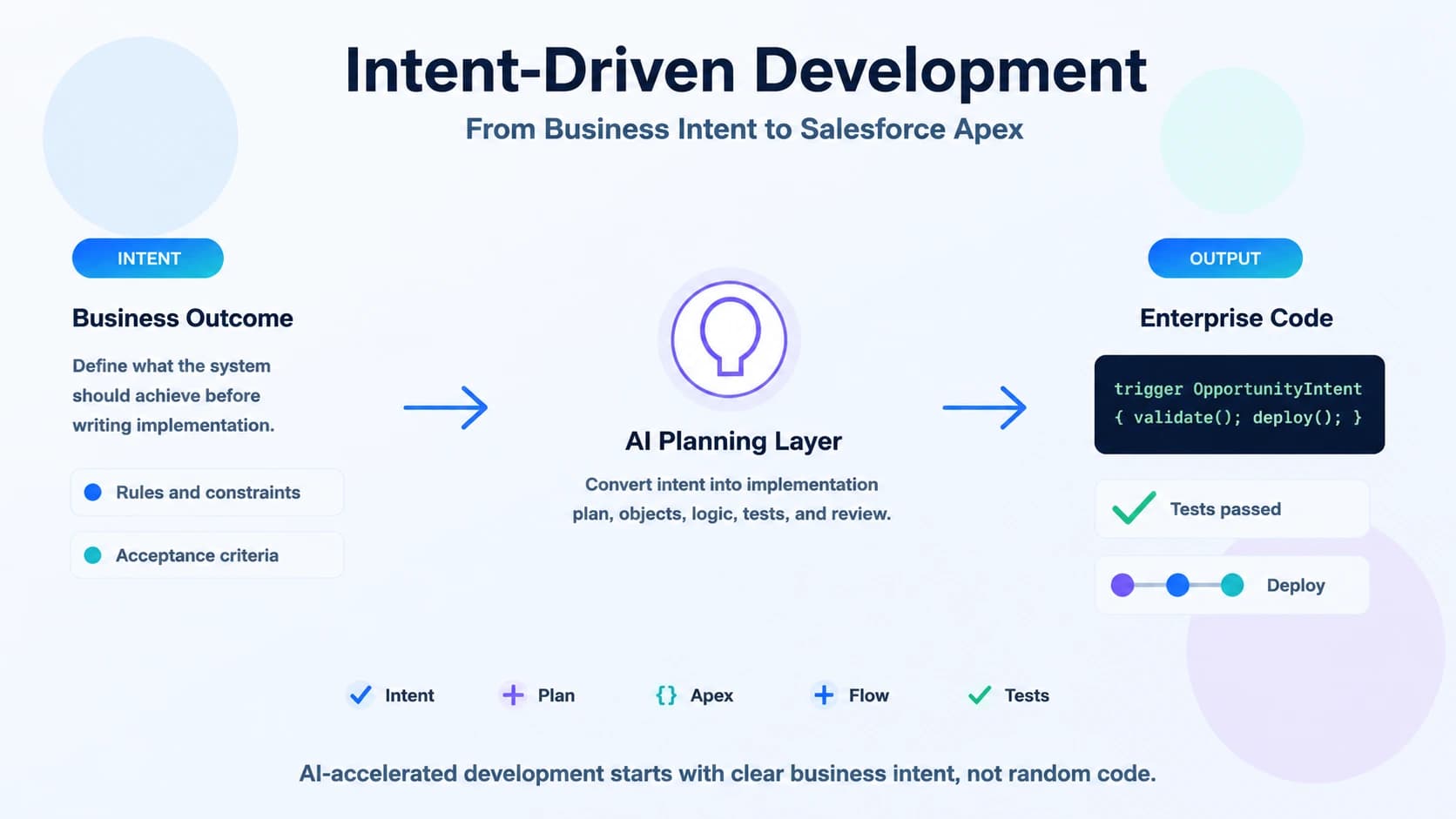
Quick Answer: Intent-driven software development is a modern AI-assisted approach where teams define the desired business outcome, constraints, acceptance criteria, and system behavior before implementation. Traditional programming starts with developers writing step-by-step logic manually. In Salesforce, intent-driven development can guide Apex classes, Flow automation, LWC components, Agentforce actions, integrations, and test coverage from a clear business intent specification.
Software development has always been about translating human intent into machine instructions. For decades, that translation was entirely manual. Developers read business requirements, interpreted them, and wrote code line by line. Today, AI is beginning to handle the translation itself — but only when the intent is structured, precise, and complete.
This is the fundamental premise behind intent-driven software development: stop treating AI as an autocomplete tool, and start treating it as an implementation partner that executes clearly defined business intent.
For Salesforce teams working with Apex, Agentforce, Flow, and LWC, this shift has profound implications. Apex is not going away. But how teams arrive at Apex — and how they govern AI-generated implementations — is changing significantly.
1. What Is Intent-Driven Software Development?
Intent-driven software development is a structured approach to building software where teams formally define what the system should do — the business outcome, conditions, constraints, security rules, and acceptance criteria — before any implementation begins.
The key distinction is in the starting artifact. Traditional development starts with a developer opening a code editor. Intent-driven development starts with an intent specification that describes:
The business problem and goal
The trigger conditions
The actions to be executed
The guardrails and restrictions
The security model
The expected test scenarios and edge cases
Once that specification is complete, AI agents assist in generating implementation plans, code scaffolding, test classes, and documentation from it — with human engineers reviewing and approving each output.
Intent-driven development is not vibe coding. Vibe coding is informal, conversational, and prompt-driven with no formal structure. Intent-driven development is disciplined, spec-first, and governance-oriented.
2. What Is Traditional Programming?
Traditional programming is the process of manually translating requirements into code. A business analyst writes requirements (often in plain English, sometimes informal). A developer reads those requirements, makes interpretive decisions, and writes step-by-step logic from scratch.
In Salesforce, traditional programming looks like:
A developer receives a ticket: "When Opportunity closes, create onboarding tasks."
The developer writes an Apex trigger or Flow manually.
The developer handles edge cases they discover during development.
The developer writes test classes to meet coverage thresholds.
The team discovers missing requirements during code review or testing.
This process has served the industry well, but it has structural inefficiencies: the most expensive part of the process — a senior developer's time — is spent on the most mechanical work.
3. Why Software Development Is Moving from Syntax to Intent
Three forces are pushing development toward intent-driven models:
AI Code Generation Has Crossed a Quality Threshold. Models like Claude, GPT-4o, and Salesforce Einstein for Developers can now generate syntactically correct, contextually appropriate Apex code when given sufficient structured context. The bottleneck is no longer generation — it is specification quality.
Developer Productivity Demands Have Increased. Enterprise Salesforce teams are expected to deliver more features, with fewer people, faster. AI-assisted development is a practical response to that pressure — but only when paired with structured intent to prevent rework.
Enterprise Governance Requirements Are Stricter. AI-generated code cannot be deployed blindly. Enterprises need audit trails, traceability from requirement to code to test, and proof that security models are honored. Intent-driven development creates that audit trail by making the specification the authoritative artifact.
4. Intent-Driven Development vs Traditional Programming
Area
Traditional Programming
Intent-Driven Development
Starting Point
Developer writes logic from informal requirements
Team defines structured business intent specification first
Main Artifact
Source code
Intent spec, constraints, acceptance tests, then code
AI Role
Optional assistant, code suggestions
Active implementation partner executing against the spec
Human Role
Writes, debugs, and maintains code
Defines intent, reviews AI output, approves deployment
Best For
Exact deterministic systems with stable requirements
Faster feature delivery with structured context and AI
Primary Risk
Slow delivery, knowledge silos, manual rework
Ambiguous intent producing wrong AI output
Salesforce Use
Apex, Flow, LWC manually built from informal requirements
Structured intent translated into Apex, Flow, LWC, Agentforce actions
Test Coverage
Written after code, often as an afterthought
Test scenarios defined in the intent spec before implementation
Traceability
Requirement to code link is often informal or lost
Full traceability from intent spec to implementation to tests
5. Where AI Agents Fit in the Development Loop
In a traditional development process, AI coding tools like Copilot or Einstein for Developers act as inline assistants — they autocomplete code as the developer types. This is useful, but it is still fundamentally developer-led. The developer still decides what to build and how to structure it.
In an intent-driven workflow, AI agents operate differently. They are given the complete intent specification and asked to:
Generate an implementation plan (which layer: Flow, Apex, LWC, Agentforce Action?)
Scaffold the Apex class or Flow structure
Generate test class scaffolding from acceptance criteria
Flag potential governor limit risks
Identify missing security model definitions (CRUD, FLS, sharing)
Draft deployment documentation
The AI is not autocompleting the developer's thoughts. It is executing against a structured brief. This is a fundamentally different and more powerful use of AI in the development loop.
6. What This Means for Salesforce Development
Salesforce is one of the most structured enterprise platforms in the world. It has explicit security models (profiles, permission sets, CRUD, FLS, sharing rules), strict governor limits, a rich declarative tool ecosystem (Flow, Process Builder), and a robust Apex runtime.
This structure is actually an advantage for intent-driven development. Salesforce's explicit guardrails mean that a well-defined intent specification can be extremely precise — you can specify exactly which object, which field, which sharing model, and which automation layer is appropriate.
In contrast, traditional requirements like "automate the onboarding process" are too vague for AI to execute correctly. Intent-driven development forces specificity that Salesforce's architecture rewards.
Intent-driven Salesforce development is not about replacing Salesforce developers. It is about making their expertise more productive by shifting their time from mechanical implementation to design, specification, and review.
7. How Intent-Driven Development Works with Apex
A common misconception is that AI-driven development means Apex becomes irrelevant. In fact, the opposite is true. Apex becomes more important in intent-driven development, because it is the layer where enterprise-grade business logic, security enforcement, async processing, and integration complexity live.
AI code generation needs a target. For Salesforce, that target is often an Apex class, and the quality of the generated Apex depends entirely on the quality of the intent specification provided.
When Apex Is the Right Choice
Intent-driven development helps teams make better decisions about when to use Apex versus declarative tools:
Complex business logic with multiple conditional branches and custom calculations
Before/after triggers that need to handle bulk operations safely
Async jobs (Queueable, Batch, Schedulable) for large data volumes
Platform Events for event-driven integrations
Invocable Actions exposed to Flow and Agentforce
Agentforce Custom Actions registered as agent capabilities
External integrations via HTTP callouts with complex auth and retry logic
Validation logic beyond what declarative validation rules support
Test classes that prove acceptance criteria pass at 85%+ coverage
Apex Intent Specification Elements
A good Apex intent specification includes:
Object: Opportunity
Trigger Context: After Update
Condition: StageName changed to 'Closed Won' AND Amount > 50000
Action: Create Onboarding Task assigned to CS Team Lead
Guardrail: Skip if Onboarding Task already exists for this Opportunity
Sharing Model: with sharing (respect record-level access)
Async Required: No (synchronous, single record context acceptable)
Governor Limit Concerns: Bulkify for up to 200 records
Test Scenarios:
  - Closed Won, amount > 50000, no existing task → task created ✓
  - Closed Won, amount < 50000 → no action taken ✓
  - Not Closed Won → no action taken ✓
  - Closed Won, amount > 50000, task already exists → no duplicate ✓
  - CS Team Lead user does not have access → run with system context for task creation ✓
With this level of specification, AI can generate a well-structured, bulkified, with-sharing Apex trigger handler and a comprehensive test class that validates each scenario.
8. Apex, Flow, LWC, and Agentforce: Who Does What?
Intent-driven development forces a critical early decision that traditional development often leaves ambiguous: which Salesforce layer should implement this capability?
High — requires test class, code review, deployment pipeline
Flow
Declarative automation, approvals, screen flows
Medium — Flow XML generation improving
Medium — visual review, version control with metadata API
LWC
Custom UI, embedded components, record pages
High — JavaScript/HTML generation very capable
Medium — SLDS compliance and Apex wire adapter review needed
Agentforce Actions
Agent-callable capabilities, natural language triggers
Emerging — Agentforce SDK guidance maturing
High — topic definitions, action permissions, agent testing
Agentforce deserves special attention here. Agentforce agents can invoke Apex via Invocable Actions and Apex-defined Agent Actions, and they can trigger Flows as agent topics. This means the same Apex classes and Flows you build for traditional automation can be exposed as Agentforce agent capabilities — making intent-driven development doubly valuable. Build it once with a clear spec, test it thoroughly, and expose it to both traditional automation and your AI agents.
9. Benefits for Salesforce Teams
Faster feature delivery without proportionally more developers. Structured intent specifications allow AI to generate implementation scaffolding, test class templates, and documentation. Senior developers spend time on design and review rather than mechanical coding.
Better requirement clarity upfront. The discipline of writing an intent specification forces business stakeholders and developers to resolve ambiguity before development begins — reducing rework that traditionally surfaces mid-sprint.
Consistent security model enforcement. When CRUD, FLS, and sharing rules are part of the intent spec, AI-generated Apex is more likely to implement them correctly and consistently. Auditors and security teams can trace requirements to implementation to test.
Higher test coverage quality. Test scenarios defined in the intent spec map directly to test class methods. Coverage becomes meaningful rather than cosmetic — each test validates a specific acceptance criterion.
Better onboarding documentation. Intent specifications become permanent artifacts that explain why code exists, what it does, and what edge cases it handles — reducing the knowledge loss when developers change roles.
10. Risks and Governance Challenges
Intent-driven development does not eliminate risk. It shifts it from implementation risk to specification risk.
Ambiguous intent produces wrong output. If the intent specification is vague, incomplete, or contradictory, the AI will generate code that is syntactically correct but functionally wrong. The garbage-in-garbage-out principle applies to specifications as much as to data.
Security model gaps are the most dangerous. Apex that runs without sharing, misses FLS checks, or exposes data through improperly scoped SOQL can pass functional tests while creating security vulnerabilities. Security model elements must be explicit in every specification.
Governor limit awareness requires Salesforce expertise. AI models trained on general programming patterns may generate Apex that works in isolated tests but fails under bulk execution. SOQL inside loops, excessive callouts, and heap size violations are classic patterns. Human review by Salesforce-experienced engineers is non-negotiable.
Deployment governance cannot be delegated to AI. Change sets, scratch orgs, unlocked packages, and CI/CD pipelines require deliberate configuration. AI-generated code must pass through the same review and deployment gates as hand-written code.
11. Intent-Driven Salesforce Development Workflow
A practical intent-driven Salesforce development workflow follows eight steps:
1
Define Business Intent — Write a structured intent spec: goal, trigger, conditions, actions, restrictions, and success definition.
2
Identify Salesforce Data Model — Specify the Objects, Fields, Relationships, and Record Types involved.
3
Define Security Rules — Specify CRUD access, FLS requirements, sharing model (with/without/inherited sharing), and permission set requirements.
4
Decide the Implementation Layer — Flow, Apex, LWC, Agentforce Action, Integration, or a combination. Document the decision rationale.
5
Define Test Scenarios — List all positive paths, negative paths, edge cases, and permission boundary cases before any code is written.
6
AI-Assisted Implementation — Feed the complete intent spec to an AI assistant to generate the Apex handler, Flow, LWC, or Agentforce action scaffolding.
7
Human Review and Test Execution — A Salesforce engineer reviews the generated code for governor limits, security, bulkification, and test class quality. All test scenarios must pass.
8
Deployment and Documentation — Deploy through the standard pipeline (CI/CD, change sets, or unlocked packages). Archive the intent spec alongside the code as permanent documentation.
12. Practical Example: From Business Intent to Apex Code
Let us walk through a complete example of intent-driven Salesforce development applied to a real scenario.
Business Intent
"When a high-value opportunity moves to Closed Won, automatically create an onboarding task for the Customer Success team, notify the CS team lead, and prevent duplicate onboarding if one already exists."
Traditional Approach
A developer receives this requirement as a Jira ticket with two sentences. They open VS Code, start writing an Apex trigger, discover they need to query for existing tasks mid-development, realize they need the CS team lead's user ID (which no one defined), write a test class that achieves 76% coverage, and ship code that misses the duplicate-prevention edge case discovered three weeks later in UAT.
Intent-Driven Approach
Step 1: Intent Specification
Feature: Opportunity Closed Won Onboarding Automation
Object: Opportunity
Trigger: After Update
Condition: StageName changed to 'Closed Won' AND Amount >= 50000
Primary Action: Create Task (Subject: 'Onboarding - {{OppName}}', Owner: CS Team Lead Queue)
Secondary Action: Create Chatter Post on Opportunity notifying CS Team Lead
Duplicate Guard: If Task with Subject starting 'Onboarding' already exists on Opportunity → skip task creation
Sharing Model: with sharing
Async: No (synchronous acceptable — max 200 records bulk scenario)
Error Handling: Log errors to custom object, do not throw exceptions that block the update
Governor Risk: SOQL for existing tasks must be outside loop, use Map<Id, List<Task>>

Test Scenarios:
  T1: Closed Won, Amount = 75000, no existing onboarding task → Task created, Chatter post created ✓
  T2: Closed Won, Amount = 30000 (below threshold) → No action ✓
  T3: Stage change to Negotiation (not Closed Won) → No action ✓
  T4: Closed Won, Amount = 75000, Onboarding task already exists → No duplicate task ✓
  T5: Bulk test: 200 opportunities all moving to Closed Won → No governor limit violations ✓
  T6: Running user lacks access to Task creation → Error logged gracefully, Opportunity update not blocked ✓
Step 2: AI-Generated Implementation Scaffold
With this spec, an AI assistant generates:
OpportunityClosedWonHandler.cls — with sharing, bulkified handler class
OpportunityTrigger.trigger — thin trigger calling the handler
OpportunityClosedWonHandlerTest.cls — test class with all 6 scenarios as test methods
Deployment notes flagging the CS Team Lead Queue ID as a configurable Custom Label
Step 3: Human Review Checkpoints
Confirm SOQL is outside the loop ✓
Confirm with sharing is applied ✓
Confirm all 6 test methods exist and pass ✓
Confirm Custom Label is used for the queue reference ✓
Deploy to sandbox, run tests, promote via CI pipeline ✓
The result is production-ready Apex generated from a structured specification, with full traceability from requirement to test, reviewed by a human engineer, and deployed through governed channels. Total time from spec to deployment: a fraction of the traditional cycle.
13. Best Practices for Enterprise Teams
Make intent specification a team artifact, not a solo task. The best intent specs involve the business stakeholder, a Salesforce architect, and a developer collaborating together. This ensures the spec captures business intent, Salesforce constraints, and implementation realities simultaneously.
Treat the intent spec as a living document. When requirements change, update the spec first. Then re-run AI-assisted generation against the updated spec. This maintains traceability and prevents the code from drifting from intent.
Never skip human review for security-sensitive code. Apex that touches financial records, personal data, user permissions, or external integrations must be reviewed by a Salesforce engineer — regardless of how complete the intent spec is.
Establish a spec template standard. Create a company-specific intent specification template for Salesforce that enforces inclusion of object names, security model, governor limit considerations, and test scenarios. Consistency in specs produces consistency in AI output.
Version control your intent specs alongside your code. Store intent specs in the same repository as your Salesforce metadata. When someone reads the code six months from now, the spec explains not just what the code does, but why it exists and which scenarios it must handle.
Use Agentforce for high-frequency, low-complexity requests. Intent-driven development helps you identify which capabilities are good Agentforce candidates. Well-defined, bounded actions with clear inputs and outputs are ideal for Agentforce exposure. Complex multi-step processes with branching logic remain better suited to Apex or Flow.
14. How IntellectualClouds Helps
Build Salesforce Faster with AI-Accelerated Development
Intellectual Clouds helps enterprise teams turn business requirements into Salesforce-ready implementation plans, Apex classes, Flows, LWC components, Agentforce actions, test cases, and deployment-ready documentation using AI-accelerated development workflows.
IntellectualClouds specializes in Salesforce consultancy with a dedicated practice in AI-accelerated Salesforce development. Our approach combines deep Salesforce architecture expertise with structured AI-assisted workflows to help enterprise teams:
Define structured intent specifications from business requirements
Architect the right implementation layer (Apex, Flow, LWC, Agentforce) for each capability
Generate AI-assisted Apex classes, test coverage, and documentation with human oversight
Establish governance frameworks for AI-generated code review and deployment
Build and expose custom Agentforce actions that leverage existing Apex and Flow automation
Train development teams on intent-driven development practices for Salesforce
Whether you are building net-new Salesforce capabilities, modernizing a legacy org, or establishing an AI-assisted development practice, our team brings the Salesforce expertise and AI methodology to deliver faster with confidence.
Intent-driven software development is a modern AI-assisted approach where teams formally define the desired business outcome, constraints, acceptance criteria, and system behavior before any implementation begins. AI agents then assist in translating that structured specification into implementation plans, Apex classes, Flows, LWC components, test coverage, and documentation — with human engineers reviewing and approving each output.
How is intent-driven development different from traditional programming?
Traditional programming starts with a developer interpreting informal requirements and writing code from scratch. Intent-driven development starts with a structured intent specification that captures the business goal, trigger conditions, security model, guardrails, and test scenarios before a single line of code is written. AI then generates implementation from that specification.
Is intent-driven development the same as vibe coding?
No. Vibe coding is informal, conversational, and low-structure — you prompt an AI in a chat window and accept whatever it generates. Intent-driven development is disciplined and spec-first. It requires formal documentation of business intent, security rules, edge cases, and acceptance criteria before AI is engaged for implementation. The structured spec is what prevents vibe coding's most common failures.
Can intent-driven development be used for Salesforce?
Yes, and Salesforce is particularly well-suited to it. Salesforce's explicit data model (Objects, Fields, Relationships), security model (CRUD, FLS, Sharing), and layered automation architecture (Apex, Flow, LWC, Agentforce) map directly onto intent specification elements. A well-written Salesforce intent spec can drive high-quality AI-generated Apex, Flow, and Agentforce action scaffolding.
Does Apex still matter in AI-driven Salesforce development?
Yes — Apex becomes more important, not less. AI needs precise instructions to generate correct enterprise code. Complex triggers, async processing, external integrations, invocable actions for Flow and Agentforce, and comprehensive test classes all require Apex. AI accelerates writing Apex dramatically, but the business logic design, security model definition, and human review of generated code remain essential.
How can Agentforce use Apex and Flow?
Agentforce agents can invoke Apex through Invocable Actions (standard @InvocableMethod annotated Apex) and Apex-defined Agent Actions registered in the Agent Action Framework. They can also trigger Record-Triggered and Autolaunched Flows as agent topics. This means well-built Apex classes and Flows you create through intent-driven development can be exposed as Agentforce capabilities with minimal additional work.
What are the risks of AI-assisted Salesforce development?
The primary risks are: ambiguous intent specifications producing incorrect Apex logic; missing CRUD, FLS, or sharing enforcement; insufficient or superficial test coverage; governor limit violations from un-bulkified queries or DML; and deploying AI-generated code without proper human review. These risks are mitigated by structured intent documentation, explicit security model requirements in every spec, test-first scenario planning, and mandatory Salesforce engineer review before deployment.
How does IntellectualClouds help with AI-accelerated Salesforce development?
Intellectual Clouds provides end-to-end AI-accelerated Salesforce development services. We help teams build intent specification frameworks, design Salesforce architecture, generate AI-assisted implementation with human oversight, establish code review governance, and train development teams on intent-driven practices. Contact us to discuss how this approach can accelerate your next Salesforce initiative.
Asim Ansari is the Founder of Intellectual Clouds and a Certified Salesforce Administrator and Pardot Specialist with 17+ years of experience across Salesforce CRM, AI automation, cloud infrastructure (AWS), and digital transformation. He writes on AI agents, Salesforce delivery, Answer Engine Optimisation (AEO), and AI-accelerated business operations.