HomeBlogWhat Is Answer Engine Optimization (AEO)? A Complete Guide for AI Search
AI SEO
What Is Answer Engine Optimization (AEO)? A Complete Guide for AI Search
Asim Ansari
June 10, 2026
34 min read
Updated June 24, 2026
Learn what Answer Engine Optimization (AEO) is, how it differs from SEO, and how to optimize content for ChatGPT, Perplexity, Google AI Overviews and AI search citations.
Quick Answer
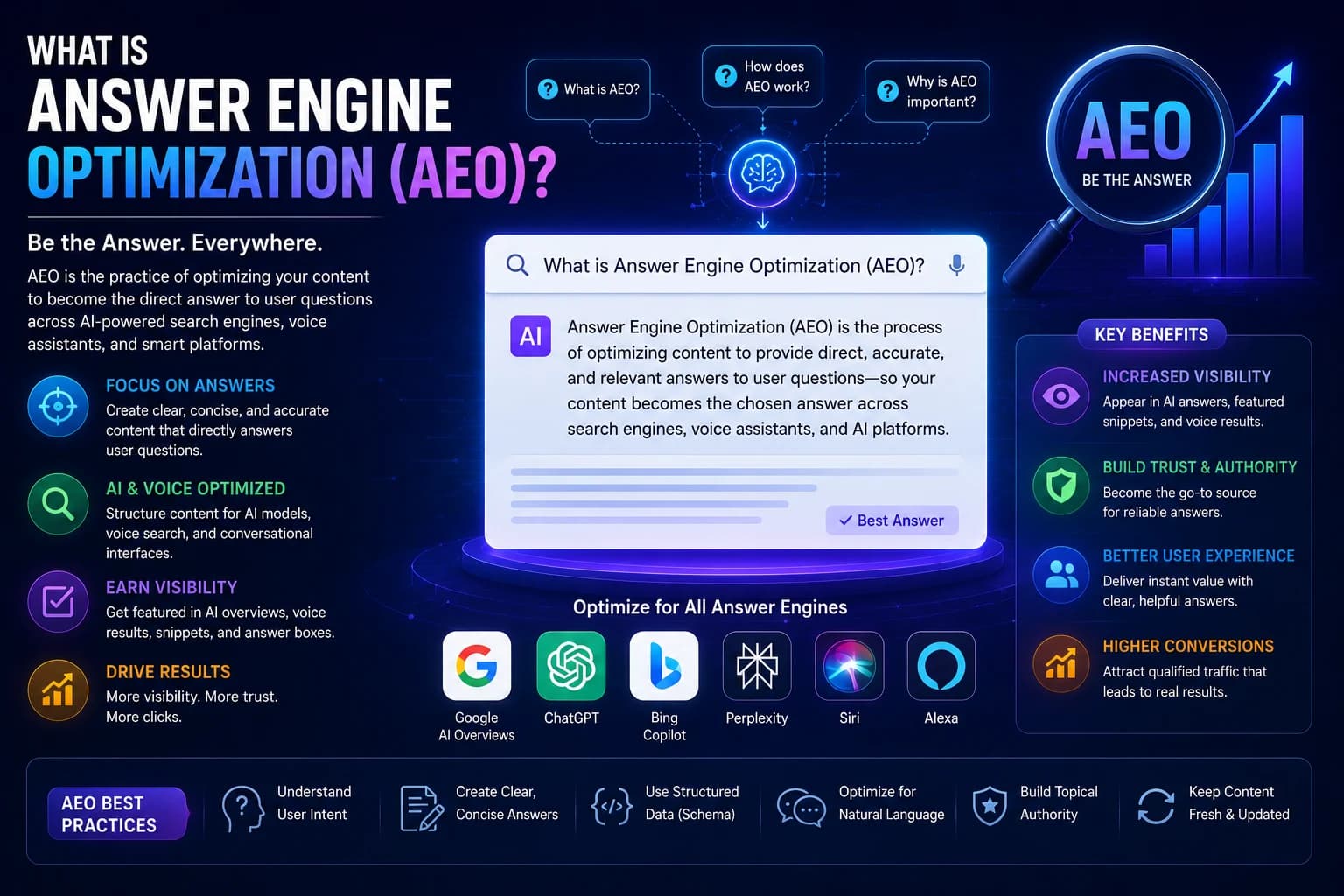
Answer Engine Optimization (AEO) is the process of structuring and formatting digital content so that AI answer engines — such as ChatGPT, Perplexity, Google AI Overviews, Gemini, and Microsoft Copilot — can understand, extract, and cite your content as a direct answer. SEO optimizes for rankings; AEO optimizes for citations and answers in AI-powered search.
What is answer engine optimization (AEO) and why it matters in 2026
How AEO differs from SEO, GEO, and AISEO
How ChatGPT, Perplexity, and Google AI Overviews select sources
8 core AEO implementation steps with real examples
The complete AEO checklist for businesses
How to measure and track AEO performance
Common AEO mistakes to avoid
What Is Answer Engine Optimization?
Answer Engine Optimization (AEO) is the strategic discipline of preparing your content, technical infrastructure, and brand authority so that AI-powered answer engines — including ChatGPT, Perplexity AI, Google AI Overviews, Gemini, and Microsoft Copilot — recognize, trust, and cite your content when users ask relevant questions.
The key distinction from traditional SEO is the end goal:
Traditional SEO → user searches → sees a list of 10 blue links → clicks your result → visits your site
AEO → user asks an AI a question → AI synthesizes an answer → cites your brand as the authoritative source
In an AEO world, your content must be extractable — meaning an AI model can read a section of your page, understand it without additional context, and confidently include it in a synthesized answer. This requires structured formatting, direct answer blocks, schema markup, entity clarity, and E-E-A-T signals.
AEO is not a replacement for SEO. It is the next layer of optimization every content team must add in the AI search era.
Why AEO Matters in AI Search
The numbers paint a clear picture of why what is answer engine optimization is one of the most searched questions in digital marketing today:
Over 58% of informational searches in the United States now trigger an AI Overview or AI-generated response
ChatGPT handles over 100 million queries per day; Perplexity processes over 10 million daily active users
Zero-click searches — where users get answers without visiting any website — have exceeded 65% of all Google searches
Brands that appear in AI citation results report 3x higher conversion intent from those referral visits
If your content is not formatted for AI extraction, your competitors who are doing AEO will dominate every informational query in your industry — even if you outrank them on traditional Google SERPs.
The AI Search Flow: From Query to Citation
User Query
"What is AEO?"
→
↓
AI Search Engine
ChatGPT / Perplexity / Gemini
→
↓
Source Selection
Crawl + Entity Authority
→
↓
Answer + Citation
Your brand gets cited
AEO vs SEO vs GEO vs AISEO
These four terms are often used interchangeably, but they have meaningful differences. Understanding each helps you build the right strategy.
Term
Full Name
Goal
Primary Platform
SEO
Search Engine Optimization
Rank pages in SERPs for clicks
Google, Bing
AEO
Answer Engine Optimization
Get cited in AI direct answers
ChatGPT, Perplexity, AI Overviews
GEO
Generative Engine Optimization
Influence AI-generated long-form answers
Gemini, Claude, ChatGPT essays
AISEO
AI Search Engine Optimization
Visibility across all AI + traditional search
Google AI Overviews + all above
The practical takeaway: For most B2B businesses, AEO is the highest-leverage starting point. It improves your visibility in both AI answer engines and traditional featured snippets simultaneously.
AEO vs SEO: A Detailed Comparison
Area
SEO
AEO
Goal
Improve Google rankings for organic clicks
Get cited in AI answer responses
Format
Keywords, backlinks, long pages
Direct answers, entities, schema markup
User Behavior
User clicks a search result link
User reads AI-generated answer
Content Style
Long-form keyword-dense ranking page
Extractable direct answer blocks
Success Metric
Rankings, clicks, organic traffic
AI citations, brand mentions, AI visibility
Platforms
Google, Bing traditional SERPs
ChatGPT, Perplexity, Gemini, Copilot, AI Overviews
Technical Layer
Core Web Vitals, backlinks, meta tags
Schema.org, llms.txt, entity graphs, clean HTML
How Answer Engines Choose Sources
Before you can optimize for answer engines, you need to understand how they decide which content to cite. Unlike Google’s traditional PageRank algorithm that heavily weights backlinks, answer engines use a fundamentally different evaluation model.
The RAG (Retrieval-Augmented Generation) Process
User submits a query to ChatGPT, Perplexity, or Google AI Overviews
The AI converts the query into a semantic vector (meaning representation)
Retrieval layer scans indexed web pages and real-time search results
Filtering by trust signals: The AI filters out low-authority, thin, or unstructured content
Content extraction: The AI reads the most relevant, trusted sources
Answer synthesis: The AI generates a response and attributes citations to the sources it used
What Makes a Source Citation-Worthy?
Answer engines prioritize sources based on four key dimensions:
Entity Clarity: Is your brand explicitly identified as an expert on this topic in structured data?
Extractability: Can the answer be pulled from your page without reading the entire article?
Consensus Alignment: Does your content agree with what other high-authority sources say?
Trust Signals (E-E-A-T): Is the author credentialed? Is the content dated? Are sources cited?
How ChatGPT, Perplexity, and Google AI Overviews Use Content
Understanding each platform’s approach to sourcing helps you tailor your AEO strategy.
Citations appear in ChatGPT Search responses with source links
Prefers content with clear authorship and organization schema
Perplexity AI
Uses PerplexityBot for web crawling
Strong preference for pages with clear H2/H3 question structure
Cites sources with visible attribution links
Favors pages that directly answer the full question in the first section
Benefits significantly from FAQ schema markup
Google AI Overviews
Uses Google’s standard Googlebot
Leverages existing index and schema data heavily
Strong correlation with featured snippet eligibility
Favors HowTo, FAQPage, and Article schema
E-E-A-T signals are paramount for inclusion
Core Elements of AEO: 8-Step Implementation
Step 1: Write Direct Answer Blocks
Every page targeting an informational query must open with a direct answer block — a concise 40–60 word paragraph that fully answers the primary query. This is often called the BLUF method (Bottom Line Up Front).
Without AEO (SEO Format)
"When it comes to understanding the intricacies of Answer Engine Optimization, many businesses are wondering how this emerging field will impact their digital marketing strategy. In today’s rapidly evolving AI landscape, the question of what AEO means has become increasingly relevant..."
With AEO (Direct Answer Format)
"Answer Engine Optimization (AEO) is the process of structuring content so that AI answer engines like ChatGPT, Perplexity, and Google AI Overviews can extract and cite it in direct answers. AEO focuses on citations; SEO focuses on rankings."
Step 2: Use Question-Based Headings
Structure your content around questions that real users ask. Every H2 and H3 should be a complete question your audience types into an AI search engine.
Good Examples:
## What Is Answer Engine Optimization?
## How Does AEO Differ from SEO?
## How Long Does AEO Take to Show Results?
This matches the conversational query format that AI engines receive, dramatically increasing your chances of being selected as the source.
Step 3: Add Structured Data and Schema
Schema markup is one of the most powerful AEO signals available. It gives AI crawlers an explicit, machine-readable understanding of your page’s content, context, and entities. According to Google’s structured data documentation, schema provides search engines with explicit clues about the meaning of a page.
Priority schemas for AEO:
Schema Type
Purpose
AEO Impact
Article
Identifies content as editorial
High — establishes authorship
FAQPage
Maps questions to direct answers
Very High — top AEO signal
HowTo
Structures step-by-step processes
High — AI Overviews love it
Organization
Defines brand entity
Medium — entity authority
Person
Identifies author expertise
Medium — E-E-A-T signals
BreadcrumbList
Shows content hierarchy
Medium — topical context
ItemList
Structured list content
Medium — checklists and comparisons
Step 4: Build Entity-Based Content
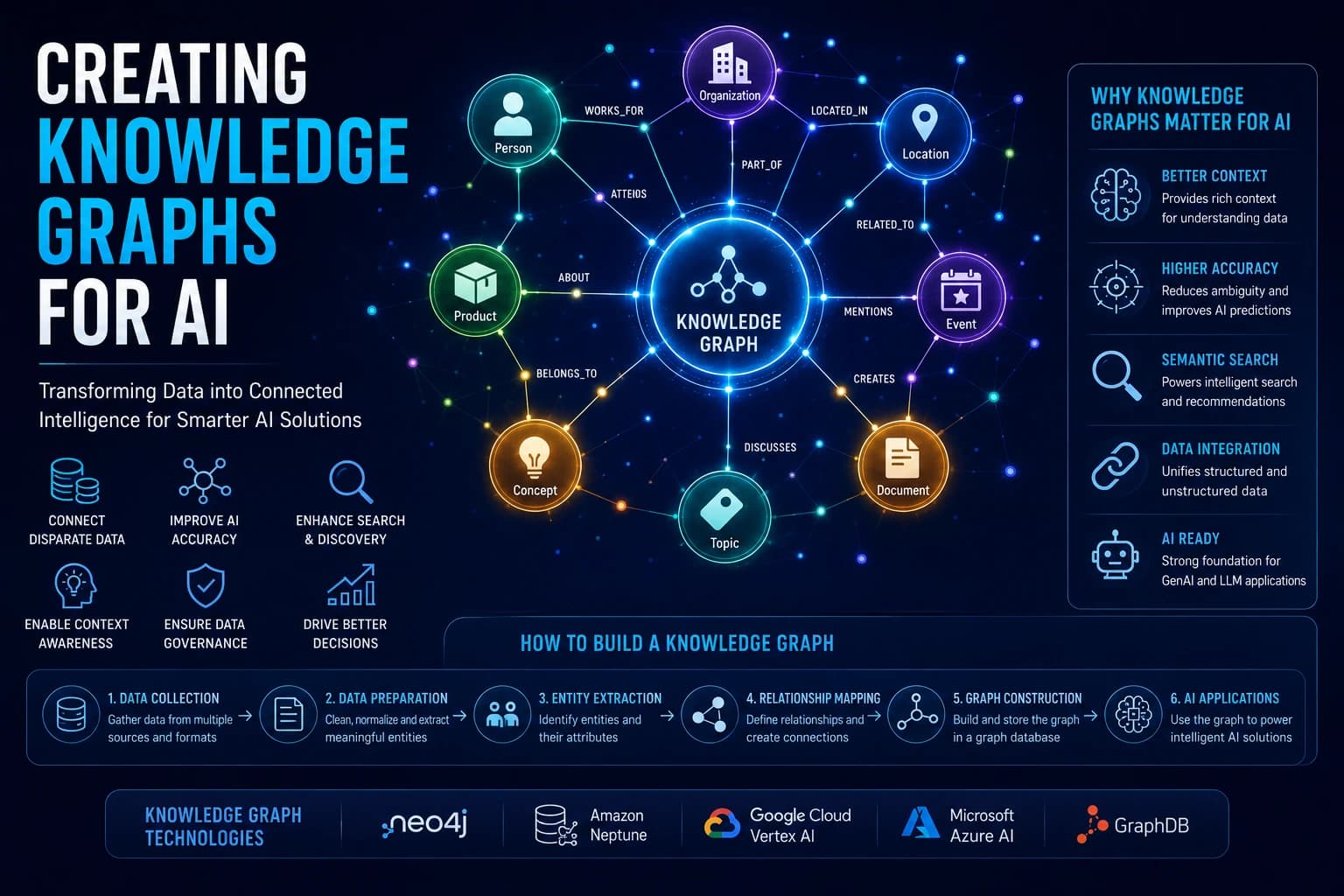
AI engines think in entities — named concepts, brands, people, and topics — not just keywords. Your content must establish clear entity relationships.
Cite recognized industry authorities and official sources
Build an internal link structure that maps your topical authority clearly
Step 5: Add Statistics, Sources, and Expert Signals
Answer engines prefer citing sources that demonstrate verifiable authority. Include:
Original statistics or data from your own research
Citations to authoritative external sources (Google, OpenAI docs, academic research)
Expert quotes with named, credentialed individuals
"Last Updated" dates on every article — AI engines prefer fresh, maintained content
Step 6: Format Content for AI Crawlers
AI crawlers (GPTBot, PerplexityBot, Googlebot) need to efficiently parse your content. Poor formatting means lower extraction confidence and fewer citations.
OpenAI’s crawler documentation notes that GPTBot, OAI-SearchBot, and ChatGPT-User each serve distinct roles in the content indexing and answer generation pipeline. All three should be permitted access for full AEO benefit.
Optionally add an llms.txt file at your domain root — a clean Markdown summary of your site’s most important pages, specifically designed for LLM ingestion. This concept, modeled after robots.txt, provides structured guidance to AI systems navigating your content and helps large language models quickly locate your most authoritative pages.
Step 7: Create FAQ and Comparison Tables
Tables and structured FAQ blocks are among the most extractable content formats for AI engines. Use HTML tables for comparison content and structure your FAQ sections with clear question-and-answer pairs.
AEO Implementation Reference Table:
AEO Element
Why It Matters
Implementation
Direct Answer Block
AI can extract and cite immediately
40–60 word answer at page top
FAQ Format
Matches conversational search queries
Natural-language H3 questions + answers
Schema Markup
Page meaning becomes machine-readable
Article, FAQPage, HowTo JSON-LD
Entity Signals
Builds brand and topic authority
Author, company, and service entity pages
Comparison Tables
AI parses structured data easily
HTML tables with semantic headers
Source Citations
Trust and verifiability improve
Link to official authoritative references
Freshness Signals
AI engines prefer current information
Add "Last updated" date + dateModified schema
llms.txt
Direct LLM navigation guidance
Markdown index of key pages at domain root
Step 8: Improve Internal Linking and Topical Authority
AI engines evaluate your topical depth — the breadth and depth of content you have published on a subject. A single AEO-optimized page is not enough. You need a cluster of interconnected pages that collectively establish your brand as the authoritative source on your topic.
Build topic clusters around your core subject:
A pillar page (like this one) that covers the topic comprehensively
Supporting articles that go deep on specific subtopics
Internal links between all cluster pages with descriptive anchor text
Intellectual Clouds helps businesses optimize content for ChatGPT, Perplexity, Google AI Overviews and other answer engines using AEO, schema markup, entity SEO, content formatting and AI citation tracking.
llms.txt File: A clean Markdown index of your key pages exists at yourdomain.com/llms.txt
Server-Side Rendering: Critical content is not exclusively rendered via client-side JavaScript
Common AEO Mistakes
Even experienced digital marketers make these errors when transitioning from SEO to AEO:
1. Blocking AI Crawlers
Adding GPTBot, OAI-SearchBot, or PerplexityBot to your robots.txt disallow list is the single fastest way to guarantee your brand never appears in AI citations. Review your robots.txt immediately.
2. Writing for Algorithms Instead of Answers
AEO content must answer a specific question completely, in the fewest possible words. Padding with marketing fluff, keyword stuffing, or excessive introductions destroys extractability.
3. Missing or Incomplete Schema
Deploying FAQPage schema but not HowTo, or having Article schema without dateModified, leaves significant citation signals on the table. Schema should be comprehensive and validated via Google’s Rich Results Test.
4. No Author Entity
If your content has no named author with a credential-linked bio, AI engines have no Person entity to attach credibility to. Anonymous or "Team" authorship is an E-E-A-T red flag.
5. Static, Never-Updated Content
AI engines — especially Perplexity and ChatGPT Search — prefer fresh content. A blog post that has not been updated in 18 months signals low trust. Google’s helpful content guidance emphasizes that people-first, useful, reliable content is what earns visibility. Add quarterly content refresh cycles to your workflow.
6. Ignoring Topical Authority
One well-optimized page on a topic is not enough. AI engines evaluate your entire domain’s depth on a subject. If you publish one AEO article but have nothing else linking to it, its authority signal is weak.
How to Measure AEO Performance
Measuring AEO success is fundamentally different from traditional SEO tracking. You cannot solely rely on Google Search Console — you need a multi-channel measurement framework.
Metric
What It Measures
How to Track
AI Citation Frequency
How often AI engines cite your brand
Manual prompting in ChatGPT, Perplexity, Gemini monthly
Google Search Console — average position 0 tracking
Schema Validity
Structured data health
Google Rich Results Test, Search Console enhancements
AI Crawler Bot Visits
Whether AI bots are indexing you
Server logs — filter for GPTBot, PerplexityBot, OAI-SearchBot
Share of Model (SOM)
How often AI mentions your brand vs. competitors
Tools: Profound.io, Otterly.ai, or manual testing
Recommended AEO Measurement Cadence:
Weekly: Check AI referral traffic in GA4
Monthly: Manually prompt ChatGPT and Perplexity with 10–15 target queries; record citation frequency
Quarterly: Full schema audit; content refresh for top AEO pages; competitor citation analysis
Frequently Asked Questions
What is Answer Engine Optimization?
Answer Engine Optimization (AEO) is the process of structuring and formatting digital content so that AI-powered answer engines — such as ChatGPT, Perplexity, Google AI Overviews, Gemini, and Microsoft Copilot — can understand, extract, and cite your content in their direct answers to user queries.
Is AEO different from SEO?
Yes. SEO focuses on ranking web pages in traditional search engine results pages (SERPs) to drive click-through traffic. AEO focuses on being cited as a source in AI-generated answers, where users often receive the answer without ever clicking through to a website. Both strategies are complementary and should be implemented together.
Does AEO replace SEO?
No. AEO and SEO serve different but complementary purposes. Traditional search still drives significant traffic for navigational and transactional queries. AEO is essential for capturing informational query visibility in AI-powered search experiences. A complete digital visibility strategy requires both.
How does AEO help with ChatGPT visibility?
ChatGPT uses OpenAI’s crawlers (GPTBot and OAI-SearchBot) to index web content. By allowing these crawlers in your robots.txt, structuring content with direct answer blocks, implementing Article and FAQPage schema, and demonstrating strong E-E-A-T signals, your content becomes eligible to be cited in ChatGPT Search responses.
How do I optimize for Perplexity?
To optimize for Perplexity AI citations: allow PerplexityBot in your robots.txt; structure pages with clear H2/H3 question headings; open each section with a direct answer; use FAQPage schema; cite authoritative external sources; and ensure your content is factually accurate and up-to-date. Perplexity heavily favors pages that directly answer the complete query within the first visible section. For a deep dive into the ranking algorithm, see our guide on how Perplexity AI ranks and sources content.
What schema is best for Answer Engine Optimization?
The highest-impact schemas for AEO are FAQPage (for question-and-answer content), HowTo (for step-by-step processes), and Article (for blog posts and guides). Supporting these with Organization, Person, and BreadcrumbList schema creates a complete entity authority picture that AI engines use to assess citation worthiness.
Is llms.txt required for AEO?
No, llms.txt is not required, but it is a valuable optional enhancement. An llms.txt file provides a clean Markdown index of your most important pages specifically designed for LLM ingestion, helping AI systems efficiently discover and prioritize your most authoritative content.
How long does AEO take to show results?
AEO results can appear within 2–6 weeks of implementation for sites with good existing authority, once AI crawlers re-index your pages. Building consistent citation presence across ChatGPT, Perplexity, and Google AI Overviews typically strengthens over 3–6 months as topical authority accumulates.
How do I measure AEO performance?
Track AEO performance through: AI referral traffic in Google Analytics 4 (filter sources like perplexity.ai and chatgpt.com); manual citation testing by prompting ChatGPT and Perplexity with target queries monthly; brand mention tracking; schema validity in Google Search Console; and AI crawler bot activity in server logs. For a step-by-step framework, read our comprehensive guide on tracking AEO performance and metrics.
Can Intellectual Clouds help with AEO?
Yes. Intellectual Clouds specializes in Answer Engine Optimization for B2B companies. Our AI SEO services cover AEO content strategy, schema markup implementation, entity authority building, crawler access optimization, AI citation tracking, and full AEO audits. Contact us to book a free AEO readiness assessment.
How Intellectual Clouds Can Help
Intellectual Clouds is an AI-first digital strategy agency helping B2B companies build AI search visibility. Our AI SEO services are specifically designed around the AEO framework described in this guide.
We help businesses with:
AEO Content Strategy: Restructuring existing content and creating new AEO-optimized articles
Schema Markup Implementation: Deploying and validating Article, FAQPage, HowTo, Organization, and Person schema
Crawler Access Optimization: Auditing and correcting robots.txt and llms.txt configurations
Entity Authority Building: Creating and linking author profiles, service pages, and knowledge graph signals
AI Citation Monitoring: Monthly tracking of brand mentions across ChatGPT, Perplexity, and Gemini
AEO Audits: Comprehensive review of your site’s AEO readiness with prioritized recommendations
Ready to Appear in AI Answers?
Stop losing informational query visibility to AI Overviews and competitor citations. Let Intellectual Clouds build your AEO strategy from the ground up.
Asim Ansari is the Founder of Intellectual Clouds and a Certified Salesforce Administrator and Pardot Specialist with 17+ years of experience across Salesforce CRM, AI automation, cloud infrastructure (AWS), and digital transformation. He writes on AI agents, Salesforce delivery, Answer Engine Optimisation (AEO), and AI-accelerated business operations.