HomeBlogThe Role of E-E-A-T in AEO: How Trust Wins AI Search Citations
AI SEO
The Role of E-E-A-T in AEO: How Trust Wins AI Search Citations
Asim Ansari
June 10, 2026
20 min read
Updated June 24, 2026
Learn how E-E-A-T supports Answer Engine Optimization by building trust, authority and citation-ready content for Google AI Overviews, ChatGPT and Perplexity.
Direct Answer: E-E-A-T helps AEO by making content more trustworthy, verifiable, and citation-ready for AI-powered search experiences. Google says E-E-A-T is not a direct single ranking factor, but it represents trust signals that search and AI systems use to judge reliability. For Answer Engine Optimization (AEO), these trust signals help answer engines decide which sources are safe and accurate enough to cite in their generated answers.
Trust is the Ultimate Metric: E-E-A-T (Experience, Expertise, Authoritativeness, Trustworthiness) is the foundation of preventing AI hallucinations. Answer engines prioritize sources that demonstrate verifiable facts.
AI Cites Authority: Platforms like ChatGPT, Perplexity, and Google AI Overviews use Retrieval-Augmented Generation (RAG). RAG systems heavily filter for high-authority, high-trust domains before synthesizing answers.
Visible Proof is Required: You must prove expertise technically (using Schema markup) and visually (using author bios, clear dates, and transparent sourcing).
AEO vs SEO: While traditional SEO relies heavily on keywords, AEO (Answer Engine Optimization) requires extreme clarity, structured data, and uncompromising factual accuracy.
Introduction: Why Trust Matters in AEO
The search landscape has undergone a tectonic shift. We are no longer just optimizing for "ten blue links." We are optimizing for AI engines that read, synthesize, and output direct answers to users. In this new era of Answer Engine Optimization (AEO), the primary currency is no longer keyword density—it is Trust.
AI search engines (like Google's AI Overviews, Perplexity, and OpenAI's SearchGPT) face a massive PR and operational risk: Hallucination. If an AI engine provides a dangerous or factually incorrect answer, it destroys user confidence. To mitigate this risk, these platforms deploy algorithms designed to find the most trustworthy, expert-verified, and authoritative sources on the web to generate their answers.
This is exactly where E-E-A-T (Experience, Expertise, Authoritativeness, Trustworthiness) comes into play. If your brand wants to be the cited source in a ChatGPT prompt or a Google AI Overview, demonstrating E-E-A-T is not optional; it is the absolute baseline requirement.
What Is E-E-A-T?
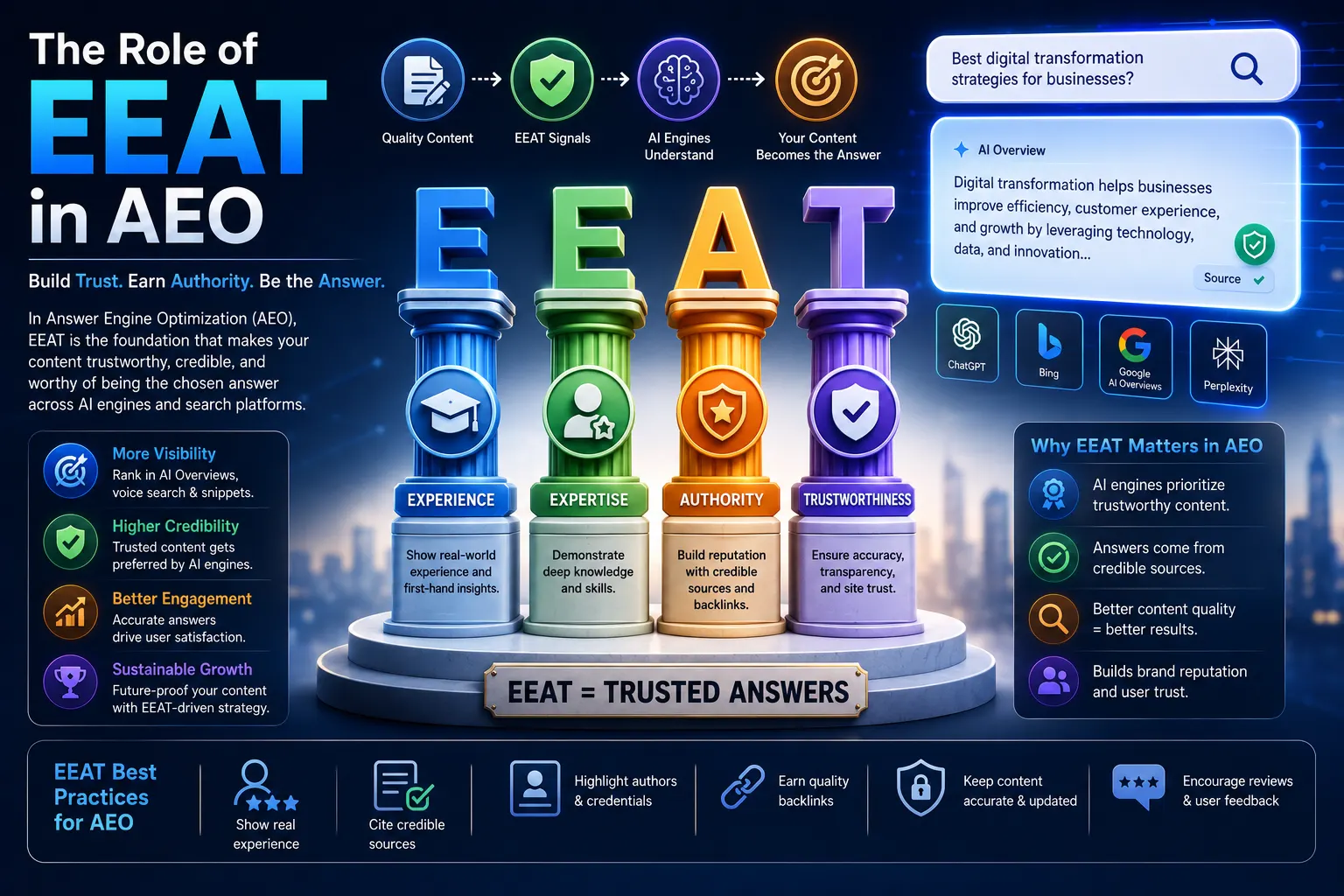
E-E-A-T is a framework created by Google to evaluate the quality and credibility of search results. Originally called E-A-T, Google added an extra "E" for "Experience" in late 2022 to acknowledge the value of first-hand knowledge. The acronym stands for:
Experience: Does the content creator have first-hand, real-world experience with the topic?
Expertise: Does the creator have the necessary knowledge, qualifications, or credentials to speak on this subject?
Authoritativeness: Is the creator or the website recognized as a go-to source by others in the industry? (e.g., through backlinks or media mentions).
Trustworthiness: The core of the entire concept. Is the page accurate, honest, safe, and transparent? Google explicitly states that Trust is the most important component of the E-E-A-T family.
Important Correction: E-E-A-T is not a direct, measurable single ranking factor like page speed or title tags. Instead, it represents a collection of trust signals that search and AI systems use to judge reliability.
What Is AEO?
Answer Engine Optimization (AEO) is the practice of structuring and writing digital content so that it can be easily ingested, understood, and cited by artificial intelligence models.
While traditional AI SEO focuses on ranking web pages in traditional search engines, AEO focuses on optimizing for Large Language Models (LLMs) and Retrieval-Augmented Generation (RAG) systems. The goal of AEO is to have your brand's data, quotes, and products featured as the definitive answer when a user asks a question to an AI assistant.
E-E-A-T vs AEO: The Connection Explained
If AEO is the "how" (structuring data, optimizing formats), then E-E-A-T is the "why" (why the AI should choose you over a competitor).
An AI model parsing the internet for an answer to "What is the best vector database for enterprise AI?" will find hundreds of articles. To decide which article provides the data it uses to generate its response, the AI evaluates the entity's authority.
If your website has published heavily-cited research, has detailed author bios with real engineering credentials, and uses structured data for knowledge graphs to explicitly define its expertise, the AI engine will assign a higher trust score to your content. Consequently, your content gets cited.
Why AI Engines Need Trusted Sources
To understand the role of E-E-A-T in AEO, you must understand how AI search engines work. They do not just guess answers; they use a framework called Retrieval-Augmented Generation (RAG).
When a user asks a question, the AI:
Translates the query into a search vector.
Retrieves the top relevant documents from its index or the live web.
Analyzes those documents to extract facts.
Synthesizes a conversational answer citing those facts.
If the AI retrieves documents with low E-E-A-T (e.g., anonymous authors, spammy domains, contradictory facts), it risks generating AI hallucinations that cause severe brand risk. Therefore, the retrieval algorithms are heavily biased toward domains with high Trust scores. High E-E-A-T equals high retrieval probability.
Experience: First-Hand Proof and Case Studies
AI models are fed billions of words of generic text. To stand out, you must provide what AI cannot generate: genuine human experience.
When optimizing for AEO, prove your Experience by:
Using first-person narratives ("When we deployed this solution...").
Including original photographs, not stock images.
Publishing detailed case studies with measurable outcomes.
Sharing failures and lessons learned, which AI models recognize as a strong signal of authentic human experience.
Expertise is about demonstrating that you know what you are talking about.
Author Bios: Every article must have a detailed author bio. The bio should explain why this person is qualified to write about the topic.
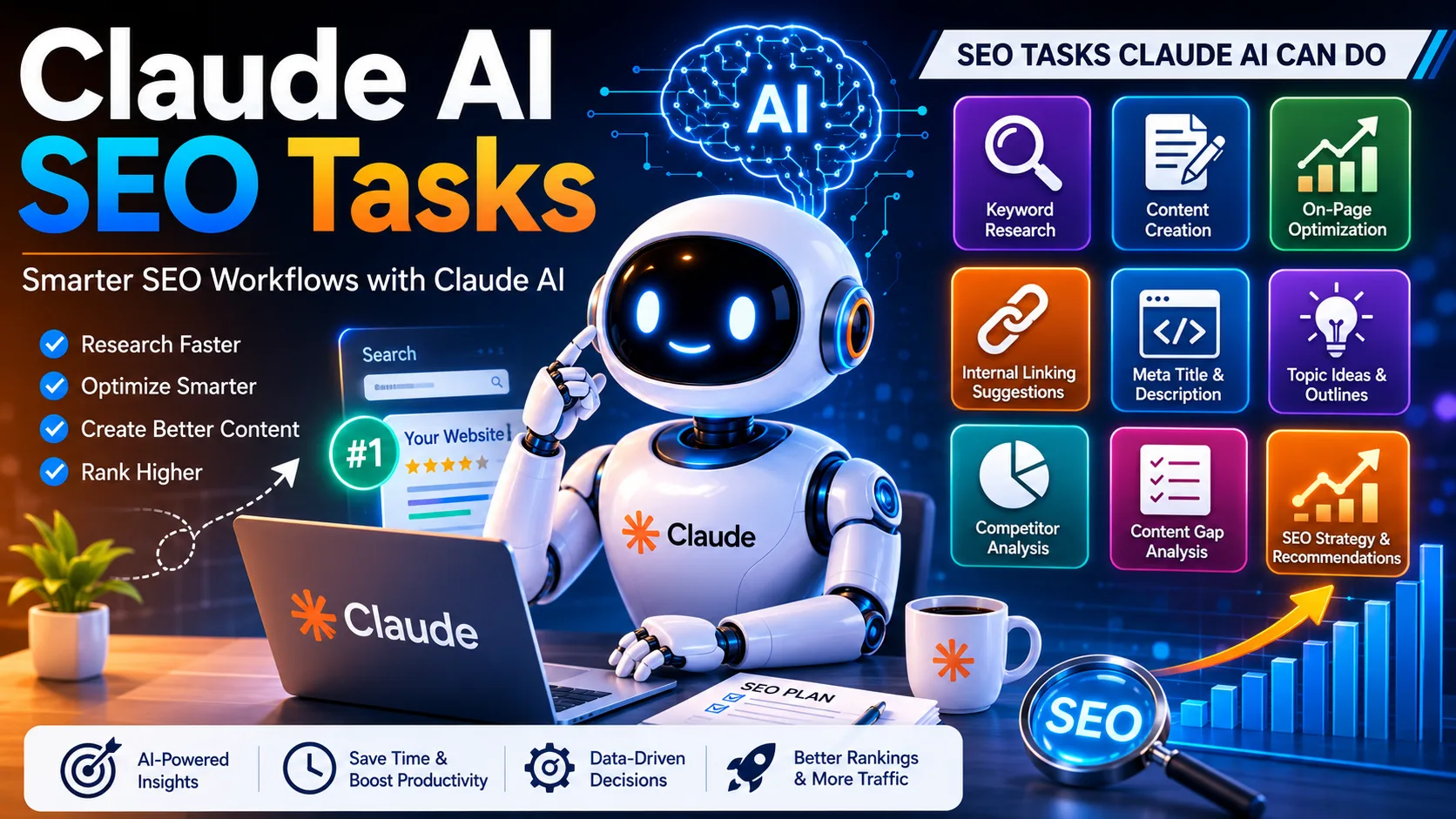
Technical Depth: Do not write fluff. If you are writing about Claude AI SEO tasks, delve into prompt engineering mechanics, token limits, and API structures. Deep semantic richness signals expertise to LLMs.
Medical/Legal/Financial (YMYL): For "Your Money or Your Life" topics, content should be reviewed by certified professionals, and that review status must be clearly stated (e.g., "Medically reviewed by Dr. Jane Doe").
Authority is determined by what others say about you. For AEO, this translates into Entity Trust.
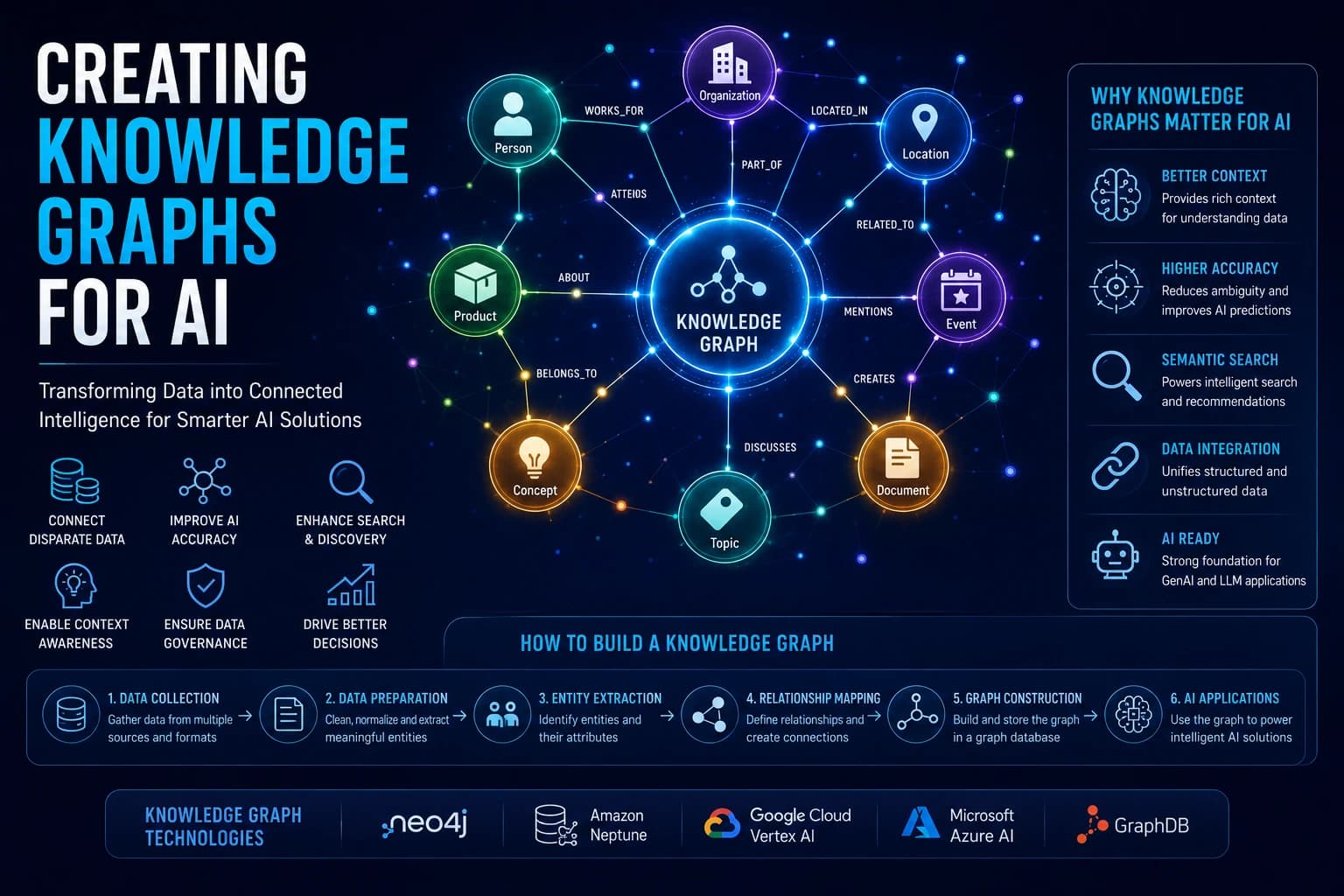
AI search engines map the web using Knowledge Graphs. If your brand (the "Entity") is frequently mentioned alongside terms like "enterprise AI," the graph builds an association.
Earn high-quality backlinks from reputable domains.
Secure unlinked brand mentions in industry news.
Ensure your brand's Wikipedia or Wikidata entries are accurate, as LLMs rely heavily on these seed databases.
Trustworthiness is the center of the E-E-A-T matrix. A secure, transparent site is a trustworthy site.
Always link out to authoritative sources to back up your claims.
Maintain transparent privacy policies, terms of service, and clear contact information.
Ensure all content has clear "Published" and "Last Updated" dates.
Avoid clickbait titles that do not match the content, as this degrades trust metrics.
E-E-A-T for Google AI Overviews
Google's AI Overviews (formerly SGE) sit directly on top of the standard Google Search algorithm. Google has explicitly stated that its core ranking systems, which are deeply intertwined with E-E-A-T evaluation, determine what content is selected for AI Overviews.
Structure your content logically (H2, H3) so Google can easily extract the exact paragraph needed for the overview. Read our guide on formatting content for AI crawlers.
Build a robust "About Us" page that clearly establishes who you are and why you are a trusted entity.
E-E-A-T for ChatGPT, Claude and Perplexity Citations
Unlike Google, platforms like OpenAI (SearchGPT) and Perplexity rely heavily on partnerships with news organizations and their own custom web crawlers.
For these platforms, E-E-A-T is evaluated slightly differently:
Perplexity: Heavily favors domains with high citation rates and academic/journalistic integrity.
ChatGPT: Favors recency, structured data, and clarity.
To optimize for these independent answer engines, your technical SEO and Schema markup must be flawless, as these bots rely on structured data to parse information quickly.
How to Prove E-E-A-T on a Blog Page
Proving E-E-A-T is both a visual and technical exercise.
Visual Trust Proof Cards
Ensure your pages visibly display:
Author Profiles: Names, photos, and credentials.
Sources & Citations: A dedicated section at the bottom of the article linking to research.
Contact Info: Don't hide behind a contact form; provide real physical addresses if applicable.
Anonymous Content: Publishing content under "Admin" or "Team." AI engines heavily discount anonymous content in YMYL (Your Money or Your Life) categories.
AI-Spam: Generating hundreds of low-effort AI articles without human editorial oversight. This destroys domain trust.
Missing Schema: Relying only on visual elements and ignoring JSON-LD, making it harder for answer engines to extract facts confidently.
No External Links: Hoarding link equity by never linking to external sources. Trustworthy content cites other trustworthy content.
Real Example
When Intellectual Clouds creates content about Enterprise AI deployment, we do not just summarize generic facts. We include detailed architectural diagrams, exact code snippets, and outcomes from real enterprise deployments.
Furthermore, we ensure that the author profile linked to the post highlights over 10 years of software architecture experience, backed by Person schema linking to verified LinkedIn profiles. This layered approach—combining rich, expert content with strict technical structuring—is what secures citations in AI-generated answers.
Frequently Asked Questions
What is E-E-A-T in AEO?
In Answer Engine Optimization (AEO), E-E-A-T refers to Experience, Expertise, Authoritativeness, and Trustworthiness. It determines whether an AI model trusts your content enough to cite it as a factual source in its generated answers.
Is E-E-A-T a direct ranking factor?
No. Google explicitly states that E-E-A-T is not a direct, quantifiable ranking factor. Instead, it is a conceptual framework that their algorithms attempt to measure through thousands of proxy signals.
Why does trust matter for AI search?
Generative AI models face massive risks from hallucinations. To prevent spreading misinformation, AI search engines (like Google AI Overviews and Perplexity) filter heavily for high-trust sources before synthesizing their answers.
How do I prove expertise to AI engines?
You prove expertise by providing technical depth, original research, and clear author credentials. Using Person and ProfilePage Schema markups helps translate human expertise into machine-readable trust signals.
Can AI-generated content show E-E-A-T?
Purely AI-generated content cannot demonstrate true human "Experience" (the first E in E-E-A-T). While AI can help draft content, human oversight, original insights, and verified facts are mandatory to build trust.
How do author bios help AEO?
Author bios link the content to a verified human entity. When supported by Schema markup, answer engines can trace the author's credibility across the web, boosting the perceived authority of the content.
Does schema markup improve E-E-A-T?
Yes, immensely. Schema markup translates visual trust signals (like an author's name or an organization's contact info) into machine-readable data, leaving zero ambiguity for the AI engine regarding who published the facts.
How do I get cited by Google AI Overviews?
Focus on providing highly accurate, logically structured, and deeply authoritative answers to complex questions. Ensure your technical SEO is flawless, your brand entity is strong, and your E-E-A-T signals are visible.
What is the difference between SEO E-E-A-T and AEO E-E-A-T?
They are fundamentally the same concept, but AEO relies much more heavily on structured data, logical content formatting, and absolute factual accuracy, whereas traditional SEO may tolerate more conversational fluff if keyword targets are met.
Can Intellectual Clouds improve my AEO trust signals?
Yes. We specialize in comprehensive Answer Engine Optimization, conducting deep technical audits, implementing advanced schema architectures, and optimizing your brand's digital presence to ensure maximum visibility in AI search engines.
How Intellectual Clouds Helps with AISEO/AEO
Getting your brand cited by AI search engines requires a strategic blend of content quality, technical structuring, and undeniable entity authority. Intellectual Clouds helps enterprises navigate this shift. Through our dedicated AI SEO services, we deploy advanced schema architectures, optimize your knowledge graph, and ensure your E-E-A-T signals are perfectly calibrated for both human readers and AI crawlers.
Conclusion
The future of search is conversational, generative, and strictly factual. As Answer Engine Optimization becomes the standard, relying solely on old SEO tactics will leave your brand invisible. You must actively engineer Trust. By investing deeply in Experience, Expertise, Authoritativeness, and Trustworthiness—and structuring those signals technically—you ensure that when an AI asks a question about your industry, it cites your brand as the definitive answer.
Build Trust Signals That AI Search Engines Can Cite
Intellectual Clouds helps businesses improve AEO visibility with structured content, schema markup, expert positioning, knowledge graphs and AI-search-ready trust signals.
Asim Ansari is the Founder of Intellectual Clouds and a Certified Salesforce Administrator and Pardot Specialist with 17+ years of experience across Salesforce CRM, AI automation, cloud infrastructure (AWS), and digital transformation. He writes on AI agents, Salesforce delivery, Answer Engine Optimisation (AEO), and AI-accelerated business operations.