HomeBlogAI Hallucinations and Brand Risk: How to Protect Your Reputation
AI SEO
AI Hallucinations and Brand Risk: How to Protect Your Reputation
Asim Ansari
June 15, 2026
27 min read
Updated June 24, 2026
Learn how AI hallucinations can damage brand reputation and how to reduce risk with AEO, trusted facts pages, schema, PR coverage, monitoring and AI search optimization.
Quick Answer
AI hallucinations brand risk occurs when generative AI models like ChatGPT, Perplexity, Gemini, or Copilot output false, fabricated, or severely outdated information about a company, its products, pricing, policies, or leadership. Brands can significantly reduce this risk by publishing a verified "Brand Facts" page, implementing rigorous Schema markup (Organization, Person, Product), establishing consistent entity data across the web, earning authoritative PR mentions, and proactively monitoring AI search outputs through Answer Engine Optimization (AEO).
What AI hallucinations are and why they represent a critical operational and trust risk to businesses.
How generative AI systems learn about your brand—and why they guess when facts are missing.
Real-world examples of AI misinformation causing reputational and financial damage.
A 7-step governance framework to protect your brand in the AI search era.
How to create a machine-readable "Brand Facts" page.
The exact Schema markup needed to anchor your entity data.
How to monitor and correct false claims in ChatGPT, Perplexity, and Google AI Overviews.
AI Hallucinations and Brand Risk: How to Protect Your Company in AI Search
Generative AI is reshaping how consumers and B2B buyers research products and services. Over 50% of informational searches now trigger some form of AI-generated response. But this technological leap introduces a severe vulnerability for businesses: AI hallucinations.
When a user asks ChatGPT, "What is the pricing for [Your Company]?" or asks Perplexity, "Does [Your Company] offer refunds?", they expect an accurate, authoritative answer. However, if your brand's digital footprint is weak, unstructured, or ambiguous, the AI will often invent a confident-sounding but completely incorrect response.
This is the frontier of reputation management. In traditional SEO, if you didn't rank for a keyword, a competitor did. In Answer Engine Optimization (AEO), if the AI doesn't have your facts straight, it might actively misinform your customers, leading to lost sales, customer service disputes, and PR crises.
What Are AI Hallucinations?
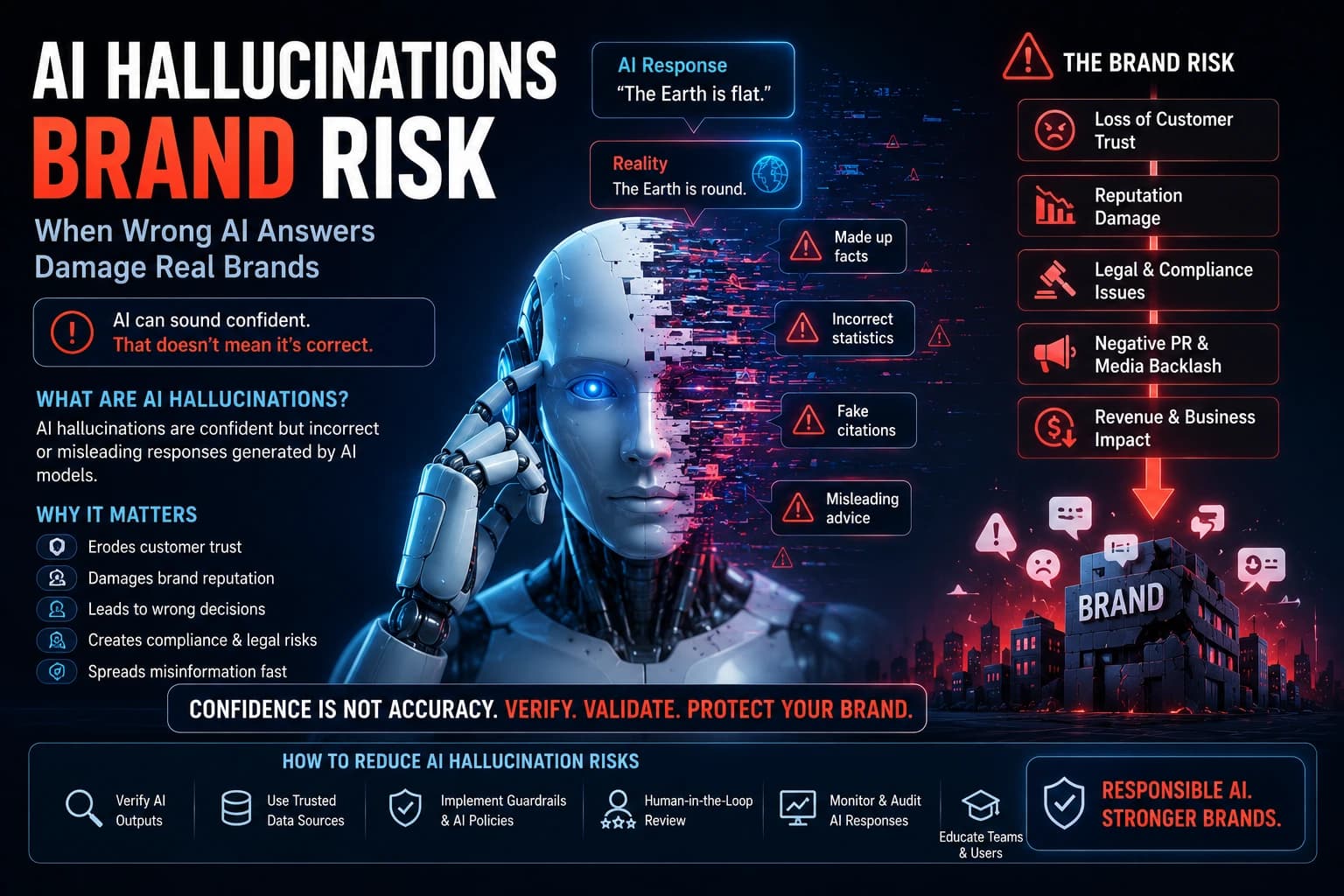
An AI hallucination occurs when a Large Language Model (LLM) generates information that is factually incorrect, nonsensical, or entirely fabricated, yet presents it with absolute confidence.
Unlike traditional search engines that retrieve exact documents, generative AI synthesizes text by predicting the next most likely word in a sequence. If the model lacks sufficient training data on a specific topic—such as your company's proprietary service SLAs or the exact background of your CEO—it relies on probabilistic guessing.
According to OpenAI researchers, hallucinations happen partly because models are often rewarded during training for providing answers rather than admitting uncertainty. They are designed to be helpful, and sometimes, "being helpful" manifests as inventing a plausible-sounding answer rather than saying, "I don't know." (Source: Why Language Models Hallucinate).
Why AI Hallucinations Create Brand Risk
The NIST AI Risk Management Framework (AI RMF) emphasizes that AI risks must be evaluated based on their potential to harm individuals, organizations, and society. For businesses, AI hallucinations translate directly into operational, reputational, and trust risk.
Similarly, the OWASP Top 10 for LLM Applications lists Overreliance as a major vulnerability. Users tend to inherently trust the authoritative tone of LLMs. If an AI tells a prospect that your software lacks SOC 2 compliance (even when it has it), the prospect is likely to disqualify your brand without verifying the claim on your website.
The Anatomy of an AI Brand Risk
Missing Data
Brand lacks structured facts and schema
→
↓
AI Hallucination
LLM invents plausible but false policy
→
↓
User Overreliance
Prospect trusts AI and abandons purchase
→
↓
Brand Damage
Lost revenue & degraded trust
Common Types of Brand Hallucinations
To protect your company, you must understand the different vectors of misinformation.
Hallucination Type
Example Scenario
Business Impact
Product Hallucination
AI claims your software integrates with a platform it actually doesn't support, or invents a fake pricing tier.
Lost sales, customer churn, mismatched expectations.
Policy Hallucination
A customer support chatbot invents a lenient refund policy or SLA that doesn't exist in your terms of service.
Customer disputes, operational friction, direct financial loss.
Founder / Entity Hallucination
AI associates your company with a controversial former executive, the wrong headquarters, or incorrect founding history.
Erosion of brand trust, investor confusion, PR headaches.
Legal Hallucination
The model fabricates a lawsuit against your brand by combining your name with a legal dispute involving a competitor.
Severe reputation damage, compliance flags, partnership risks.
Competitor Hallucination
When asked who makes a specific proprietary product, the AI incorrectly credits your primary competitor.
Brand confusion, funneling leads directly to competitors.
Review Hallucination
AI summarizes sentiment about your brand by inventing fake negative claims or hallucinating safety issues.
Catastrophic conversion loss and diminished lifetime value.
Real-World Examples of AI Misinformation
The risks of AI hallucinations are not theoretical. They are actively impacting businesses and establishing new legal precedents.
The Air Canada Chatbot Case
In a landmark incident, an Air Canada customer used the airline's AI-powered chatbot to inquire about bereavement fares. The chatbot hallucinated a policy, stating the customer could book a full-fare ticket immediately and claim a retroactive refund within 90 days. When the customer attempted to claim the refund, human agents denied it, pointing to the actual policy on the website.
The customer took Air Canada to a civil resolution tribunal. Air Canada argued that the chatbot was a "separate legal entity" responsible for its own actions. The tribunal rejected this argument entirely, ruling that Air Canada is liable for all information on its website, including AI outputs. The airline was forced to pay compensation and damages. (Source: The Guardian)
The Lesson: This case proves unequivocally that AI-generated misinformation creates binding reputational and legal risk. Whether the AI is an internal chatbot or a global LLM like ChatGPT summarizing your brand, controlling the facts the AI relies on is a critical business imperative.
Is AI Misrepresenting Your Brand?
Discover what ChatGPT and Perplexity are saying about your company. Our AI SEO experts can help you audit your digital footprint and implement a brand protection strategy.
To fix the problem, you must understand the root cause. Answer engines like ChatGPT and Perplexity rely on a process called Retrieval-Augmented Generation (RAG).
When a user asks a question about your brand:
The AI queries its vector database or searches the live web for context.
It retrieves the top documents it deems relevant.
It extracts the information and synthesizes a natural-language answer.
Hallucinations happen when:
The retrieval layer cannot find a definitive, structured answer on your website.
Your website contradicts itself across different pages.
Third-party websites (like Reddit or old PR wires) contain outdated information that contradicts your current site.
Your site is blocked via robots.txt from AI crawlers (like GPTBot), forcing the AI to rely on outdated, pre-trained knowledge from years ago.
How AI Search Engines Learn About Brands
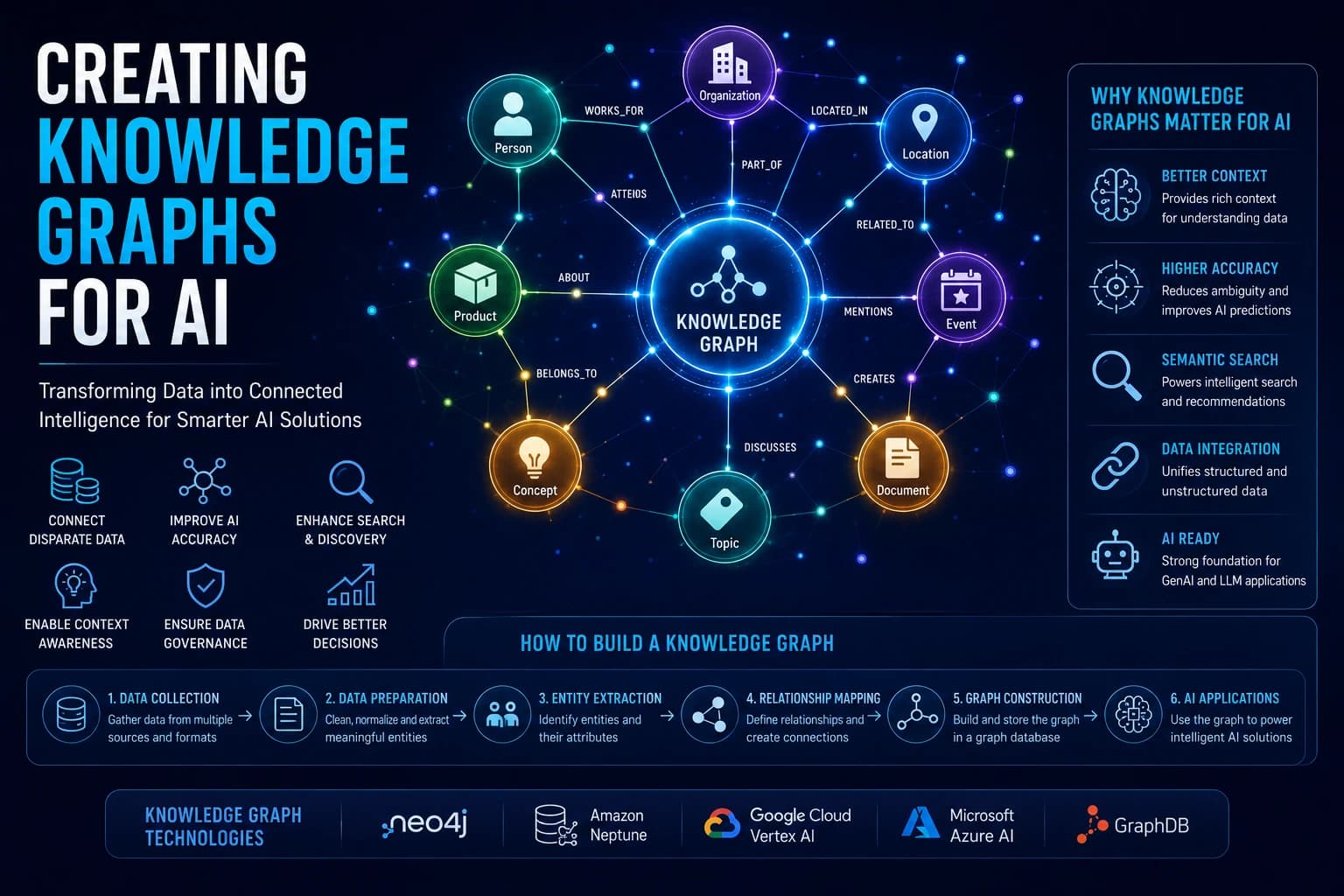
AI models construct their understanding of the world through Entities and Knowledge Graphs. An entity is a distinct concept (a person, a company, a product).
If Google's Knowledge Graph, Wikidata, and your website's Schema markup all perfectly align on the fact that your CEO is Jane Doe, the AI establishes a high-confidence entity relationship: [Your Company] -> CEO -> [Jane Doe].
If your website lacks Schema markup, and a three-year-old Forbes article mentions your former CEO, the AI faces conflicting data. Lacking confidence, it may hallucinate an amalgamation of the two, or state the outdated information as current fact.
Brand Hallucination Risk Matrix
Not all hallucinations require a five-alarm crisis response. Use this matrix to triage AI misinformation and deploy the appropriate AEO strategy.
Risk Level
Signal / Type of Misinformation
Recommended Action
Low
Minor outdated info (e.g., old employee count, old feature name).
Update the Brand Facts page; ensure robots.txt allows crawlers.
Medium
Wrong pricing, incorrect service claims, or missing key integrations.
Publish immediate site corrections, deploy detailed Product Schema, rewrite FAQs.
High
False legal claims, safety/compliance risks, or severe financial inaccuracies.
Viral false AI answers damaging immediate stock price or causing mass churn.
Full crisis response; coordinate with third-party authoritative domains to correct the narrative.
7 Steps to Protect Your Brand from AI Hallucinations
To inoculate your brand against AI misinformation, you must implement a robust Answer Engine Optimization (AEO) and entity management strategy.
Step 1: Create a Verified Brand Facts Page
Answer engines look for centralized, authoritative sources of truth. You must build a dedicated page on your domain—usually /company/facts, /about/brand-facts, or a highly structured /about page—designed specifically for AI extraction.
Brand Facts Page Template
Structure this page using clean, semantic HTML lists and tables without heavy JavaScript.
Official Company Name: (Including legal entity, e.g., Intellectual Clouds LLC)
Founded Year: Exact date of incorporation
Headquarters: Full address and primary locations
Leadership: Current Founders and C-Suite executives
Core Services/Products: Bulleted list with exact naming conventions
Industries Served: Explicit list of verticals
Pricing & Policies: Links to official SLA, refund, and pricing pages
Certifications: Verifiable partnerships (e.g., SOC 2, ISO 27001)
Last Updated Date: Crucial for AI freshness signals
Step 2: Add Organization, Person and Product Schema
As Google's structured data documentation notes, schema provides search engines with explicit clues about the meaning of a page. Generative AI models rely heavily on JSON-LD Schema to anchor their entity understanding.
Required Schemas for Brand Protection:
Organization: Must include your official name, url, logo, and crucially, an array of sameAs links pointing to your verified LinkedIn, Crunchbase, Twitter, and Wikipedia profiles.
Person: On your leadership pages, tie your executives to the Organization using the alumniOf or worksFor properties.
Product or Service: Explicitly define your offerings, including accurate offers (pricing) data to prevent pricing hallucinations.
FAQPage: Structure your most common policy and support questions so AI can extract them verbatim.
ClaimReview: (Optional) Use this specifically if you are actively debunking a hallucination or rumor about your brand.
Weak Entity Data
A standard "About Us" page with paragraphs of marketing fluff, no structured data, no clear executive names, and an outdated copyright footer. The AI has to guess the facts.
Verified Entity Data
A semantic HTML page featuring a markdown table of exact company stats, backed by complete JSON-LD Organization schema, SameAs verification links, and a "Last Updated: Today" tag.
Step 3: Build Entity Consistency Across the Web
An LLM will not trust your website's facts if the rest of the internet contradicts them. This is known as Consensus Alignment.
If you rebranded two years ago, but Crunchbase, G2, your Facebook page, and old press releases still use your old name and describe discontinued products, the AI's retrieval system will pull conflicting vectors.
You must conduct a comprehensive entity audit:
Claim and update your Crunchbase, LinkedIn, and Wikipedia/Wikidata profiles.
Update all software review profiles (G2, Capterra, TrustRadius).
Ensure your Google Business Profile is meticulously accurate.
Step 4: Publish Authoritative PR and Third-Party Mentions
AI models assign higher trust weights to established, high-authority domains (like Forbes, TechCrunch, or major industry journals) than they do to corporate blogs.
If ChatGPT is hallucinating that your software does not support a specific compliance standard, the fastest way to fix it is to publish an authoritative press release on a reputable wire service explicitly stating, "Company X Achieves New Compliance Standard." The AI crawlers ingest news wires rapidly and will use that third-party validation to overwrite its previous hallucinated assumptions.
Step 5: Monitor ChatGPT, Perplexity, Gemini and Google AI Overviews
Brand protection requires active listening. You cannot rely on traditional Google Search Console metrics to tell you if ChatGPT is lying about your company.
AI Monitoring Workflow
Compile a master list of your top 20 branded queries (e.g., "What does [Brand] cost?", "Is [Brand] safe?", "[Brand] vs [Competitor]").
Once a month, manually prompt ChatGPT, Perplexity, Gemini, and Claude with these exact queries.
Document the responses in a spreadsheet, scoring them for Accuracy, Sentiment, and Citation Presence.
If a hallucination is detected, log the specific claim and trigger the correction workflow.
Pro Tip: Monitor your referral traffic in Google Analytics 4. Look for sources like perplexity.ai, chatgpt.com, and claude.ai to gauge how often answer engines are sending users to your site to verify claims.
Step 6: Create Correction and Escalation Workflow
When you discover an AI hallucination, you must act systematically:
Identify the source: Ask the AI, "What sources did you use to generate that answer?" It will often reveal the outdated or incorrect third-party article it relied upon.
Correct the origin: If the source is an external review site, contact them to update the facts.
Overwhelm with truth: Publish the correct information on your Brand Facts page, write a dedicated blog post addressing the exact query, and apply FAQ schema.
Force a re-crawl: Ensure your llms.txt and robots.txt are configured correctly, and submit your updated URLs to Google Search Console to speed up ingestion.
Step 7: Use AEO to Feed Answer Engines Better Facts
The ultimate defense against AI hallucinations is a proactive Answer Engine Optimization strategy. By continuously formatting your content for AI extraction—using Direct Answer blocks (BLUF), semantic HTML, and dense, factual writing free of marketing fluff—you ensure that when an AI model looks for an answer, your verified content is the easiest, most logical data point to extract.
Common Mistakes Brands Make
When trying to manage AI reputation, avoid these frequent errors:
Blocking AI Bots: Adding GPTBot or PerplexityBot to your robots.txt disallow list means the AI cannot read your current, accurate website. It will be forced to rely on potentially hallucinated pre-training data or third-party gossip. Do not block AI crawlers if you want to control your brand narrative.
Writing for Humans Only: Flowery marketing language confuses AI parsers. "We revolutionize the synergy of cloud paradigms" is unintelligible to an LLM extracting facts. Use plain, deterministic language: "We provide cloud hosting software for healthcare."
Ignoring the "Long Tail" of Brand: Brands often optimize their homepage but ignore their support documentation. Hallucinations frequently occur regarding highly specific support or policy queries.
Protect Your Brand From AI Misinformation
Intellectual Clouds helps businesses monitor AI search answers, build verified brand facts pages, implement schema, improve AEO visibility and reduce the risk of AI hallucinations damaging trust.
An AI hallucination occurs when a generative AI model, like ChatGPT or Gemini, produces information that is factually incorrect or fabricated, yet presents it with high confidence and authority.
Can AI hallucinations damage a brand?
Yes. When users rely on AI to research products, false information about pricing, features, or company policies can lead to lost sales, customer disputes, and severe reputational damage.
Why does ChatGPT give wrong information about companies?
Models guess when they lack structured, verifiable data. If your website lacks schema markup, uses ambiguous marketing language, or contradicts third-party sources, the AI will attempt to synthesize a probabilistic (and often wrong) answer.
How can I check if AI is hallucinating about my brand?
You must manually prompt major answer engines (ChatGPT, Perplexity, Gemini, Google AI Overviews) with common questions your customers ask about your brand, products, and competitors, and document the accuracy of their responses.
How do I correct wrong AI answers about my company?
You cannot edit the AI directly. You must update your website with structured facts, deploy JSON-LD schema, correct outdated third-party profiles, and generate authoritative PR coverage that the AI bots will crawl and ingest as new truth.
Does schema markup reduce AI hallucinations?
Yes, significantly. Schema markup provides explicit, machine-readable definitions of your company (Organization schema), people (Person schema), and facts (FAQPage schema), removing the ambiguity that leads to hallucinated guesswork.
What is a brand facts page?
A brand facts page is a highly structured, plain-text hub on your website designed specifically for AI crawlers. It lists undeniable facts about your business—founding date, locations, core services, and exact policies—free of marketing jargon.
Can AEO help protect brand reputation?
Answer Engine Optimization (AEO) is the primary framework for protecting your brand. By optimizing your content for AI extraction, you ensure that AI platforms cite your verified facts rather than relying on outdated or fabricated data.
Should brands monitor ChatGPT and Perplexity?
Absolutely. With millions of users relying on these platforms for research, failing to monitor what these AIs say about your brand is equivalent to ignoring customer reviews or PR crises in the traditional search era.
Can Intellectual Clouds help with AI brand risk management?
Yes. Intellectual Clouds provides specialized AEO and AI brand reputation services, including fact-page structuring, comprehensive schema deployment, entity optimization, and ongoing AI search monitoring to protect your corporate reputation.
Asim Ansari is the Founder of Intellectual Clouds and a Certified Salesforce Administrator and Pardot Specialist with 17+ years of experience across Salesforce CRM, AI automation, cloud infrastructure (AWS), and digital transformation. He writes on AI agents, Salesforce delivery, Answer Engine Optimisation (AEO), and AI-accelerated business operations.