HomeBlogHow to Format Content for AI Crawlers: AISEO, Schema and llms.txt Guide
AI SEO
How to Format Content for AI Crawlers: AISEO, Schema and llms.txt Guide
Asim Ansari
June 10, 2026
23 min read
Updated June 24, 2026
Learn how to format content for AI crawlers using semantic HTML, Markdown tables, schema markup, SSR, FAQ blocks and llms.txt to improve AI search visibility.
Direct Answer: To format content for AI crawlers, use semantic HTML, server-rendered text, clear H2/H3 headings, short direct-answer blocks, structured tables, FAQ sections, JSON-LD schema, descriptive internal links, and an llms.txt file. AI crawlers and answer engines extract meaning from clean structure, not visual design, so content must be easy to parse without relying on CSS or complex JavaScript.
Structure Over Style: AI crawlers do not see CSS styling or colors; they extract entities, relationships, and answers exclusively from your underlying HTML architecture.
Server-Side Rendering (SSR) is Safest: While Googlebot can render JavaScript, lightweight AI bots (like GPTBot) often extract raw HTML. Serve pre-rendered content for maximum visibility.
Implement Schema & llms.txt: You must explicitly spoon-feed facts to AI models using JSON-LD schema markup and dedicated markdown files like llms.txt.
Use Tables for Data: Avoid "walls of text" when comparing items. AI extracts tabular data much more accurately when formatted with clean HTML <table> tags.
Introduction: Why Formatting for AI Crawlers Matters
For two decades, Search Engine Optimization (SEO) was primarily focused on human readers and Google's keyword-matching algorithms. We designed beautiful websites using heavy JavaScript frameworks, relying on CSS to visually separate content.
However, Answer Engine Optimization (AEO) fundamentally changes the rules. AI crawlers do not read your website like humans. They do not care about your brand colors, your drop shadows, or your parallax scrolling animations. They extract entities, relationships, answers, and source credibility purely from your HTML structure and structured data.
If your website relies on complex <div> soup and client-side JavaScript to display core facts, those facts are virtually invisible to the Large Language Models (LLMs) that power ChatGPT, Perplexity, and Google AI Overviews. This technical guide covers exactly how to structure your content so that AI engines can extract, understand, and cite your brand.
What Are AI Crawlers?
AI crawlers (often called "bots" or "spiders") are automated scripts deployed by AI companies (like OpenAI, Anthropic, and Google) to index the web. Their purpose is not to rank a page on a traditional SERP (Search Engine Results Page). Instead, they harvest data to:
Train future models: Digesting raw text to learn language patterns and facts.
Fuel RAG systems: Retrieving live, real-time answers for users querying search engines like Perplexity or SearchGPT.
Crawler Compatibility Matrix
Different AI companies use different user agents to crawl your site. Here is a quick reference:
Crawler Name
Company
Primary Purpose
Googlebot / GoogleOther
Google
Standard Search & AI Overviews (SGE)
GPTBot
OpenAI
Training future GPT models
OAI-SearchBot / ChatGPT-User
OpenAI
Live search queries for ChatGPT users
ClaudeBot
Anthropic
Training and live retrieval for Claude
PerplexityBot
Perplexity
Live real-time web search for answers
AI Crawlers vs Traditional Search Crawlers
Traditional crawlers evaluate keyword density, backlink profiles, and domain authority to assign a ranking score.
AI crawlers are completely different. They are evaluating semantic relationships. They want to extract the subject, the predicate, and the object. They do not care if your keyword is in the H1 tag; they care if the paragraph following the H2 tag provides a definitive, verifiable answer to a user's question. Understanding AEO vs SEO differences is the first step to optimizing your formatting.
The AI Citation Architecture Flow
To visualize how your HTML structure translates into a citation in an AI chat interface, consider this data flow:
graph TD
    A[Clean Semantic HTML] -->|Provides Structure| B(JSON-LD Schema Markup)
    B -->|Provides Explicit Facts| C[llms.txt File]
    C -->|Provides AI Map| D{AI Web Crawlers}
    D -->|Extract & Store| E[(LLM Vector Database)]
    E -->|RAG Retrieval| F[AI Answer & Citation]

    classDef html fill:#f06529,stroke:#fff,stroke-width:2px,color:#fff;
    classDef schema fill:#00a1e0,stroke:#fff,stroke-width:2px,color:#fff;
    classDef bot fill:#10a37f,stroke:#fff,stroke-width:2px,color:#fff;

    class A html;
    class B,C schema;
    class D,E,F bot;
Semantic HTML: The Foundation
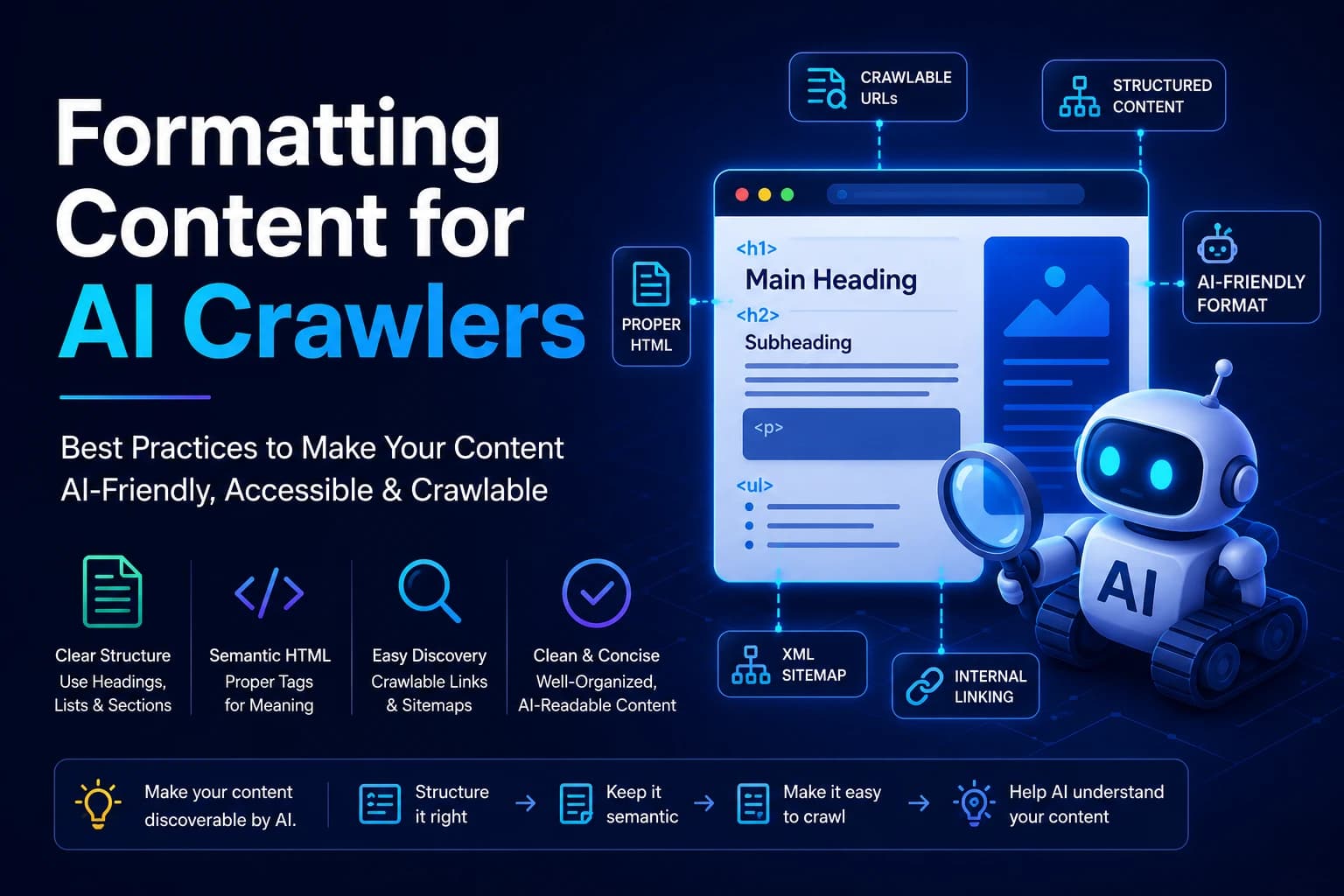
Because AI ignores visual CSS, HTML5 semantic tags are the only way to tell a crawler what a block of text represents.
Bad vs Good Formatting
Bad Formatting (Unstructured Div Soup):
<div class="content-wrapper">
  <div class="large-text">What is AI SEO?</div>
  <div class="body-text">AI SEO is the process of optimizing...</div>
</div>
Good Formatting (Semantic HTML):
<article>
  <h2>What is AI SEO?</h2>
  <p>AI SEO is the process of optimizing...</p>
</article>
When you use semantic HTML (like <article>, <section>, <aside>, <nav>), you give the AI a hierarchical map of your content's logical flow.
Server-Side Rendering vs Client-Side Rendering
Do AI crawlers execute JavaScript? Sometimes.
Google explicitly states that Googlebot can render JavaScript. However, rendering JavaScript is computationally expensive. Many lightweight AI bots (like the bots used by smaller RAG startups or early-stage LLM crawlers) will simply scrape the raw, unrendered HTML returned by the server.
If your website relies entirely on Client-Side Rendering (CSR)—meaning the HTML is empty until a React or Vue bundle loads—you are invisible to a significant portion of AI crawlers. Always use Server-Side Rendering (SSR) or Static Site Generation (SSG) to ensure the raw HTML contains your critical facts immediately.
Headings: H1, H2, H3 Structure for AI Extraction
AI models chunk data. When an AI crawler digests your page, it uses your headings as "chunk boundaries."
If you use an H2 tag, the AI assumes all paragraphs following it (until the next H2) belong to that specific topic. Therefore, headings should be descriptive, and ideally, framed as the questions your users are asking.
Poor Heading: "Our Services"
AI-Optimized Heading: "What AI SEO Services Does Intellectual Clouds Provide?"
Direct Answer Blocks
The most effective AEO tactic is the "Direct Answer Block." Immediately following an H2 or H3 heading, provide a succinct, 40-to-60 word answer that directly addresses the heading. Do not use fluff. Get straight to the point using a Bottom-Line-Up-Front (BLUF) approach.
Markdown Tables and HTML Tables
AI models, particularly those based on the GPT architecture, are heavily trained on Markdown and structured tabular data. If you are comparing two products, listing features, or providing specifications, do not write a wall of text. Use a table.
Format Type
Human Readability
AI Crawler Readability
Best Use
Wall of text
Low
Low
Avoid entirely
Bulleted list
High
High
Features, benefits, steps
Numbered list
High
High
Processes and how-to content
HTML table
Medium
Very high
Comparisons, pricing, specs
FAQ block
High
Very high
Direct answers
JSON-LD schema
Invisible to users
Very high
Structured facts and entities
llms.txt
Medium
Very high
AI-specific site summary
FAQ Formatting for Answer Engines
When formatting a Frequently Asked Questions (FAQ) section, use native HTML <details> and <summary> tags rather than complex JavaScript accordions. AI crawlers can natively parse the <details> tag, recognizing it as a Q&A pair.
JSON-LD Schema Markup
If semantic HTML is a map for the AI crawler, JSON-LD Schema is a direct database injection. Schema markup completely removes the need for the AI to guess the context of your page.
To format content perfectly for AI, you must inject <script type="application/ld+json"> blocks containing:
Article Schema: To define the author, publish date, and publisher entity.
FAQPage Schema: To explicitly pair questions with their direct answers.
HowTo Schema: If your article is a step-by-step guide.
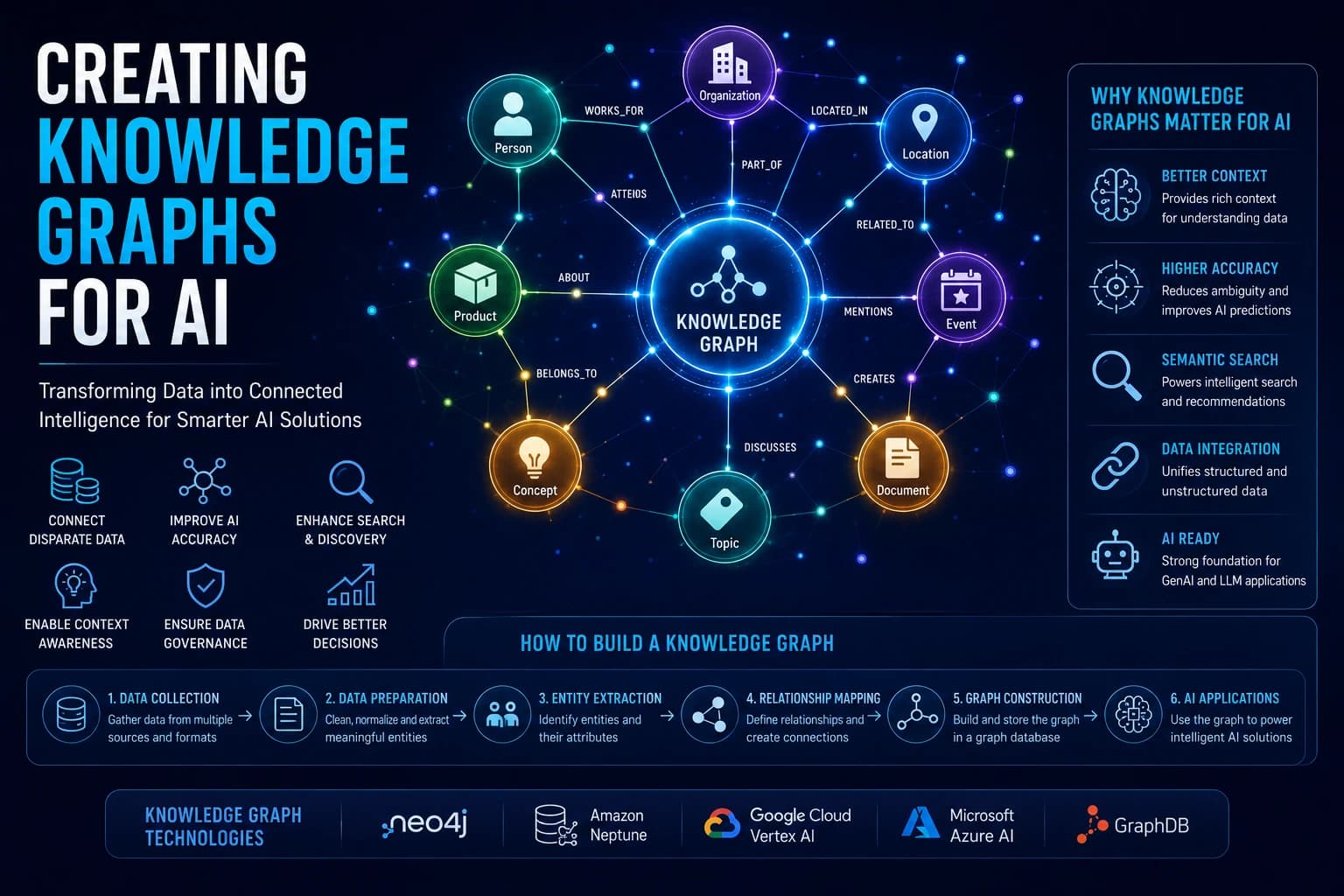
Organization Schema: To build a knowledge graph that connects your brand to your social profiles and contact info.
Here is an example of perfectly formatted FAQPage schema:
{
  "@context": "https://schema.org",
  "@type": "FAQPage",
  "mainEntity": [{
    "@type": "Question",
    "name": "Do AI crawlers execute JavaScript?",
    "acceptedAnswer": {
      "@type": "Answer",
      "text": "Some AI crawlers, like Googlebot, can render JavaScript. However, many lightweight AI crawlers do not execute JavaScript, which is why Server-Side Rendering (SSR) is highly recommended for AEO."
    }
  }]
}
llms.txt: What It Is and How to Use It
As AI crawlers become more prominent, a new standard has emerged: the llms.txt file. Similar to a robots.txt file, llms.txt sits at the root of your domain (yourwebsite.com/llms.txt).
The purpose of llms.txt is to provide a clean, Markdown-formatted summary of your website specifically designed for LLMs. It tells the crawler exactly what your site is about and provides direct links to the most important content.
Example llms.txt Template
# Intellectual Clouds

Intellectual Clouds provides AI SEO, AI agents, cloud integrations, data analysis and enterprise automation services.

## Key Services
- AI SEO: /services/ai-seo
- AI Agents: /services/ai-agents
- Cloud Integrations: /services/cloud-integrations
- Data Analysis: /services/data-analysis

## Best Guides
- AEO vs SEO: /blog/aeo-vs-seo-differences
- Formatting Content for AI Crawlers: /blog/formatting-content-for-ai-crawlers
- The Role of E-E-A-T in AEO: /blog/role-of-eeat-in-aeo
robots.txt and AI Crawler Access
Many websites block GPTBot or ClaudeBot in their robots.txt file out of fear of their data being scraped. However, if you block AI crawlers, you cannot achieve Answer Engine Optimization.
If your goal is citation visibility—meaning you want ChatGPT to recommend your cloud integrations to a user—you must allow these user agents to crawl your site.
Internal Links and Entity Relationships
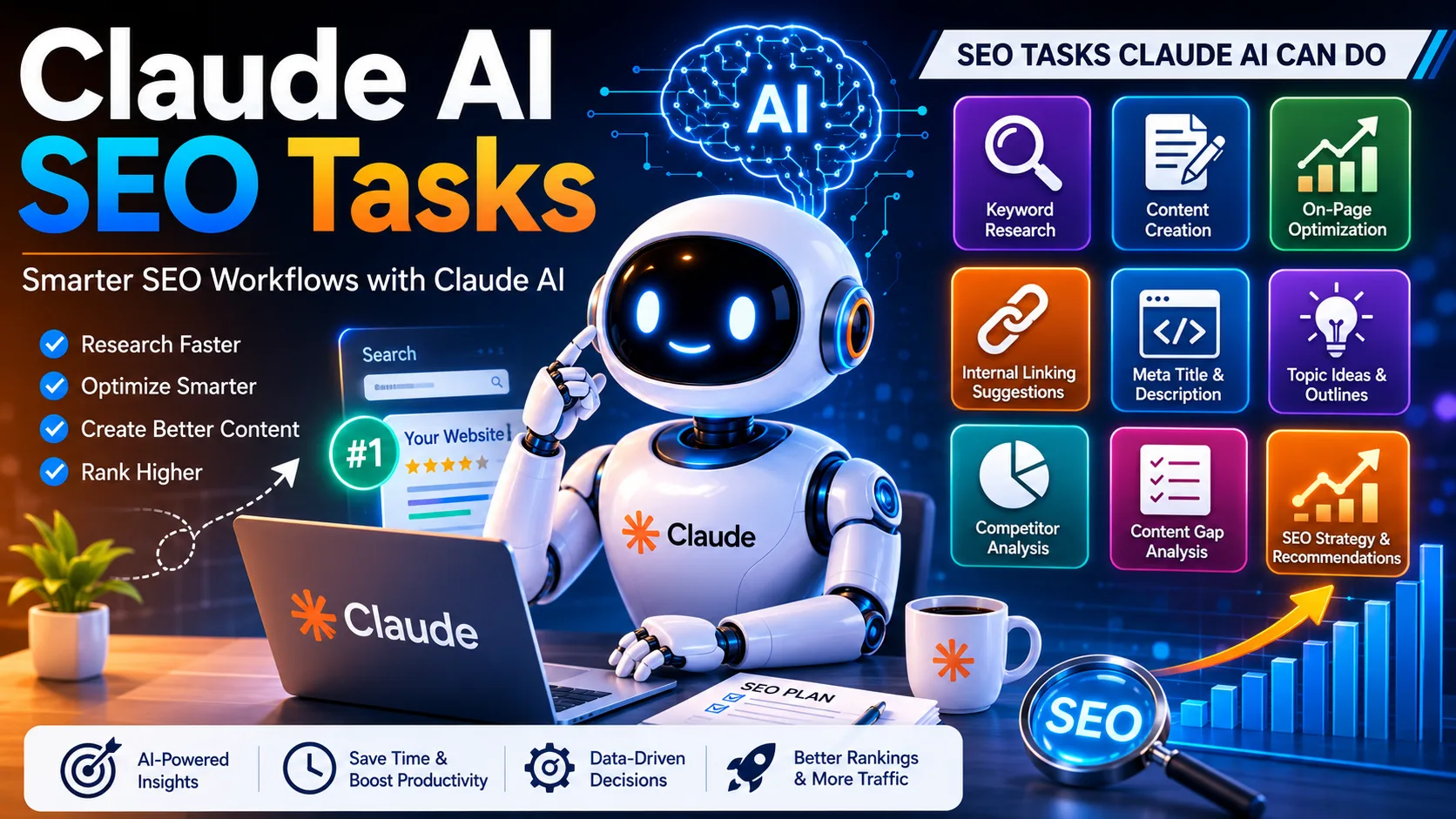
Descriptive internal linking is critical. AI models use anchor text to build relationships between entities. Do not use anchor text like "Click Here." Instead, use highly descriptive text like "learn more about Claude AI SEO tasks." This tells the crawler exactly what semantic concept the destination URL covers.
Images, Alt Text and Captions
While AI vision models are improving, text is still king. When you include an image, do not leave the alt text blank. The alt text should be a literal, descriptive sentence explaining the image, which provides critical context to text-only crawlers.
JavaScript, Accordions and Hidden Content
As mentioned, avoid hiding crucial information (like pricing or core features) behind JavaScript-only accordions or tabs that require a user click to load. If the content is not in the DOM upon the initial server response, assume the AI crawler will not see it.
Common Formatting Mistakes
Using Headings for Styling: Using an H2 just because you want big text, disrupting the logical hierarchy.
Missing Schema: Forgetting to implement FAQPage schema on pages that contain Q&As.
Keyword Stuffing: AI models penalize unnatural language. Write clearly and concisely.
Ignoring E-E-A-T: As discussed in our E-E-A-T in AEO guide, AI models prioritize content that visibly demonstrates experience and trust. Formatting means nothing if your content lacks verifiable authority.
Make Your Website Easy for AI Crawlers to Understand
Intellectual Clouds helps businesses audit and optimize websites for AI crawlers, answer engines, Google AI Overviews, ChatGPT, Perplexity and Claude using semantic HTML, schema markup, llms.txt and AISEO content architecture.
Before publishing any major piece of content, verify it against this technical checklist:
✓ Use one clear, descriptive H1 tag.
✓ Use logically descending H2 and H3 headings formatted as questions.
✓ Add 40-60 word Direct Answer blocks immediately following major headings.
✓ Use real HTML <table> elements for comparisons, not plain text.
✓ Add FAQPage, Article, and BreadcrumbList schema markup via JSON-LD.
✓ Ensure important content is Server-Side Rendered (SSR) and not hidden behind JS.
✓ Use highly descriptive anchor text for all internal links.
✓ Create and maintain an /llms.txt file at the root of your domain.
✓ Allow critical AI crawlers access via robots.txt to enable citations.
Real Example
When deploying AI Agents to scrape enterprise knowledge bases for internal RAG systems, we frequently encounter formatting disasters. In one instance, an enterprise had their entire product catalog rendered purely via client-side JavaScript tables. Our crawlers saw nothing but empty <div> tags. By restructuring their catalog into semantic HTML, injecting ItemList schema, and deploying an llms.txt map, the AI's retrieval accuracy shot from 12% to 94% overnight.
Frequently Asked Questions
What are AI crawlers?
AI crawlers are automated bots deployed by companies like OpenAI (GPTBot) and Perplexity (PerplexityBot) to index web content for training Large Language Models or retrieving live facts for generative search answers.
How do AI crawlers read website content?
They read the raw HTML and structured data (Schema markup) of your page, ignoring CSS styling. They use your H1/H2 tags and semantic elements (like articles and tables) to understand context and extract entities.
Do AI crawlers execute JavaScript?
While sophisticated crawlers like Googlebot can execute JavaScript, many lightweight AI bots do not. It is always safer to use Server-Side Rendering (SSR) to ensure your content is visible in the raw HTML payload.
What is the best HTML structure for AI crawlers?
The best structure utilizes HTML5 semantic tags (<article>, <section>), hierarchical headings, proper HTML tables for data, and avoids deep, unstructured nesting of <div> tags.
Is schema markup required for AISEO?
While not strictly "required," it is the most powerful tool available. JSON-LD Schema feeds deterministic, structured facts directly to the crawler, removing any ambiguity and vastly improving citation likelihood.
What is llms.txt?
llms.txt is a proposed markdown file hosted at the root of a domain. It serves as a stripped-down, highly condensed directory designed explicitly to help Large Language Models navigate and understand a website's core offerings.
Should I allow AI crawlers in robots.txt?
If your goal is Answer Engine Optimization (AEO) and you want your brand to be cited as an authoritative source in AI platforms like ChatGPT, you absolutely must allow AI crawlers access in your robots.txt file.
Do accordions hurt AI crawler visibility?
They can, if they rely entirely on client-side JavaScript to render the hidden content. If you use native HTML <details> and <summary> tags, the content is in the DOM and easily readable by AI.
Are Markdown tables better for AI search?
LLMs understand Markdown exceptionally well. However, when formatting a website, converting data into proper HTML <table> tags ensures both human browsers and AI crawlers can parse the relational data perfectly.
How can Intellectual Clouds audit my AI crawler readiness?
We conduct deep technical audits of your site's DOM structure, schema markup, and rendering processes. We map your entity relationships and optimize your content architecture to ensure maximum visibility for AEO.
How Intellectual Clouds Audits AI Readiness
The transition from SEO to AEO is highly technical. It requires stripping away visual fluff and enforcing strict, data-driven semantic architecture. At Intellectual Clouds, our audit process involves analyzing your site exactly how an LLM crawler sees it. We implement comprehensive Knowledge Graphs, deploy custom llms.txt directories, and inject targeted JSON-LD schema to guarantee that when an AI asks a question about your industry, it cites your brand.
Conclusion
Formatting content for AI crawlers requires a paradigm shift. You are no longer designing for a human eye; you are structuring data for a machine's logical extraction. By utilizing semantic HTML, avoiding client-side rendering traps, formatting data with tables, and explicitly spoon-feeding facts via JSON-LD schema and llms.txt, you will construct a website that AI engines trust, retrieve, and cite consistently.
Make Your Website Easy for AI Crawlers to Understand
Intellectual Clouds helps businesses audit and optimize websites for AI crawlers, answer engines, Google AI Overviews, ChatGPT, Perplexity and Claude using semantic HTML, schema markup, llms.txt and AISEO content architecture.
Asim Ansari is the Founder of Intellectual Clouds and a Certified Salesforce Administrator and Pardot Specialist with 17+ years of experience across Salesforce CRM, AI automation, cloud infrastructure (AWS), and digital transformation. He writes on AI agents, Salesforce delivery, Answer Engine Optimisation (AEO), and AI-accelerated business operations.