HomeBlogOptimize Your Website for ChatGPT Search & AI Citations
AI SEO
Optimize Your Website for ChatGPT Search & AI Citations
Asim Ansari
June 10, 2026
22 min read
Updated June 24, 2026
Learn how to optimize your website for ChatGPT search with AI crawler access, llms.txt, BLUF answers, schema markup, semantic HTML and entity-rich content.
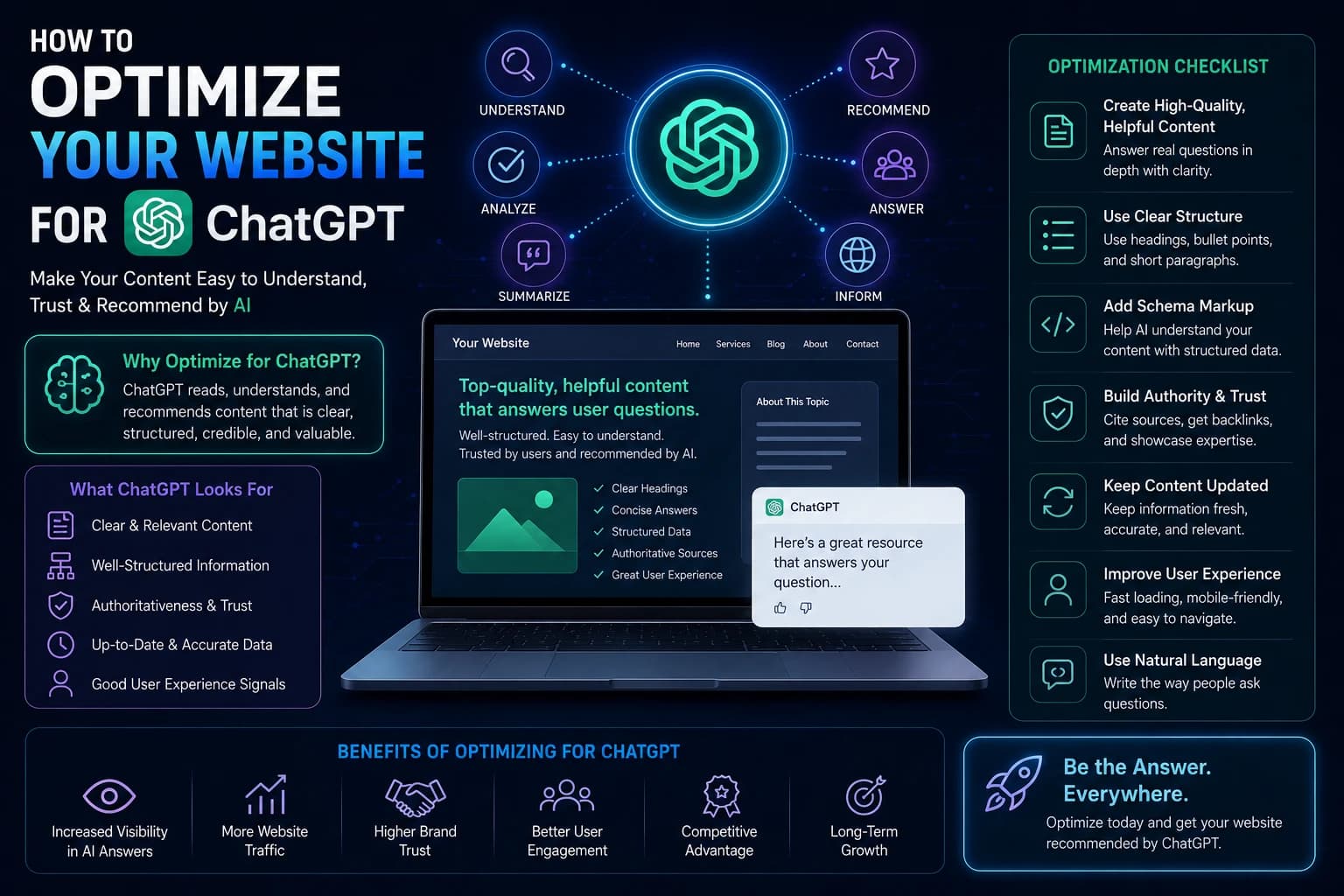
Direct Answer: To optimize your website for ChatGPT, allow AI crawlers in robots.txt, create an /llms.txt file, write BLUF-style answer blocks, use semantic HTML, add Article/FAQ/Organization schema, build entity-rich About and Service pages, and establish strong E-E-A-T signals. AI citations go to websites that are crawlable, structured, factual, and authoritative.
Crawler Access First: If GPTBot or OAI-SearchBot is blocked in your robots.txt, ChatGPT cannot discover or cite your content — full stop.
GPTBot ≠ OAI-SearchBot: They are two distinct bots. GPTBot trains future models; OAI-SearchBot powers live ChatGPT search results. You need to allow both.
Structure Beats Keywords: ChatGPT favors content with clear semantic structure — direct answers, HTML tables, FAQ blocks, and JSON-LD schema — over keyword-dense paragraphs.
Entity Authority Matters: Clearly defining who you are (via Organization, Person, and ProfilePage schema) helps ChatGPT cite you with confidence rather than risk hallucinating your details.
What Does It Mean to Optimize for ChatGPT?
Traditional Google SEO focused on ranking a page on a results page. Optimizing for ChatGPT is fundamentally different. When a user asks ChatGPT "What is the best AI SEO agency in Pakistan?", ChatGPT does not return a list of ten blue links. It generates a single, synthesized, conversational answer — and it cites its sources.
Optimizing for ChatGPT means engineering your website to be the cited source.
This requires a specific blend of technical configuration (crawler access, schema markup) and content architecture (BLUF answers, entity-rich pages, E-E-A-T signals). Understanding this distinction between traditional AEO vs SEO is the critical first step.
ChatGPT Search vs Traditional Google SEO
The underlying goal of both is visibility. But the mechanism is radically different:
Google SEO: An algorithm ranks pages based on relevance, authority, and user experience signals. Users see a list and choose which page to visit.
ChatGPT Search: An LLM reads multiple pages, synthesizes a single answer, and cites the most trustworthy source. Users rarely leave ChatGPT to visit the page.
This means your content must be immediately useful to the AI, not just to a human reader who clicks through. Content that buries its answer 500 words in is not useful to ChatGPT.
How ChatGPT Finds, Reads and Cites Websites
ChatGPT's search capability (powered by OpenAI's search infrastructure) works in a Retrieval-Augmented Generation (RAG) loop:
Crawl: OAI-SearchBot crawls live web pages in real-time when a user submits a search query.
Retrieve: The relevant pages are fetched and their HTML content is extracted.
Augment: The extracted text is injected into the LLM's context window as source material.
Generate: The model synthesizes a response, citing the sources it used.
Your website must be optimized at the Crawl and Retrieve stages. If the crawler cannot access your page, or if the extracted HTML is an unstructured mess, you will never make it to the Generate stage.
GPTBot vs OAI-SearchBot vs ChatGPT-User: The Key Difference
This is one of the most critical and misunderstood distinctions in AISEO. According to OpenAI's crawler documentation, these are three distinct user agents with completely different purposes:
User Agent
Who Deploys It
Primary Purpose
Block to Prevent
GPTBot
OpenAI
Training future GPT language models
Your data being used for model training
OAI-SearchBot
OpenAI
Live ChatGPT search results & citations
Being cited in live ChatGPT answers
ChatGPT-User
OpenAI
Browsing triggered by a specific ChatGPT user
ChatGPT reading a specific URL a user shared
ClaudeBot
Anthropic
Training Claude models and Anthropic research
Your data used in Anthropic's model training
PerplexityBot
Perplexity
Live retrieval for Perplexity answer engine
Appearing in Perplexity citations
The key insight: Most websites that block GPTBot think they are blocking all ChatGPT access. In reality, they may still be crawled by OAI-SearchBot for live search. However, if you want both training visibility and live search citations, you must allow both explicitly.
Step 1: Fix Crawl Access in robots.txt
The very first step is auditing your robots.txt file. If any of the AI user agents are in your Disallow list, fix it immediately.
If there are specific sections you genuinely do not want AI crawlers to access (like a private client portal), disallow only those specific paths rather than blocking the entire bot.
Step 2: Create /llms.txt
An llms.txt file lives at the root of your domain (yourdomain.com/llms.txt). It is a Markdown-formatted file that serves as an AI-readable directory of your most important content. According to the llms.txt proposal, it provides LLMs with a concise, distraction-free overview of your site.
Example llms.txt for Intellectual Clouds:
# Intellectual Clouds

Intellectual Clouds is an AI-first technology consultancy specializing in AI SEO, AI Agents, Salesforce, Cloud Integrations, and Enterprise Automation.

## Core Services
- AI SEO & AEO: /services/ai-seo
- AI Agents: /services/ai-agents
- Salesforce Consultancy: /services/salesforce-consultancy
- Cloud Integrations: /services/cloud-integrations
- Data Analysis: /services/data-analysis

## Key Guides
- AEO vs SEO: /blog/aeo-vs-seo-differences
- Formatting Content for AI Crawlers: /blog/formatting-content-for-ai-crawlers
- E-E-A-T in AEO: /blog/role-of-eeat-in-aeo
- Optimize Website for ChatGPT: /blog/optimize-website-for-chatgpt
Step 3: Use BLUF Answer Formatting
BLUF stands for Bottom Line Up Front. AI models extract direct answers fastest when the answer is at the top of the section, not buried after three paragraphs of context.
For every H2 and H3 heading on your page, the very next paragraph should be a 40-to-60 word direct answer. This is the format ChatGPT itself uses when it cites content. If your answer matches what the AI needs to say, it will quote or paraphrase you.
Step 4: Add Semantic HTML
AI crawlers strip away your CSS and JavaScript. If your content relies on visual formatting for structure, the AI sees chaos. Use proper HTML5 semantic tags:
<article> — wraps your main blog content
<section> — separates distinct topic areas
<h2> / <h3> — define the chunk boundaries for AI extraction
<table> — used for all comparative data, specifications, or multi-column information
<details> / <summary> — for FAQ accordions (native, AI-readable, no JS required)
JSON-LD schema is the most direct way to communicate facts to an AI engine. It removes ambiguity entirely. ChatGPT uses schema to verify facts before including them in a generated answer.
Priority schema types for ChatGPT optimization:
{
  "@context": "https://schema.org",
  "@type": "Organization",
  "name": "Intellectual Clouds",
  "url": "https://intellectualclouds.com",
  "description": "AI SEO, AI Agents and Salesforce consultancy",
  "contactPoint": {
    "@type": "ContactPoint",
    "contactType": "customer service",
    "url": "https://intellectualclouds.com/contact"
  }
}
Beyond Organization, implement Article, FAQPage, BreadcrumbList, and HowTo schema on every appropriate page. This ensures that when ChatGPT reads your page, it has a machine-verified fact sheet to draw from.
Step 6: Build Entity-Rich About and Service Pages
ChatGPT is an entity-based model. It understands the world through named entities and the relationships between them. If your About page is a vague, flowery paragraph about "passionate professionals," ChatGPT cannot reliably extract facts about your business.
Restructure your About and Service pages to be explicitly factual:
Company Name: Intellectual Clouds
Founded: [Year]
Specializations: AI SEO, AI Agents, Salesforce, Cloud Integrations
Headquarters: [City, Country]
Key Team Members: [Names and Roles with LinkedIn links]
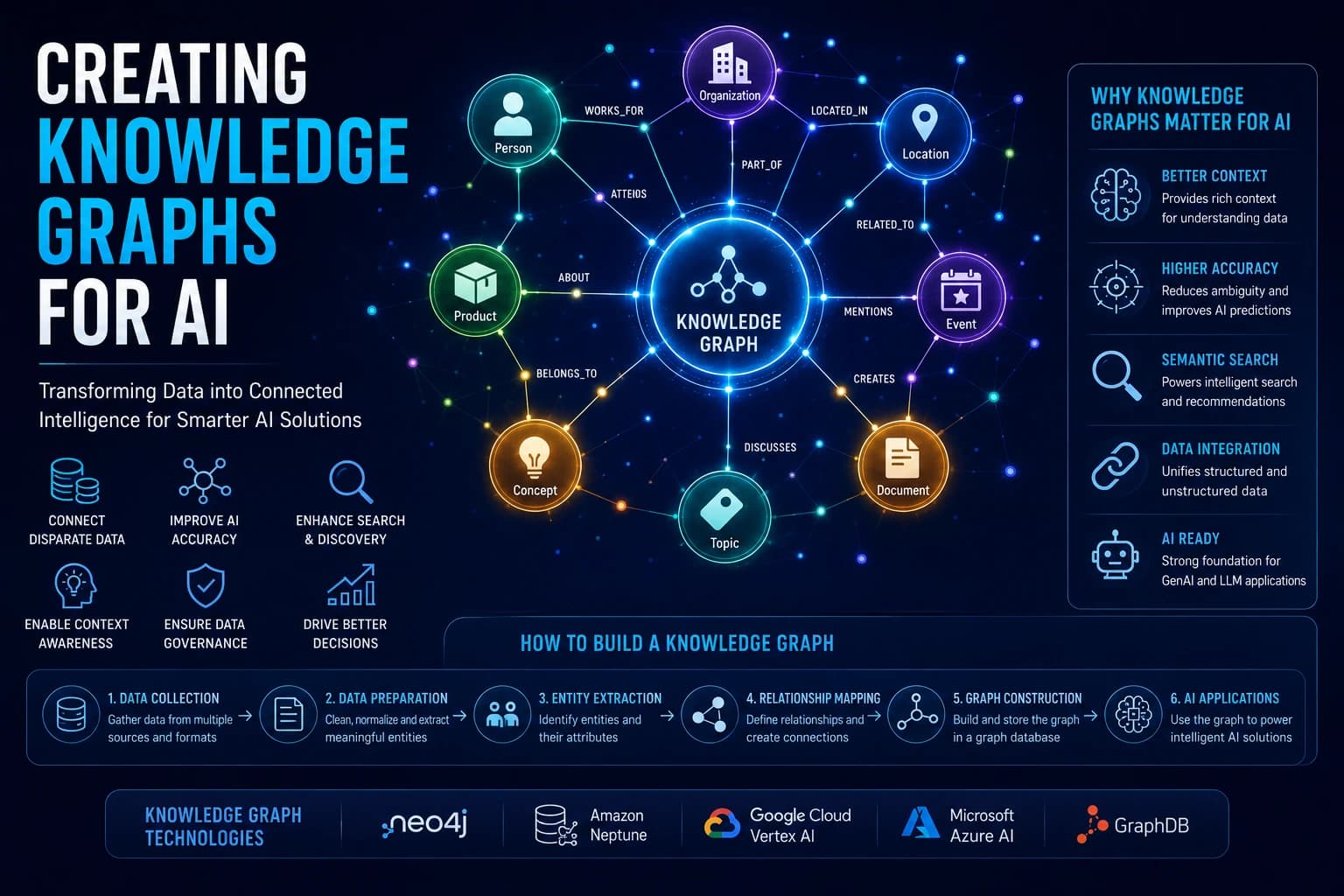
This is also how you build a knowledge graph — by establishing clear entity relationships that AI systems can map.
Step 7: Add FAQ Blocks for Conversational Queries
ChatGPT users ask conversational questions. If your page contains a well-structured FAQ section (paired with FAQPage schema), you are essentially pre-loading the exact Q&A pairs that ChatGPT needs to formulate its answer.
For every key topic on your page, anticipate the follow-up questions a user might ask and include them as FAQ items.
Step 8: Improve Internal Linking and Topic Clusters
Internal links teach AI crawlers the semantic relationships between your pages. A link from this article to the E-E-A-T in AEO guide signals that these two concepts are connected. Over time, this creates a topical cluster — a tightly-linked network of content around a core theme that AI systems recognize as comprehensive coverage of a subject.
Always use descriptive anchor text for internal links. Avoid "click here" or "read more." Use the specific, keyword-rich topic name as the anchor.
Step 9: Add Author, Company and E-E-A-T Signals
AI engines are not just looking for information — they are looking for trustworthy information. Optimizing for ChatGPT means implementing the E-E-A-T principles visibly across your site.
Every article should display:
Author name, title, and profile photo
A link to the author's LinkedIn or professional profile
The published and last-updated date
External citations linking to trusted sources
An Organization schema connecting your brand to verifiable data points
This matters because AI engines can hallucinate brand facts if your entity information is unclear. Providing a complete, verified entity profile prevents AI hallucinations about your brand.
Step 10: Monitor Server Logs for AI Crawlers
How do you know if ChatGPT is actually visiting your site? Check your server access logs for the following user agent strings:
OAI-SearchBot — live ChatGPT search crawl
GPTBot — OpenAI training crawl
ChatGPT-User — user-triggered browsing
ClaudeBot — Anthropic crawl
PerplexityBot — Perplexity live retrieval
If you see these in your logs, your site is being actively indexed by AI systems. If you do not, your robots.txt is blocking them, your server is returning errors, or your content is rendering via JavaScript that the bots cannot execute.
Make Your Website Discoverable in ChatGPT Search
Intellectual Clouds helps businesses optimize websites for ChatGPT, Perplexity, Claude and AI Overviews using crawler access, schema markup, llms.txt, entity architecture and AISEO content systems.
Blocking only GPTBot: Thinking this prevents all ChatGPT crawling. OAI-SearchBot is a separate bot — and it is the one that powers live ChatGPT search results.
No llms.txt: Leaving AI agents to figure out your site's structure by themselves instead of giving them a clear, curated directory.
Client-side rendered content: Important facts about your services hidden inside React components that only load after JavaScript executes are invisible to many AI crawlers.
Vague entity pages: An "About Us" page full of adjectives ("passionate," "innovative," "cutting-edge") with no specific, verifiable facts is useless for AI citation.
No FAQPage schema: Having FAQ content on the page but no corresponding schema, meaning AI cannot efficiently extract Q&A pairs.
ChatGPT Optimization Checklist
✓ Allow OAI-SearchBot and GPTBot in robots.txt
✓ Publish /llms.txt at your domain root with a Markdown site summary
✓ Add BLUF answer blocks (40-60 words) following every major H2 heading
✓ Use semantic HTML5 tags (article, section, h2, table)
✓ Serve all critical content as server-side rendered (SSR) HTML
✓ Build entity-rich About, Service, and Team pages
✓ Include author bios, credentials, and Person/ProfilePage schema
✓ Monitor server logs for OAI-SearchBot, GPTBot, ChatGPT-User entries
✓ Build internal topic clusters with descriptive anchor text
Frequently Asked Questions
What is ChatGPT SEO?
ChatGPT SEO (also called AISEO or AEO) is the practice of structuring website content so that ChatGPT and other AI-powered search engines can crawl, understand, and cite your website in their generated answers.
Does ChatGPT browse live websites?
Yes. When ChatGPT search is enabled, OAI-SearchBot crawls live websites in real-time to retrieve up-to-date information for user queries. This makes live website optimization critical for AI citations.
What is OAI-SearchBot?
OAI-SearchBot is OpenAI's web crawler used specifically for ChatGPT's live search functionality. It retrieves real-time web content to power ChatGPT search results and citations. It is distinct from GPTBot, which is used for model training.
What is GPTBot?
GPTBot is OpenAI's web crawler used to collect training data for future GPT language models. Blocking GPTBot prevents your content from influencing future model training, but it does NOT block ChatGPT from using your site for live search results.
Should I allow ChatGPT crawlers?
If your goal is to appear in ChatGPT's answers and gain AI-driven traffic and citations, yes. Allow OAI-SearchBot for live search visibility and GPTBot for long-term model training influence.
What is llms.txt?
llms.txt is a markdown-formatted file hosted at your domain root. It provides AI agents with a clean, curated summary of your website's content, services, and key pages — similar to how robots.txt guides crawlers, but specifically designed for Large Language Models.
Does schema help ChatGPT understand my website?
Yes, significantly. JSON-LD schema provides explicitly structured facts that AI models can read without interpreting ambiguous prose. Article, Organization, and FAQPage schemas are particularly effective for establishing brand facts and service descriptions.
How do I know if ChatGPT visited my site?
Check your server access logs for user agent strings including "OAI-SearchBot", "GPTBot", or "ChatGPT-User". You can also monitor referral traffic from chatgpt.com in your analytics platform.
How can I get my website cited by ChatGPT?
Allow AI crawlers, publish an llms.txt, implement schema markup, write BLUF-style direct answer content, build E-E-A-T authority signals, and monitor your server logs to confirm crawler access. Consistency and factual accuracy are essential for earning AI citations.
How can Intellectual Clouds help with AISEO?
Our AI SEO services include full AISEO audits, schema architecture, llms.txt deployment, entity optimization, and ongoing monitoring of AI crawler activity on your website.
How Intellectual Clouds Can Help
Optimizing for ChatGPT requires deep technical expertise across schema markup, entity architecture, content strategy, and server configuration. At Intellectual Clouds, we have built a systematic AISEO framework that addresses every layer of the AI citation pipeline — from robots.txt configuration to knowledge graph construction.
Our AI SEO services are designed specifically for organizations that understand that the next wave of organic traffic will not come from Google's ten blue links — it will come from a single ChatGPT answer that recommends your brand to millions of users.
Conclusion
Optimizing your website for ChatGPT search is not optional in 2026 — it is an urgent strategic priority. The businesses that will win AI-driven visibility are those that make their websites structurally transparent, factually accurate, and explicitly entity-rich. Allow the right crawlers, create an llms.txt, format your content for direct extraction, and back every claim with schema markup. The result will be a website that AI search engines trust and reliably cite.
Make Your Website Discoverable in ChatGPT Search
Intellectual Clouds helps businesses optimize websites for ChatGPT, Perplexity, Claude and AI Overviews using crawler access, schema markup, llms.txt, entity architecture and AISEO content systems.
Asim Ansari is the Founder of Intellectual Clouds and a Certified Salesforce Administrator and Pardot Specialist with 17+ years of experience across Salesforce CRM, AI automation, cloud infrastructure (AWS), and digital transformation. He writes on AI agents, Salesforce delivery, Answer Engine Optimisation (AEO), and AI-accelerated business operations.