HomeBlogAI Infrastructure Best Practices 2026: Scalable, Secure Enterprise Guide
AI Engineering
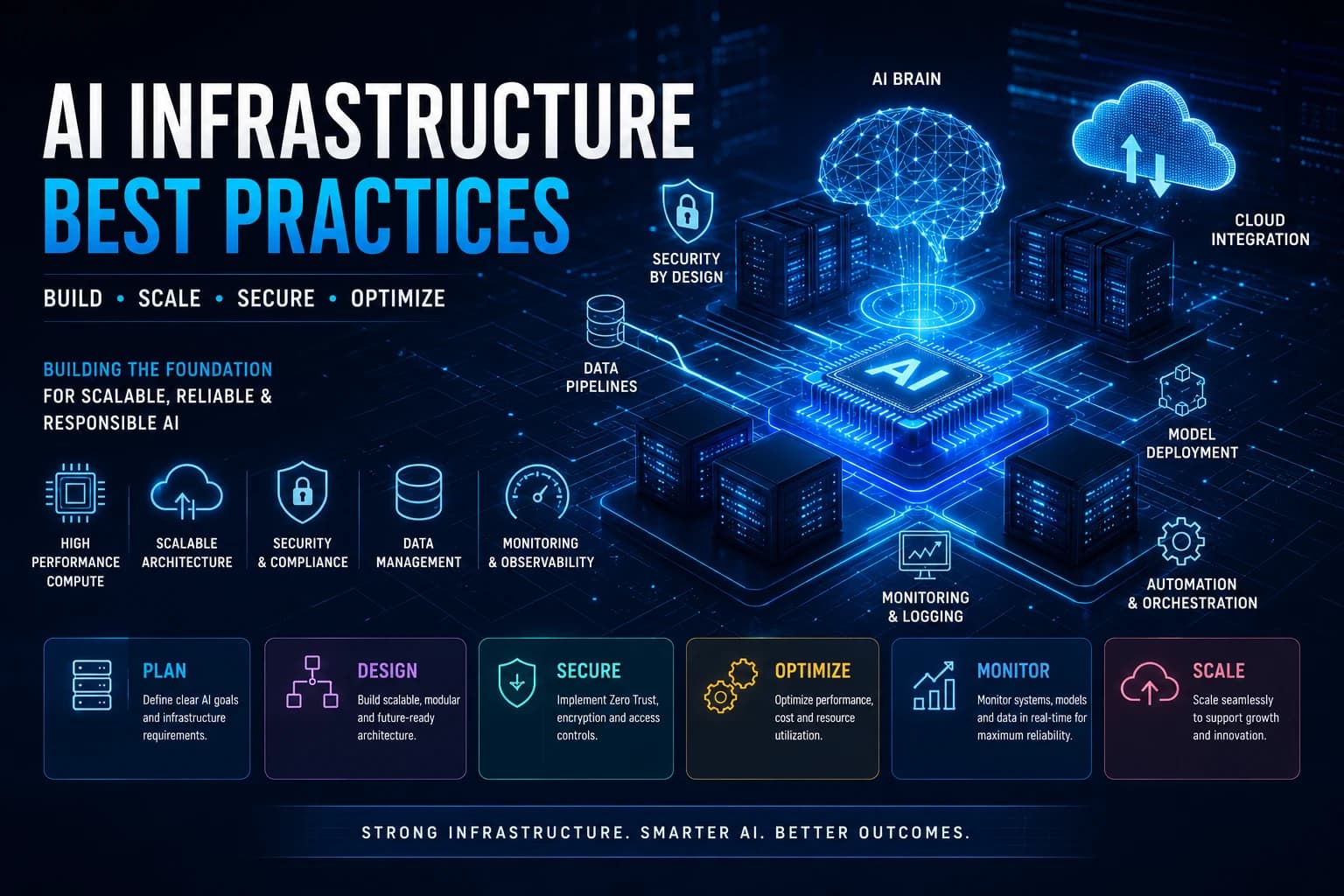
AI Infrastructure Best Practices 2026: Scalable, Secure Enterprise Guide
Asim Ansari
June 24, 2026
20 min read
Learn AI infrastructure best practices for 2026, including GPU planning, MLOps, security, observability, cost optimization, data pipelines, scalability and disaster recovery.
Quick Answer
AI infrastructure best practices include designing scalable compute, secure data pipelines, GPU/accelerator planning, MLOps automation, continuous model monitoring, strict cost controls, disaster recovery, enterprise governance, and full-stack observability. A robust AI infrastructure must support experimentation, model training, deployment, real-time inference, automated retraining, compliance, and continuous performance evaluation without operational bottlenecks.
Detailed implementation of MLOps pipelines (CI/CD/CT).
Security and governance frameworks based on NIST and AWS Well-Architected ML Lens.
Cost optimization strategies for training and inference.
AI Infrastructure Best Practices 2026: A Complete Enterprise Guide
Moving a machine learning model from a Jupyter Notebook sandbox to a highly available, enterprise-grade production environment requires a fundamental shift in architecture. The infrastructure must handle enormous data ingestion, distributed computing, unpredictable inference traffic, and stringent security—often while balancing astronomical GPU costs.
In 2026, generative AI demands unprecedented scale. Organizations can no longer rely on ad-hoc servers; they need resilient, observable, and automated AI Infrastructure.
Scale Your AI Systems Confidently
Intellectual Clouds helps businesses design secure, scalable and cost-efficient AI infrastructure with cloud architecture, MLOps, observability, governance, data pipelines and production-ready deployment support.
AI infrastructure is the complete technology stack—hardware and software—required to build, test, deploy, monitor, and maintain machine learning and generative AI models.
It encompasses the foundational compute layer (CPUs, GPUs, TPUs, network bandwidth), the data storage layer (data lakes, vector databases, feature stores), the operational orchestration layer (MLOps, Kubernetes), and the governance and security layer.
Why AI Infrastructure Matters in 2026
The AWS Well-Architected Machine Learning Lens establishes that AI/ML workloads must be designed for operational excellence, security, reliability, performance efficiency, cost optimization, and sustainability.
Without proper AI infrastructure, organizations experience:
Model Decay: Without MLOps and Continuous Training (CT), models drift from reality as data profiles change.
Security Vulnerabilities: Improperly secured RAG pipelines can lead to data exfiltration or prompt injection attacks.
Deployment Bottlenecks: A lack of CI/CD means new models take months to reach production.
AI Infrastructure Architecture: From Data to Deployment
A modern AI architecture is an interconnected pipeline.
Standard AI Infrastructure Architecture
1. Data Engineering
Data Lake, Vector DB, Feature Store
→
2. MLOps Pipeline
CI/CD, Training, Model Registry
→
3. Deployment
Kubernetes, Endpoints, Load Balancers
→
4. Observability
Drift, Latency, Auth, Telemetry
The 10 Best Practices for AI Infrastructure
Best Practice 1: Start With Clear Workload Requirements
Do not simply provision A100 or H100 GPUs without sizing your workload. Training, fine-tuning, batch processing, and real-time inference have vastly different requirements.
Training: Requires high-bandwidth interconnects (like NVLink) and massive VRAM.
Inference: Requires low-latency networking, autoscaling, and often smaller, optimized GPUs (like L4s or T4s).
Batch Processing: Can utilize spot instances or preemptible VMs to save money, as latency is not critical.
Best Practice 2: Choose the Right Compute
Area
Best Practice
Why It Matters
Compute
GPU/TPU/CPU workload matching
Cost aur performance balance hota hai (Balances cost and performance).
Data
Clean, versioned pipelines
Model quality stable rehti hai (Maintains stable model quality).
MLOps
CI/CD/CT pipelines
Deployment repeatable hoti hai (Ensures repeatable deployments).
Security
IAM, encryption, private networking
Sensitive data protect hota hai (Protects sensitive corporate data).
Observability
Logs, metrics, traces, model drift
Failures jaldi detect hoti hain (Detects failures rapidly).
Cost
Autoscaling, right-sizing, quotas
AI spend control hota hai (Controls runaway AI spending).
Reliability
Backup, DR, failover
Business continuity improve hoti hai (Improves business continuity).
Best Practice 3: Build Reliable Data Pipelines
Garbage in, hallucination out. Your architecture must define a Data Lake/Lakehouse for raw data, a Feature Store for traditional ML, and a Vector Database (like Pinecone or Milvus) for Generative AI / RAG workloads. Keep data, model artifacts, and prompts rigidly version-controlled.
Best Practice 4: Use MLOps for CI/CD/CT
According to Google Cloud MLOps documentation, production ML systems must include data validation, model validation, continuous training (CT), metadata management, and model monitoring alongside standard CI/CD.
If data distributions shift (Data Drift) or the relationship between inputs and outputs changes (Concept Drift), the model's accuracy decays. Continuous Training triggers automatic retraining pipelines when performance drops below a threshold.
Best Practice 5: Secure Models, Data and APIs
Security is not just an application-layer concern.
Isolate AI workloads in private subnets (VPCs).
Enforce strict IAM (Identity and Access Management) roles so inference containers only access necessary buckets.
Encrypt model artifacts at rest.
For generative inference APIs, implement strict rate limiting, robust authentication, logging, and automated prompt abuse detection to mitigate prompt injection.
Best Practice 6: Add Observability and Model Monitoring
Google notes that models can silently decay without throwing traditional 500 errors. You must implement a dual-layer observability strategy:
Monitoring Layer
What to Track
Infrastructure
CPU utilization, GPU memory usage, network bandwidth, disk I/O
Schema changes, missing values, data quality, vector index freshness
Cost
Spend per model, spend per inference request, idle GPU time
Security
IAM access logs, prompt abuse, data exfiltration attempts
Best Practice 7: Optimize AI Infrastructure Cost
Compute costs can destroy an AI project's ROI. To optimize, use:
Autoscaling: Scale to zero during off-peak hours for inference endpoints.
Quantization: Serve quantized models (e.g., INT8 instead of FP16) to reduce VRAM requirements.
Spot Instances: Use preemptible instances for non-urgent batch training.
Batching: Configure dynamic batching on inference servers (like Triton or vLLM) to increase GPU utilization.
Best Practice 8: Plan for Scalability and Performance
In RAG systems, monitor the freshness of your vector index and your chunking strategy. A fast LLM is useless if the retrieval pipeline is the bottleneck. Ensure your deployment targets (like Kubernetes or Vertex AI) are configured for multi-zone redundancy.
Best Practice 9: Add Disaster Recovery and Backup
An AI system requires specific disaster recovery (DR) planning beyond standard database backups.
Backup your Model Registry.
Maintain Infrastructure-as-Code (IaC) templates for rapid redeployment.
Define a clear rollback strategy for model versions in case an update causes severe performance degradation.
Best Practice 10: Govern AI Risk and Compliance
The NIST AI Risk Management Framework (RMF) mandates that AI risk extends to individuals, organizations, and society. AI infrastructure planning must include trustworthiness, design validation, and evaluation. Governance means implementing Model Cards, requiring manual approval workflows for high-risk deployments, keeping audit trails for prompt/model changes, and maintaining a centralized AI risk register.
Cloud vs On-Prem vs Hybrid AI Infrastructure
Infrastructure Type
Best For
Limitation
Cloud AI Infrastructure
Fast scaling, managed MLOps services
Ongoing OPEX cost control zaroori hai (Strict monitoring needed)
On-Prem AI Infrastructure
Total data control, predictable continuous workloads
Extremely high upfront hardware & maintenance cost
Hybrid AI Infrastructure
Regulated industries, mixed data privacy workloads
Severely limited compute capacity and battery drain
Common Mistakes in AI Infrastructure
Avoid these critical failures when architecting your enterprise AI:
Buying GPUs without workload sizing.
Deploying models without setting up continuous monitoring.
Failing to version control datasets alongside model code.
Forgetting to set strict cloud cost alerts and quotas.
Limiting security to the app layer, leaving the data lakes exposed.
Failing to update and prune the vector database (causing stale RAG context).
Keeping no audit trail for prompt engineering or model architecture changes.
Skipping sandbox/staging environments in the rush to production.
Operating without an AI disaster recovery plan.
Thinking about AI governance only after a catastrophic failure occurs.
AI Infrastructure Deployment Checklist
Verify these steps before releasing a model into production.
Build Scalable AI Infrastructure With Intellectual Clouds
Intellectual Clouds helps businesses design secure, scalable and cost-efficient AI infrastructure with cloud architecture, MLOps, observability, governance, data pipelines and production-ready deployment support.
AI infrastructure refers to the hardware (GPUs, networking) and software stack (MLOps, data lakes, registries) required to develop, test, deploy, and maintain machine learning models reliably at scale.
What are AI infrastructure best practices?
Key practices include matching compute resources to workload needs, deploying automated MLOps pipelines (CI/CD/CT), enforcing strict IAM security, establishing comprehensive model monitoring, and planning for disaster recovery.
What infrastructure is needed for generative AI?
Generative AI requires massive GPU/TPU compute, a robust vector database for Retrieval-Augmented Generation (RAG), a low-latency network for serving tokens, and rigorous prompt security frameworks.
Is cloud or on-prem better for AI infrastructure?
Cloud offers rapid scaling, managed MLOps, and immediate access to the latest GPUs. On-prem is better for highly regulated industries requiring absolute data sovereignty and for predictable, 24/7 continuous training workloads where hardware amortization is cheaper.
How do I reduce AI infrastructure cost?
Implement endpoint autoscaling, utilize spot instances for offline batch jobs, apply model quantization (e.g., INT8) to use cheaper GPUs, enforce hard spending quotas, and continuously monitor GPU idle times.
Why is MLOps important for AI infrastructure?
MLOps bridges the gap between data science and IT operations. Without MLOps, models cannot be reliably updated, tested, or deployed automatically, leading to slow release cycles and model decay in production.
What should I monitor in AI systems?
You must monitor hardware metrics (CPU/GPU load), model performance (latency, concept drift, accuracy), data quality (schema changes, missing values), and financial metrics (cost-per-token or inference request).
How do I secure AI infrastructure?
Enforce strict Identity and Access Management (IAM), run models in private Virtual Private Clouds (VPCs), encrypt data at rest, implement API rate limiting, and deploy specialized detection for prompt injection attacks.
What is the role of GPUs in AI infrastructure?
GPUs (Graphics Processing Units) handle the massive parallel mathematical operations required for neural networks. High-VRAM GPUs (like H100s) are used for training, while optimized GPUs (like L4s) are better suited for inference.
Can Intellectual Clouds help build AI infrastructure?
Yes. Intellectual Clouds provides comprehensive cloud architecture and AI engineering services, helping enterprises build secure, scalable, and cost-optimized infrastructure pipelines for generative and predictive AI.
Asim Ansari is the Founder of Intellectual Clouds and a Certified Salesforce Administrator and Pardot Specialist with 17+ years of experience across Salesforce CRM, AI automation, cloud infrastructure (AWS), and digital transformation. He writes on AI agents, Salesforce delivery, Answer Engine Optimisation (AEO), and AI-accelerated business operations.