⚡ Quick Answer: What Is the AI Energy War?
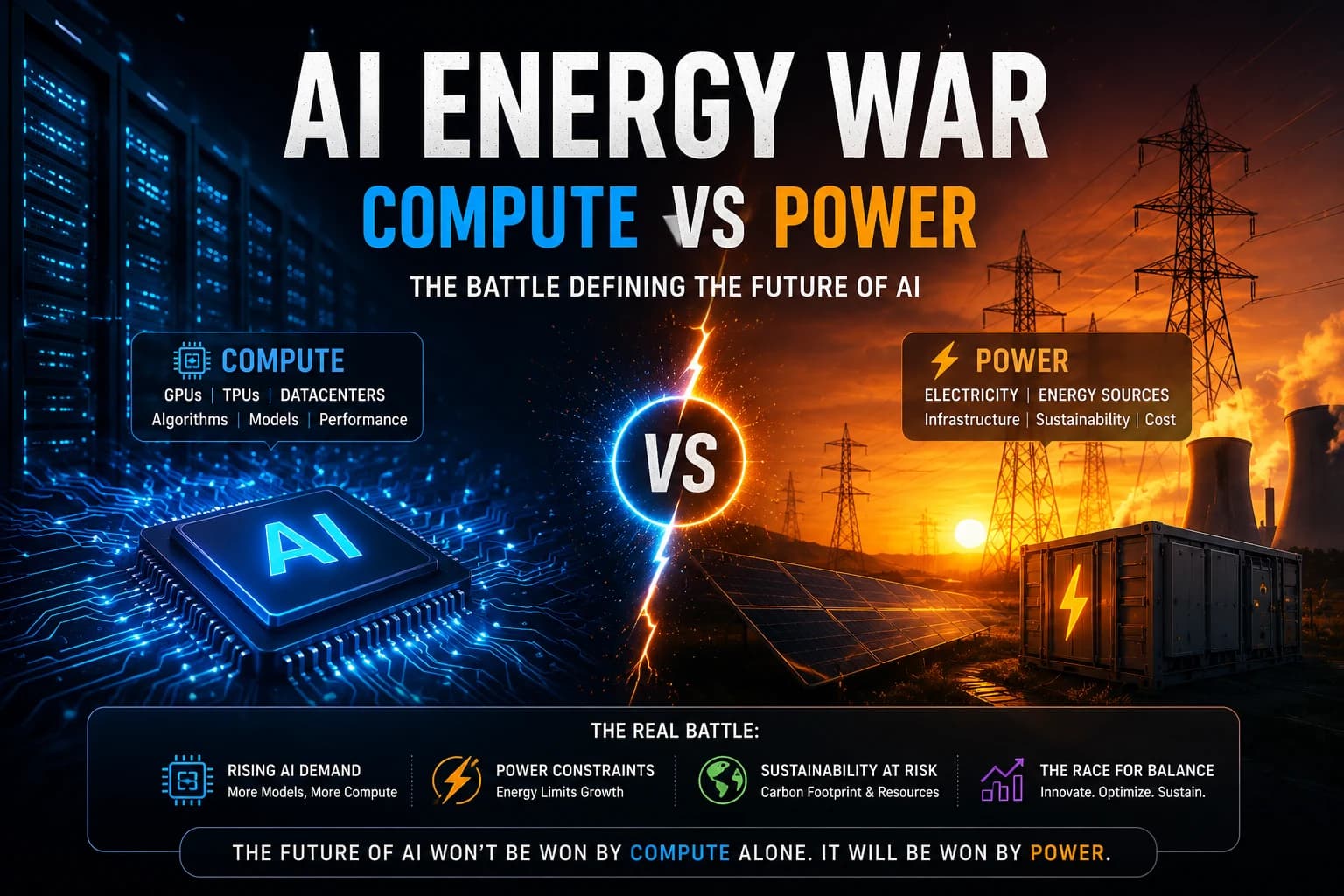
The AI energy war refers to the shift from competing over GPUs and compute capacity to competing over electricity, cooling, grid access, and reliable energy supply. As AI models and data centers scale, the biggest constraint is no longer only chips — it is whether companies can secure enough affordable, stable, and low-carbon power to run AI infrastructure at global scale.
Key Takeaways
- • Phase 1 was GPUs: The first AI arms race was about acquiring NVIDIA chips, H100 clusters, and raw compute capacity. That phase is maturing.
- • Phase 2 is electricity: Goldman Sachs projects data center power demand may grow 160% by 2030. Energy is the new compute bottleneck.
- • A ChatGPT query uses ~10x the energy of a Google search: At scale, inference energy costs dwarf training costs within any enterprise AI deployment.
- • Big Tech is buying nuclear power: Microsoft's Three Mile Island deal and Google's nuclear investments signal a fundamental shift in AI infrastructure strategy.
- • Joules per Token is the new KPI: Energy efficiency, not just FLOPS, will define which enterprises win the next AI wave.
1. Introduction: AI's Next Bottleneck Is Not GPUs — It's Electricity
For three years, the dominant narrative in artificial intelligence was simple: whoever controls the GPUs, controls the future. Companies spent billions acquiring NVIDIA H100s. Cloud providers raced to build GPU clusters. Startups pivoted entire business models around chip access. Compute was the scarce resource. Compute was the moat.
That era is closing.
A new bottleneck has emerged — one that is older, larger, and far harder to solve than a semiconductor supply chain problem. That bottleneck is electricity.
AI agents are becoming ambient infrastructure. Every enterprise search, every customer service automation, every real-time recommendation engine now runs on inference. And inference runs on power. As AI workloads scale from experimental to operational, the organizations building the most powerful AI infrastructure are not asking "How many GPUs can we get?" They are asking: "How many megawatts can we secure?"
This is the AI Energy War — and it will shape the next decade of technology, business, and national strategy.
2. What Is the AI Energy War?
The AI Energy War is not a metaphor. It is a real, ongoing competition between hyperscalers, nation-states, energy utilities, and enterprise technology buyers for access to reliable, affordable, and scalable electricity to power AI infrastructure.
Just as the first AI arms race produced GPU shortages, export controls on chips, and trillion-dollar valuations for compute providers, the second AI arms race is producing:
- Data center construction backlogs stretching years into the future
- Nuclear power deal signings by Microsoft, Google, Amazon, and Oracle
- Grid stress tests in Virginia (the world's largest data center market), Ireland, Singapore, and the Netherlands
- National AI energy strategies embedded in the U.S. CHIPS Act, EU AI Act, and India's emerging AI policy framework
The companies and countries that solve the power problem will own the AI economy of the 2030s. Those that don't will find their AI ambitions constrained — not by the availability of large language models, but by the availability of electrons.
3. Phase 1: The Compute War (2020–2024)
To understand why energy matters now, we must understand what came before.
The Compute War was ignited by the release of GPT-3 in 2020 and supercharged by ChatGPT in late 2022. Suddenly, every company understood that AI capabilities were directly proportional to the number of parameters a model could process — and parameters required compute.
The defining resource of Phase 1 was the NVIDIA H100 GPU, which cost between $25,000 and $40,000 per unit. Cloud providers and hyperscalers ordered them by the hundreds of thousands. Microsoft, Google, Meta, and Amazon collectively spent over $200 billion on AI infrastructure between 2022 and 2024.
The success metric of Phase 1 was simple: FLOPS (floating point operations per second). How fast could your cluster train? How many tokens per second could you generate?
Phase 1 achievements included:
- GPT-4, Gemini Ultra, Claude 3 — frontier models requiring clusters of 10,000–25,000 H100s
- The emergence of AI cloud platforms (Azure AI, Google Vertex, AWS Bedrock)
- A GPU shortage that lasted nearly two years
- NVIDIA's market cap crossing $3 trillion
But as training compute scaled, a new problem became impossible to ignore: inference.
4. Phase 2: The Battle for Power (2024–2030)
Training a frontier model once is expensive. Running it a billion times a day is catastrophically expensive — in electricity.
The transition from Phase 1 to Phase 2 is driven by the shift from training to inference at scale. When AI moves from research labs into production — powering search engines, customer service platforms, coding assistants, healthcare diagnostics, and financial analysis tools — the number of queries per second explodes. And each query burns electricity.
Phase 2 success metrics are different from Phase 1:
- Not FLOPS — but Joules per Token (energy efficiency of inference)
- Not GPU count — but Megawatts secured and Power Usage Effectiveness (PUE)
- Not cluster size — but grid reliability and carbon intensity of power supply
The winners of Phase 2 will not simply own the best models. They will own the most efficient AI infrastructure, the smartest cloud architecture, and the most reliable energy strategy.
5. Why AI Data Centers Consume So Much Electricity
A traditional enterprise data center might consume 1–5 megawatts of power. A modern AI hyperscale data center can consume 100–500 megawatts — the equivalent of powering a mid-sized city.
The electricity demand comes from three primary sources:
Compute: GPUs Running Hot
Modern AI accelerators like the NVIDIA H100 consume 700 watts each under full load. A single rack of 8 H100s draws 5.6 kilowatts continuously. A cluster of 10,000 H100s — the minimum required for training a frontier model — consumes 7 megawatts continuously, 24/7, 365 days a year.
Cooling: The Hidden Energy Tax
For every watt of compute power consumed, an equal amount of heat must be removed. Traditional air cooling adds 30–50% overhead to total data center energy consumption. Liquid cooling reduces this overhead but requires expensive retrofitting. The most advanced AI data centers are experimenting with immersion cooling — submerging server hardware directly in dielectric fluid — to achieve PUE ratings below 1.1.
Networking: The Invisible Load
The interconnects between GPU clusters — InfiniBand switches, optical transceivers, and high-speed networking fabrics — add another 10–15% to total data center energy consumption. At hyperscale, this becomes non-trivial.
6. Training vs. Inference: The Real Energy Equation
A common misconception frames AI energy consumption as primarily a training problem. In reality, inference is where the energy math becomes alarming at scale.
| Factor | Training | Inference |
|---|
| Frequency | Once (or periodically) | Billions of times per day |
| Energy per Run | Very high (single event) | Low per query, catastrophic at scale |
| Cumulative Cost | Bounded (one-time CapEx) | Unbounded (ongoing OpEx) |
| Business Risk | High upfront capital | Energy cost volatility, grid dependency |
| Optimization Lever | Compute efficiency, mixed precision | Model distillation, quantization, caching |
According to Goldman Sachs research, a single ChatGPT query consumes approximately 2.9 Wh of electricity — roughly 10 times the energy used by a standard Google Search query (0.3 Wh). This differential seems small at the individual query level. At the scale of hundreds of millions of daily users, it becomes a civilization-level energy problem.
7. The Phase 1 vs. Phase 2 Comparison Table
| AI Bottleneck Dimension | ⚙️ Phase 1: Compute War | ⚡ Phase 2: Energy War |
|---|
| Main Resource | GPUs, chips, compute clusters | Electricity, cooling, grid access |
| Success Metric | FLOPS, H100 count, parameter scale | Joules/Token, PUE, uptime, power cost |
| Main Players | NVIDIA, cloud providers, AI labs | Utilities, nuclear operators, renewables, grid operators |
| Primary Constraint | Chip manufacturing & supply chain | Power availability, grid capacity, permitting |
| Business Risk | High CapEx, chip shortage delays | Energy cost volatility, grid delay, carbon emissions |
| Geopolitical Dimension | Chip export controls (US–China) | Grid sovereignty, energy independence |
| Time Horizon | 2020–2024 (peak phase) | 2024–2035 (accelerating) |
8. Why Context Windows, Agents, and Video AI Multiply Energy Use
The energy problem is not static. Several emerging AI capability vectors are dramatically increasing per-query energy costs:
Long Context Windows: Models like Google Gemini 1.5 Pro with 1 million token context windows require significantly more compute per inference pass. Processing 1M tokens consumes approximately 50–100x more energy than processing a standard 4K-token query.
AI Agents: Autonomous AI agents running multi-step tasks do not perform a single inference — they chain dozens to hundreds of inference calls together in a single task execution. A complex AI agent workflow might consume as much electricity as 500 individual chat queries.
Video AI: Training and inference on video data is orders of magnitude more energy-intensive than text. OpenAI's Sora-class video generation models require massive GPU clusters and consume energy at rates that make LLM training look modest by comparison.
Multimodal Search: When AI systems process image + text + audio simultaneously, energy costs per query multiply accordingly. The AI SEO implications are significant: AI-powered search is far more energy-intensive than traditional keyword matching.
9. Data Centers vs. Power Grids: A Collision Course
The electricity grid was not designed for AI. Most national grids were architected around gradual, predictable load growth driven by residential and industrial consumers. AI data centers represent a qualitatively different kind of load:
- Density: AI data centers require 10–50x the power density of traditional facilities per square meter
- Predictability: GPU workloads can spike from 0% to 100% utilization in milliseconds, creating grid instability
- Scale: A single hyperscale AI campus can consume as much power as 200,000 homes
According to the U.S. Department of Energy, American data centers consumed approximately 4.4% of total U.S. electricity in 2023, and this figure may reach 6.7% to 12% by 2028 — driven primarily by AI workloads. This projection does not account for the announced investment plans of Microsoft ($80B), Google ($75B), Amazon, and Meta for 2025 alone.
In Northern Virginia — home to the largest concentration of data centers on Earth — utility provider Dominion Energy has reported grid capacity constraints that are slowing data center construction approvals. Similar stories are playing out in Ireland, Singapore, the Netherlands, and the Australian East Coast.
The grid is becoming a bottleneck to AI deployment.
10. Why Big Tech Is Turning to Nuclear Power
The most dramatic signal of the AI energy war's intensity is the re-emergence of nuclear power as a preferred energy source for AI infrastructure.
Nuclear power offers something that wind and solar cannot reliably provide: firm, 24/7, zero-carbon baseload electricity. For hyperscalers with aggressive sustainability commitments and insatiable power appetites, this is an extraordinarily valuable combination.
Key nuclear deals in AI infrastructure:
| Company | Nuclear Initiative | Capacity / Detail |
|---|
| Microsoft | Three Mile Island restart (Constellation Energy deal) | 835 MW, 20-year PPA signed 2023 |
| Google | Small Modular Reactor (SMR) agreement with Kairos Power | 500 MW from multiple SMRs by 2035 |
| Amazon | Acquired 960-acre nuclear-adjacent data center campus | Susquehanna nuclear plant, Pennsylvania |
| Oracle | Plans to power AI data centers with SMRs | Announced 2024, three SMR commitment |
| OpenAI / Sam Altman | Invested in Oklo (next-gen fission startup) | Personal investment + strategic alignment |
Microsoft's Three Mile Island deal is particularly symbolic. The same plant that became synonymous with nuclear danger in 1979 is now being restarted specifically to power artificial intelligence — the most transformative technology of the 21st century. As reported by Politico, this deal signals that nuclear power has been rehabilitated as a credible AI energy source.
11. Renewables, Batteries, and the 24/7 Power Problem
If nuclear represents one solution to AI's power problem, renewables represent another — but with a critical caveat: intermittency.
Solar panels generate power during daylight. Wind turbines generate power when the wind blows. AI data centers require power continuously, 24 hours a day, 7 days a week, 365 days a year. A hyperscale AI campus cannot simply "pause" its GPU clusters when the sun sets.
This creates what energy analysts call the "24/7 clean power problem." Several solutions are emerging:
Long-Duration Battery Storage: Companies like Form Energy are developing iron-air batteries capable of storing electricity for 100+ hours. If economics improve, large-scale battery arrays could buffer renewable intermittency for AI data centers.
Power Purchase Agreements (PPAs) + RECs: Many hyperscalers purchase Renewable Energy Certificates to offset their carbon footprint without requiring real-time renewable matching. This approach satisfies accounting requirements but does not solve physical grid dependency.
Hydrogen Fuel Cells: Microsoft has tested hydrogen fuel cell backup systems for data center power resilience. Hydrogen produced from surplus renewable electricity ("green hydrogen") could become a firm-power bridge in a renewable-heavy grid.
Pumped Hydro: The most mature long-duration storage technology, pumped hydroelectric facilities store energy by pumping water uphill during surplus generation and releasing it downhill during demand peaks.
| Energy Source | 24/7 Reliability | Carbon Intensity | Cost Trend | AI Suitability |
|---|
| Nuclear (Existing) | ✅ Firm | 🟢 Very Low | Stable | ⭐⭐⭐⭐⭐ |
| Nuclear (SMR) | ✅ Firm | 🟢 Very Low | Declining (2030+) | ⭐⭐⭐⭐⭐ |
| Solar + Storage | ⚠️ Partial | 🟢 Low | Rapidly Declining | ⭐⭐⭐ |
| Wind + Storage | ⚠️ Partial | 🟢 Low | Declining | ⭐⭐⭐ |
| Natural Gas | ✅ Firm | 🔴 High | Volatile | ⭐⭐ (ESG risk) |
| Geothermal | ✅ Firm | 🟢 Very Low | Location-limited | ⭐⭐⭐⭐ |
12. Natural Gas, Grid Stress, and the Carbon Trade-Off
Not every AI energy story is green. The uncomfortable reality is that much of today's AI infrastructure is powered by natural gas — the dominant marginal fuel source in most grids.
When a hyperscale AI data center in Virginia demands 200 MW of additional power, the utility company meets that demand by running gas peaker plants. In the short term, AI growth is driving increased natural gas combustion in regions that had been reducing carbon emissions from their power mix.
This creates a paradox: AI is simultaneously the most powerful tool for optimizing energy systems and one of the fastest-growing sources of energy demand and carbon emissions. According to the IEA's 2024 report on Energy and AI, there is fundamentally no AI without electricity for data centers — and the path to sustainable AI requires either grid decarbonization or massive efficiency improvements in AI systems themselves.
13. Energy Efficiency: Joules per Token as the New AI Metric
As energy becomes the binding constraint in AI infrastructure, a new technical metric is emerging as the key performance indicator for enterprise AI systems: Joules per Token (J/T).
Joules per Token measures the energy required to generate a single token of AI output. It is to Phase 2 what FLOPS per dollar was to Phase 1 — the efficiency frontier that separates leaders from laggards.
Several architectural strategies dramatically reduce Joules per Token:
Model Distillation: Training a smaller "student" model to mimic the outputs of a larger "teacher" model. Distilled models can achieve 80–90% of frontier model performance at 10–30% of the compute cost.
Quantization: Reducing the numerical precision of model weights from 32-bit floats to 8-bit or 4-bit integers. Modern quantized models running on consumer-grade hardware can approach the quality of full-precision cloud deployments.
Speculative Decoding: Using a small draft model to predict likely token sequences, then verifying with the large model only when necessary. This reduces the number of expensive large-model forward passes per output token.
Caching and KV-Cache Optimization: Storing and reusing key-value computations from the attention mechanism across similar queries, eliminating redundant computation.
Request Batching: Intelligently grouping multiple user queries into single inference passes, dramatically improving GPU utilization and reducing per-query energy cost.
These are not merely research abstractions. At Intellectual Clouds, implementing proper batching and caching alone has reduced inference costs by 40–60% for enterprise AI agent deployments.
14. What This Means for Enterprises
The AI energy war is not a problem exclusive to hyperscalers. Every enterprise deploying AI at scale faces a version of this challenge — even if they are consuming compute through cloud APIs rather than owning their own data centers.
Here is how the energy economics cascade down to enterprise AI buyers:
Higher Cloud Inference Costs: As energy costs rise for hyperscalers, those costs are passed through to cloud API pricing. Every token you generate through OpenAI, Anthropic, or Google has an energy cost embedded in its price.
On-Premise vs. Cloud Trade-offs: For enterprises with high-volume, predictable AI workloads, on-premise inference hardware (running efficient local models) may become economically superior to cloud APIs — particularly as electricity costs in enterprise facilities are often lower than hyperscaler blended power costs.
ESG Reporting Implications: AI workloads are increasingly appearing in corporate carbon accounting. Enterprises with sustainability commitments need to measure, attribute, and reduce the Scope 2 emissions from their AI infrastructure.
Vendor Selection Criteria: The energy efficiency of cloud providers — measured by their PUE scores, renewable energy percentages, and carbon intensity — should become a standard criterion in enterprise AI vendor evaluation alongside latency, cost, and capability.
15. How Businesses Can Build Energy-Aware AI Systems
Enterprises do not need to build nuclear plants to participate in sustainable AI strategy. There are concrete, implementable steps available today:
Model Selection Strategy
Choose the smallest model capable of satisfying your accuracy requirements. For many enterprise use cases — classification, structured extraction, routing — a 7B parameter model running on-premise outperforms a 70B API call on both cost and energy efficiency.
Inference Infrastructure Optimization
Work with cloud integration partners to right-size your inference infrastructure. Over-provisioned GPU instances running at 20% utilization are the most wasteful pattern in enterprise AI deployment.
Intelligent Caching
Implement semantic caching layers that intercept repetitive queries before they reach the model. For enterprise AI deployments where many users ask similar questions, caching can reduce model calls by 30–60%.
Workload Scheduling
Train and run batch inference workloads during off-peak grid hours when electricity is cheaper and often greener (more renewable generation during low-demand periods).
Monitoring and Attribution
Implement energy consumption monitoring for your AI workloads. Tools like CodeCarbon, ML CO2 Impact, and cloud-native carbon dashboards (AWS Carbon Footprint Tool, Google Cloud Carbon Footprint) enable measurement and attribution of AI energy costs.
16. Sustainable AI Infrastructure Checklist
🌱 Sustainable AI Infrastructure Checklist
- ✓Model right-sizing: Use the smallest model that meets your accuracy threshold for each use case
- ✓Inference caching: Implement semantic caching to eliminate redundant API calls
- ✓Request batching: Batch similar inference requests to maximize GPU utilization
- ✓Workload scheduling: Run batch AI jobs during off-peak grid hours
- ✓Carbon-aware cloud selection: Prefer cloud regions with higher renewable energy percentages
- ✓Energy monitoring: Instrument AI workloads with energy consumption tracking
- ✓Model quantization: Deploy quantized models for latency-tolerant workloads
- ✓PUE evaluation: Include Power Usage Effectiveness in cloud vendor assessments
- ✓ESG reporting integration: Include AI energy in Scope 2 emissions accounting
- ✓Prompt engineering: Reduce average token count per query through structured, concise prompts
17. The Future: AI, Energy, and National Competitiveness
The IEA has stated clearly: there is no AI without electricity for data centers. This is not merely an infrastructure observation — it is a geopolitical forecast.
Nations that can offer AI companies reliable, affordable, low-carbon power will attract the next generation of hyperscale investment. Those that cannot will cede AI infrastructure leadership to those that can.
This is why:
- The U.S. is relicensing nuclear plants and fast-tracking transmission infrastructure under the CHIPS Act and Inflation Reduction Act
- The UAE (Abu Dhabi, Dubai) is investing heavily in AI data center campuses powered by solar energy and nuclear (the Barakah plant)
- Singapore has introduced moratoriums on new data center construction while it restructures its grid capacity planning
- Germany faces tension between AI ambition and its nuclear phase-out policy
- India is positioning itself as a low-cost AI inference hub, leveraging its planned renewable energy buildout
The intersection of AI capability and energy sovereignty will define the next generation of national technology competitiveness. Enterprises that understand this dynamic will make better decisions about where to locate workloads, which cloud providers to partner with, and how to architect their AI data analysis infrastructure for long-term resilience.
18. How Intellectual Clouds Helps Build Efficient AI Infrastructure
At Intellectual Clouds, we help enterprises navigate both phases of the AI war simultaneously: acquiring the right compute capabilities and deploying them with maximum energy and cost efficiency.
Our approach to energy-aware AI infrastructure spans four dimensions:
Architecture Design: We architect AI agent systems with inference efficiency as a first-class design constraint — not an afterthought. This includes model selection, caching strategy, batching architecture, and load balancing across cloud and edge infrastructure.
Cloud Integration: Our cloud integration services help enterprises right-size their AI infrastructure across AWS, Azure, and GCP — selecting the optimal regions, instance types, and managed inference endpoints to minimize both cost and carbon intensity.
Data Pipeline Optimization: Efficient data analysis pipelines reduce the volume of data that must be processed by AI systems, directly reducing compute and energy requirements per business insight generated.
AI SEO and Content Infrastructure: Our AI SEO services ensure that your AI-powered content infrastructure is efficient by design — avoiding the trap of burning compute on content generation that could be better served by optimized retrieval and caching.
Build AI Infrastructure That Scales Without Wasting Power
Intellectual Clouds helps businesses design efficient AI systems, optimize cloud infrastructure, deploy AI agents, and reduce operational overhead across data, compute, and automation workflows.
19. Frequently Asked Questions
Why does AI use so much electricity?
AI systems — particularly large language models and GPU clusters — consume electricity through three main channels: compute (GPUs running at 700W+ each), cooling (removing heat from dense server hardware), and networking (high-speed interconnects between servers). At the scale of billions of daily queries, even small per-query energy costs become enormous aggregate power demands.
What is the AI energy war?
The AI energy war is the ongoing competition between hyperscalers, enterprises, and nations for access to reliable, affordable, and low-carbon electricity to power AI infrastructure. Just as the previous phase involved competition over GPUs and compute, this phase involves competition over megawatts, grid access, nuclear power agreements, and energy efficiency.
Is energy now more important than compute for AI?
For cutting-edge model training, compute remains paramount. But for AI deployment at enterprise and consumer scale, energy is becoming the binding constraint. The ability to run inference continuously — at competitive cost, with acceptable latency, and with manageable carbon footprint — is increasingly an energy problem rather than a chip problem.
How much power do AI data centers use?
U.S. data centers consumed approximately 4.4% of total U.S. electricity in 2023, according to the U.S. Department of Energy. This figure is projected to reach 6.7%–12% by 2028, driven primarily by AI workloads. A single hyperscale AI campus can consume 100–500 megawatts — equivalent to the power consumption of a medium-sized city.
Why are AI companies investing in nuclear energy?
Nuclear power provides firm, 24/7, zero-carbon baseload electricity — exactly what AI data centers need. Unlike wind and solar, which are intermittent, nuclear plants generate power continuously regardless of weather conditions. Companies like Microsoft (Three Mile Island), Google (Kairos Power SMRs), and Amazon have signed nuclear power agreements specifically to meet their AI infrastructure energy demands with clean, reliable power.
Can renewable energy power AI data centers?
Renewables can supply a significant portion of AI data center electricity, but the intermittency challenge remains. Solar and wind generate power only when conditions permit. AI data centers require 24/7 power. Without adequate long-duration storage — which is still maturing — renewables alone cannot reliably power hyperscale AI infrastructure. Most credible sustainable AI strategies combine renewables with nuclear and storage.
What is Joules per Token?
Joules per Token (J/T) is an emerging efficiency metric that measures the energy consumed to generate a single output token from an AI language model. It is becoming the AI industry's equivalent of miles-per-gallon — a standardized way to compare the energy efficiency of different models, inference architectures, and hardware configurations. Lower Joules per Token equals more efficient AI infrastructure.
How can businesses reduce AI infrastructure costs?
Businesses can reduce AI infrastructure costs through model right-sizing (using the smallest model that meets accuracy requirements), inference caching (storing and reusing common AI responses), request batching (grouping queries for GPU efficiency), quantization (reducing model precision), and workload scheduling (running batch jobs during off-peak grid hours). Each strategy reduces both cost and carbon footprint simultaneously.
What is sustainable AI infrastructure?
Sustainable AI infrastructure refers to AI systems designed and deployed to minimize energy consumption and carbon emissions without sacrificing performance or business value. It encompasses model efficiency, carbon-aware cloud selection, energy monitoring and attribution, renewable power procurement, and architectural patterns that reduce redundant computation.
How can Intellectual Clouds help with AI infrastructure optimization?
Intellectual Clouds designs enterprise AI systems with energy efficiency as a core design principle. We help organizations select the right models for each use case, architect efficient inference pipelines, integrate cloud infrastructure with minimal waste, and implement monitoring for both cost and carbon impact. Our services span AI agents, cloud integrations, data analysis, and AI SEO — all with an efficiency-first philosophy.
20. Conclusion
The AI energy war is not a distant future scenario. It is happening today, in board rooms where hyperscalers sign nuclear power agreements, in grid control centers where operators struggle to serve unprecedented data center loads, and in enterprise IT departments where AI cloud bills are growing faster than any other technology cost line.
Phase 1 of the AI arms race was about acquiring intelligence — building or buying access to frontier models and the GPU clusters to run them. Phase 2 is about sustaining that intelligence at scale, affordably, reliably, and responsibly.
The winners of the next AI wave will not only own the best models. They will own the most efficient AI infrastructure, the smartest cloud architecture, and the most reliable energy strategy.
For enterprises, the message is clear: AI efficiency is no longer a technical optimization problem. It is a business strategy imperative. Organizations that treat energy and compute efficiency as core KPIs — measuring Joules per Token alongside FLOPS, tracking carbon alongside cost — will build AI systems that are not just powerful, but sustainably competitive in a world where electricity is the new oil.
The compute war asked: how many GPUs can you get?
The energy war asks: how intelligently can you use them?
Sources: Goldman Sachs Global Investment Research (2024), U.S. Department of Energy Data Center Report (2024), IEA Energy and AI Report (2024), Politico reporting on Microsoft Three Mile Island Agreement (2023).
Related Reading: AI Agent Memory Wall | AEO vs SEO Differences | OpenClaw Deployment Guide