⚡ Quick Answer: The Memory Wall
The Memory Wall is the gap between what AI agents can store and what they can meaningfully remember, prioritize, and apply over time. Today’s AI agents rely on context windows, RAG, vector databases, and summaries, but these systems do not yet match human memory, which continuously filters, compresses, forgets, and reorganizes experience into useful understanding. AI agents will not become reliable digital workers until enterprises build proper memory architectures around them.
Key Takeaways
- • Context windows are not memory: They are temporary workspaces. Once the session ends, the "memory" vanishes.
- • RAG is just search: Retrieval-Augmented Generation retrieves documents, but it lacks hierarchical understanding and true reasoning over past experiences.
- • Knowledge Graphs provide structure: Unlike vector databases that rely on probabilistic similarity, knowledge graphs provide deterministic, relationship-based memory for AI.
- • Forgetting is a feature: A major limitation in current AI is the inability to selectively forget noisy, outdated, or conflicting data, leading to context degradation.
1. Introduction: AI Agents Look Powerful, But Still Forget
Generative AI has evolved from simple chat interfaces into autonomous AI agents capable of executing complex workflows, writing code, and analyzing data. They sound intelligent. They seem capable. Yet, interact with one for long enough, and a glaring flaw emerges: they have profound amnesia.
An AI agent might draft a brilliant 50-page business proposal on Tuesday, but by Thursday, it forgets your brand's core messaging guidelines unless you remind it. This phenomenon—the inability of AI to retain, organize, and strategically recall long-term context—is known as the Memory Wall. It is the single largest bottleneck preventing AI from transitioning from a "useful assistant" to an "autonomous digital employee."
AI agents will not become reliable digital workers until enterprises build proper memory architectures around them.
2. What Is the Memory Wall?
In traditional computer science, the "Memory Wall" refers to the growing disparity between CPU processing speeds and the slower speed of accessing data from RAM. In Artificial Intelligence, the AI Agent Memory Wall represents a cognitive gap: the divide between an LLM's vast, static training knowledge (what it knows generally) and its dynamic, stateful memory (what it knows about you, right now, over time).
When an AI agent hits the memory wall, it loses the plot. It hallucinates. It repeats tasks it already completed. It brings up outdated information. It acts like a brilliant savant who wakes up every morning with zero recollection of yesterday.
3. Why Bigger Context Windows Are Not Real Memory
The tech industry's primary band-aid for the memory problem has been expanding the Context Window—the amount of text an LLM can process in a single prompt. We have gone from 4,000 tokens to 1 million+ tokens (like Google's Gemini 1.5 Pro).
"You can't solve memory just by making the context window larger. Shoving a million tokens into a prompt is like trying to read a 3,000-page textbook every time someone asks you a single question."
Massive context windows are:
- Expensive: Computing millions of tokens for every query drives up inference costs astronomically.
- Slow: Latency increases significantly when processing massive contexts.
- Noisy: Due to the "Lost-in-the-Middle" phenomenon, LLMs struggle to recall specific facts buried deep inside a massive prompt.
A context window is working memory (RAM), not long-term memory (a hard drive). Once the chat session closes, the RAM is wiped clean.
4. Human Memory vs AI Memory
To understand why AI agents struggle, we must look at how human memory works. Human memory is not a hard drive where files are saved perfectly and retrieved verbatim.
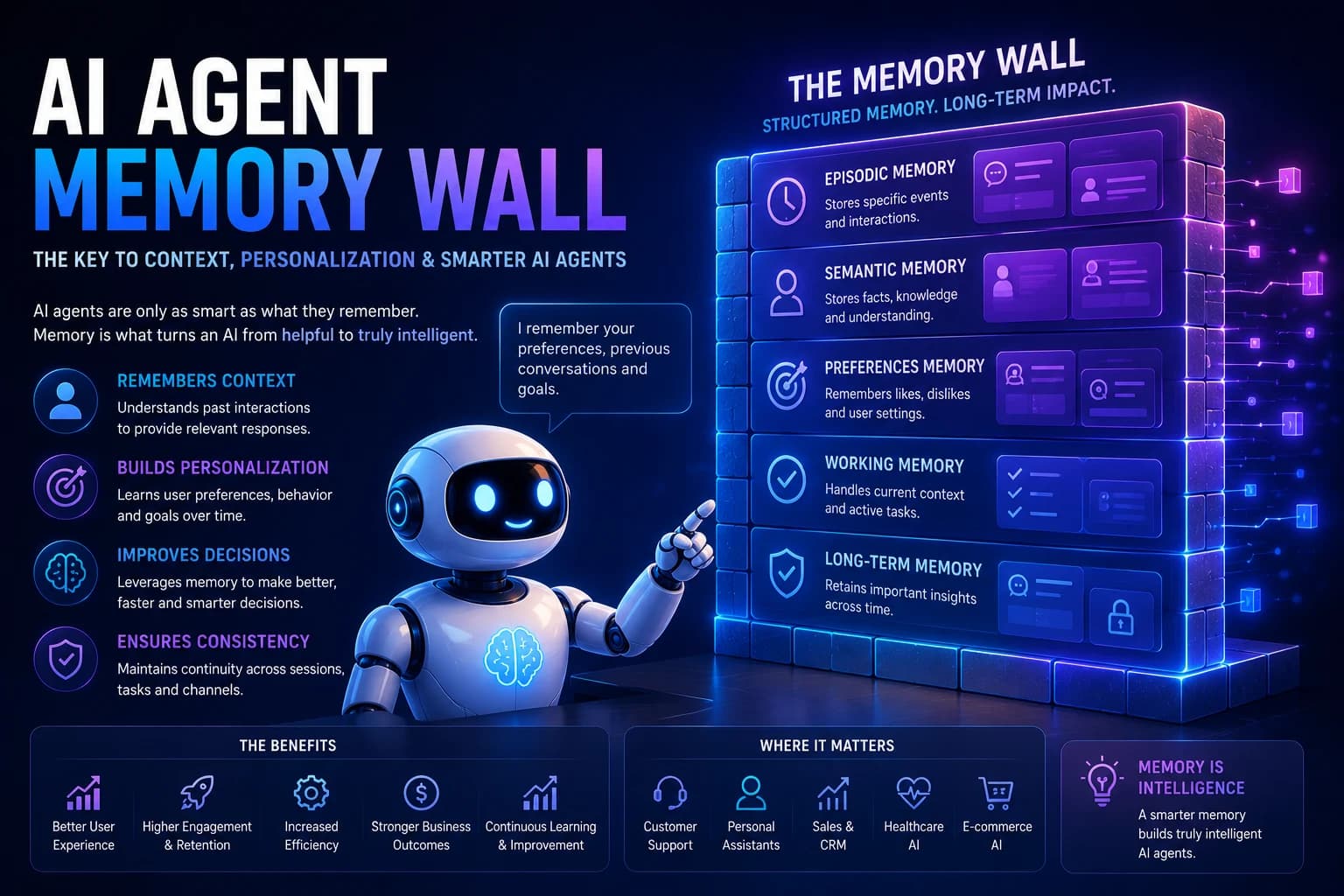
Human memory is a highly sophisticated, multi-tiered system:
- Sensory Memory: Milliseconds of data (AI equivalent: prompt ingestion).
- Working Memory: Active thinking space, limited to a few concepts (AI equivalent: context window).
- Long-Term Memory: Experiences, facts, and skills encoded over time.
- Semantic Memory: General knowledge about the world.
- Episodic Memory: Specific events and experiences ("I remember when...").
Crucially, human memory compresses and forgets. We do not remember every word of a conversation; we remember the meaning (semantics) and the outcome. Current AI systems try to remember the exact pixels and tokens, which overwhelms them.
5. How AI Memory Works Today
Modern AI agents attempt to simulate long-term memory using a patchwork of external systems. If you are building an enterprise AI agent, you are likely relying on one or more of these architectures.
The Enterprise AI Agent Memory Stack
Context Window
Temporary Working Memory (RAM)
➔
⬇
Vector Database
Semantic Search & Document Retrieval (RAG)
➔
⬇
Knowledge Graph
Deterministic Relationships & Entities
➔
⬇
Memory Controller
Agentic Brain: Routing, Summarization, Forgetting
6. Context Windows Explained
The context window is the immediate text the LLM "sees" right now. It is the agent's short-term working memory. If an AI agent is a chef, the context window is the cutting board. It can only hold the ingredients currently being chopped. If an ingredient falls off the board, it no longer exists to the chef.
7. RAG as External Memory
Retrieval-Augmented Generation (RAG) is the most common approach to giving AI agents "memory." When a user asks a question, the system searches an external database for relevant documents, retrieves them, and pastes them into the context window for the LLM to read.
RAG is highly effective for AI SEO and document querying, but RAG is not true memory. It is simply an automated Google search attached to a chatbot. It lacks temporal awareness (understanding when a memory was formed) and hierarchical reasoning.
8. Vector Databases: Search, Not Understanding
RAG systems are powered by Vector Databases (like Pinecone, Milvus, or pgvector). These databases convert text into numbers (embeddings) and plot them in a multi-dimensional space.
When you ask an AI agent, "What did we decide about the Q3 marketing budget?", the system finds text chunks in the database that are mathematically "similar" to your question.
The problem? Similarity is not understanding. The vector database might retrieve a document from Q1 because it contains the words "marketing budget," completely missing the updated decision from yesterday's meeting.
9. Knowledge Graphs: Structured Memory for AI Agents
To solve the limitations of vector search, enterprises are moving toward Knowledge Graphs. A knowledge graph stores data as interconnected entities (nodes) and relationships (edges).
Instead of storing a block of text, a knowledge graph stores: [Client X] --(purchased)--> [Salesforce Integration] --(on)--> [June 10th].
When an AI agent utilizes a knowledge graph, it possesses deterministic memory. It doesn't guess based on text similarity; it traverses mathematical logic. This is critical for building reliable custom AI agents for Salesforce.
10. Why Current AI Memory Fails
Even with RAG and Knowledge Graphs, autonomous AI agents struggle in the wild. This happens due to several critical architectural flaws in how we implement memory today.
11. Lost-in-the-Middle Problem
A landmark 2023 paper titled "Lost in the Middle: How Language Models Use Long Contexts" revealed that LLMs are very good at remembering the beginning and the end of a long prompt, but they suffer drastic performance drops when recalling information buried in the middle of the context. Feeding an AI agent a massive retrieved memory file guarantees it will overlook critical nuances.
12. Context Degradation in Long Conversations
As an autonomous agent operates over days or weeks, it generates a massive log of its own actions. To keep the context window manageable, systems typically "summarize" old messages.
Summary of Day 1 + Summary of Day 2 + Summary of Day 3... eventually, the memory degrades into a blurry, generalized mess. Important granular details are permanently lost through recursive compression.
If a user tells an AI agent on Monday: "My budget is $5,000," and on Friday says: "Actually, my budget is $10,000," traditional vector memory stores both facts.
When queried later, the AI retrieves both chunks. Lacking temporal logic and conflict resolution, the AI agent becomes confused, often hallucinating an average ("Your budget is $7,500") or picking the wrong one entirely.
14. Why Forgetting Is a Feature, Not a Bug
Human brains are exceptionally good at forgetting. We discard useless information (like what we had for breakfast 12 days ago) to prioritize critical knowledge.
AI agents currently suffer from "digital hoarding." They save every system log, every minor chat interaction, and every retrieved document. A true AI memory architecture requires an active "Garbage Collection" or "Forgetting Mechanism" that decays the importance of trivial interactions over time while cementing core facts into long-term schema.
15. Why Memory Matters for Enterprise AI Agents
For a consumer chatting with ChatGPT, amnesia is annoying. For an enterprise deploying Salesforce Data Cloud agents to manage customer service, amnesia is a catastrophic failure of UX and brand trust.
Enterprise AI agents require:
- Persistent User Profiles: Remembering a client's specific SLAs, past complaints, and communication preferences across thousands of interactions.
- Workflow Memory: Remembering what step of a complex, multi-day approval process the agent is currently executing.
- Organizational Alignment: Understanding the shifting hierarchy and evolving internal policies of a company without needing to be re-prompted.
16. Memory Architecture for Business AI Systems
To build AI agents that actually function as digital employees, businesses need a tiered memory architecture:
The AI Memory Stack Comparison
| System | What It Does | Enterprise Limitation |
|---|
| Context Window | Temporarily holds prompt and immediate context | Expensive, noisy, limited recall (amnesia upon reset) |
| RAG (Vector) | Retrieves documents based on semantic similarity | Can retrieve wrong, conflicting, or outdated context |
| Knowledge Graph | Stores entities and deterministic relationships | Requires intensive data modeling and clean ETL pipelines |
| Hierarchical Memory | MemGPT-style active memory management | High latency; requires complex agent orchestration |
| Human Memory | Filters, forgets, compresses, and recalls adaptively | Still not fully replicated mathematically in AI |
Build AI Agents That Remember What Matters
Intellectual Clouds helps businesses design AI agents with enterprise RAG, knowledge graphs, persistent user profiles, and workflow memory. Book a consultation to build AI systems that retain context, reduce hallucinations, and improve over time.
17. Future of AI Agent Memory
Research into AI memory is accelerating. We are seeing the rise of GraphRAG (combining Knowledge Graphs with Vector RAG) and MemGPT (an OS-inspired architecture that pages memory in and out of the context window intelligently).
In the future, models will feature Continuous Pre-training, where agents literally update their own neural weights overnight based on the day's experiences—similar to human REM sleep.
18. Could Memory Be the Missing Piece of AGI?
Artificial General Intelligence (AGI) requires autonomous planning, reasoning, and reflection. In the famous "Generative Agents" paper (Park et al., 2023), researchers found that when AI agents were given a memory stream, the ability to reflect on past memories, and the capability to plan future actions based on those reflections, they exhibited shockingly human-like social behaviors.
Memory is not just a storage system; it is the foundational prerequisite for reasoning.
19. What Businesses Should Do Now
If you are implementing AI, stop relying entirely on raw LLMs and massive context windows.
- Audit Your Data: AI memory is only as good as the data it accesses. Clean up your documentation.
- Move Beyond Basic RAG: Implement Hybrid Search (Keyword + Vector) and begin exploring Knowledge Graphs.
- Design Stateful Applications: Use session management, persistent user databases, and hierarchical summarization to mimic episodic memory for your users.
20. How Intellectual Clouds Builds Memory-Driven AI Agents
At Intellectual Clouds, we don't just build chatbots; we architect cognitive engines. By leveraging robust Data Analysis pipelines, integrating deeply with Cloud Integrations (AWS), and deploying sophisticated multi-agent frameworks, we ensure your AI digital workers remember your enterprise logic, respect your security protocols, and learn from every interaction.
21. Frequently Asked Questions
What is AI agent memory?
AI agent memory is the system architecture that allows an artificial intelligence to retain, organize, and strategically recall past context, user preferences, and enterprise facts across multiple separate sessions.
What is the Memory Wall in AI?
The Memory Wall refers to the cognitive gap between an AI's massive training knowledge and its inability to effectively recall specific, long-term dynamic contexts without overwhelming its processing constraints.
Is RAG the same as memory?
No. Retrieval-Augmented Generation (RAG) is a search mechanism. It retrieves external documents and injects them into the prompt. True memory involves hierarchical understanding, temporal awareness, and the ability to selectively forget.
How can knowledge graphs improve AI agent memory?
Knowledge graphs store deterministic relationships between entities (e.g., User -> bought -> Software). This prevents the AI from guessing based on text similarity and allows for highly accurate, logical reasoning over past data.
Does Intellectual Clouds build AI agents with memory?
Yes. We design enterprise-grade AI agents utilizing advanced memory architectures including vector databases, knowledge graphs, and persistent state management to ensure highly reliable autonomous operations.
22. Conclusion
The Memory Wall is the defining technical challenge of the current AI era. As we push toward autonomous agents capable of managing complex enterprise workflows, relying on massive context windows and simple vector search will no longer suffice. By building sophisticated, multi-tiered memory architectures that mimic human cognition—incorporating reflection, knowledge graphs, and selective forgetting—businesses can finally deploy AI digital workers that truly understand context.