HomeBlogWhat Is Salesforce Data Cloud? A Complete Guide
Salesforce
What Is Salesforce Data Cloud? A Complete Guide
Asim Ansari
June 24, 2026
14 min read
Learn what Salesforce Data Cloud is, how it works, its main features, use cases, pricing model, and why Salesforce now calls it Data 360.
Direct Answer: Salesforce Data Cloud, now officially called Data 360, is a real-time data engine that unifies fragmented customer data from multiple systems into a single, trusted Customer 360 profile. It helps teams activate that data across Salesforce applications and powers AI, personalization, and automation without requiring complex, brittle data pipelines.
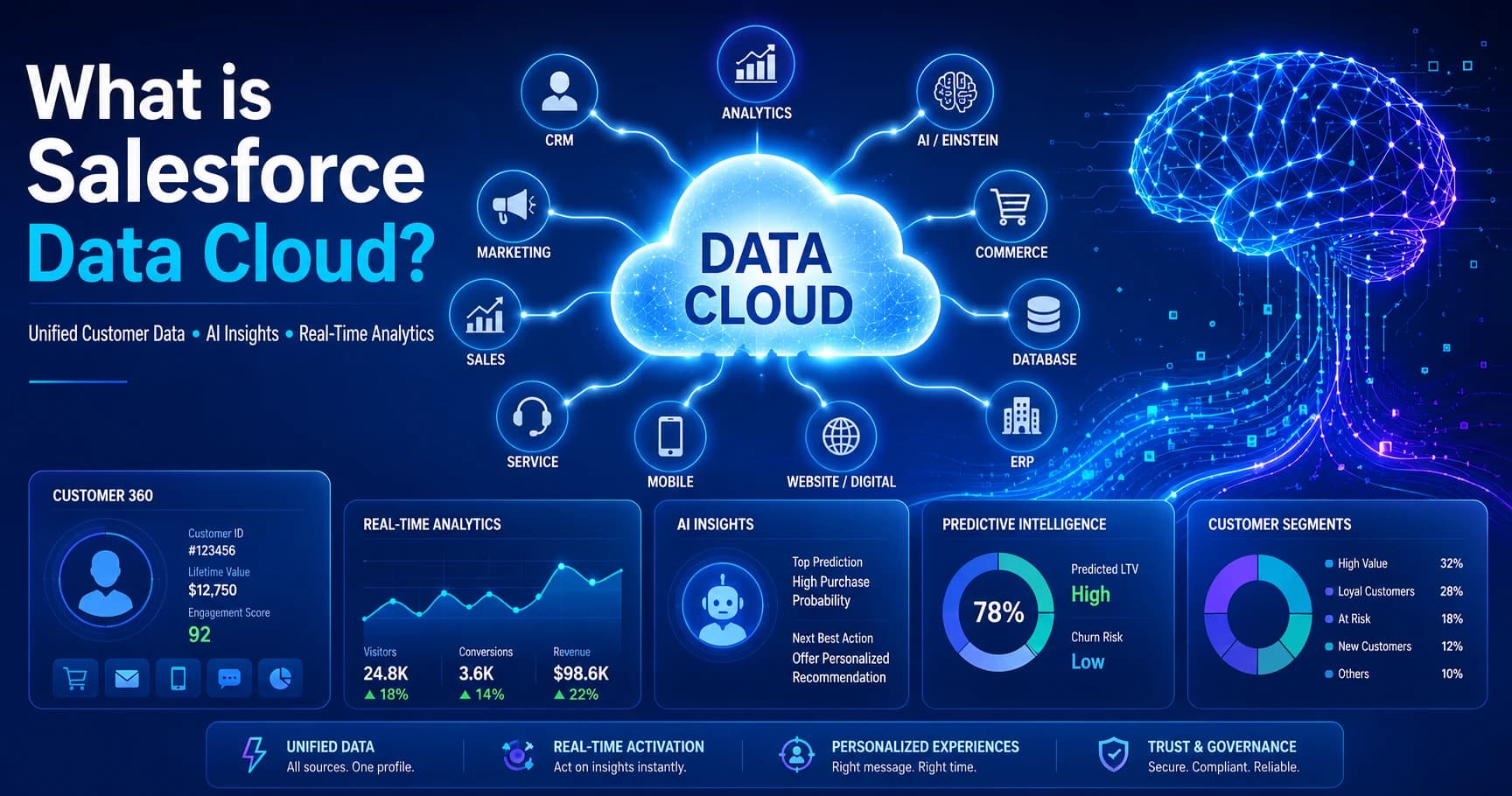
Salesforce Data Cloud is Salesforce's real-time data engine. It exists to solve the oldest problem in enterprise software: disconnected customer data.
In a typical enterprise, a customer's purchase history lives in an ERP, their website behavior lives in Google Analytics, their support tickets live in Service Cloud, and their marketing engagement lives in a separate marketing platform.
Salesforce Data Cloud unifies these disparate, fragmented data points into a trusted, unified profile. Most importantly, it activates that data across all Salesforce products natively, making it immediately usable by sales reps, service agents, and automated AI workflows.
Why Salesforce Renamed It Data 360
If you are researching this topic, you will notice a transition in terminology. While the industry—and the majority of search queries—still refer to it as Salesforce Data Cloud, Salesforce has officially rebranded the platform to Data 360.
Why the change? "Data Cloud" sounded like a standalone storage product (like AWS S3 or Snowflake). "Data 360" better communicates the platform's core purpose: feeding a complete, 360-degree view of the customer directly into the Salesforce CRM and its native AI engines. Regardless of the name, the underlying architecture and zero-copy principles remain the same.
How Salesforce Data Cloud Works
Data Cloud operates as a continuous, four-step engine. It does not just store data; it harmonizes and activates it.
Connect: It ingests data from external sources (data lakes like Snowflake or Databricks, legacy CRMs, website SDKs, and mobile apps) using native connectors or zero-copy architecture.
Harmonize: It takes raw, unstructured, or differently formatted data and maps it to the standard Salesforce metadata model.
Unify (Identity Resolution): It looks at different identifiers (an email address from Marketing Cloud, a device ID from the website, a phone number from an ERP) and merges them into a single, comprehensive Customer Profile.
Activate: It pushes calculated insights, segmented lists, and unified metrics back into core Salesforce clouds — including Sales Cloud, Service Cloud, Marketing Cloud, Commerce Cloud, and CRM Analytics — as well as Agentforce, triggering real-time contextual actions across the entire enterprise.
Key Features of Data Cloud / Data 360
The platform is designed to bridge the gap between heavy IT data warehousing and fast-moving business workflows. Its core features include:
Zero-Copy Architecture
Traditionally, unifying data meant extracting it from Snowflake, copying it into Salesforce, and trying to keep both databases synced. Data 360's "zero-copy" architecture allows Salesforce to read and act on data residing in Snowflake, Databricks, or Google BigQuery without physically copying or moving the data. This reduces latency, lowers storage costs, and tightens security.
Identity Resolution
Identity resolution is the engine's core superpower. It uses fuzzy matching and deterministic rules to realize that "J. Smith" who bought a laptop in-store is the same "John Smith" who just opened a support ticket online.
Connectors and Ingestion
Data 360 comes with a massive library of pre-built connectors for AWS, Google Cloud, Azure, and hundreds of web and mobile endpoints, enabling both batch and streaming data ingestion.
Unstructured Data and Vector Search
Modern customer data isn't just rows and columns. It is PDF contracts, call transcripts, and email threads. Data 360 includes a native vector database, allowing Salesforce's AI to search and understand unstructured data just as easily as structured data.
Real-Time Activation
Unlike traditional batch processing that updates overnight, Data 360 can process a user's action on an ecommerce site and trigger a personalized email or alert a sales rep within milliseconds.
Main Business Benefits
Understanding the features is one thing; understanding the ROI is another. Implementing Data 360 delivers significant business outcomes:
Better Personalization: Marketing messages are no longer based on what a customer did last month, but what they did 10 minutes ago.
Faster Decision Making: Sales reps don't have to check three different systems before calling an account; the complete history is injected directly into the Contact record.
Less Data Pipeline Complexity: IT teams spend less time building and maintaining brittle API integrations and ETL pipelines.
More Accurate AI Outputs: AI is only as good as its training data. By feeding Agentforce unified, real-time data, AI hallucinations drop significantly.
Improved Customer Experience: Service agents can see a customer's recent web browsing history, allowing them to solve problems proactively before the customer even explains them.
Real-World Use Cases
How are enterprises actually using Data 360 today? Here are the most common deployments:
Targeted Marketing Campaigns
A retailer connects their point-of-sale system to Data Cloud. If a customer buys running shoes in-store, Data Cloud immediately removes them from an online ad campaign for those same shoes, saving ad spend, and adds them to a campaign for running socks.
Real-Time Omnichannel Ecommerce Recommendations
A B2B buyer abandons a shopping cart containing heavy machinery parts. Data Cloud instantly alerts the assigned account executive in Sales Cloud with a suggested discount to close the deal.
Proactive Customer Support
A telecommunications company detects a service outage in a specific neighborhood via an external IoT system. Data Cloud cross-references this with Service Cloud and proactively emails affected VIP customers before they call the support center.
Powering AI Agents (Agentforce)
A custom AI agent built in Salesforce needs to answer a complex billing question. Instead of hallucinating, it queries Data 360, retrieves the unstructured PDF contract and the real-time billing API data, and generates a perfectly accurate response.
Data Cloud vs Traditional CDP
A common question from technical buyers is: "Isn't this just a Customer Data Platform (CDP)?"
Yes and no. A traditional CDP (like Segment or mParticle) is primarily used by marketing teams to collect website data and orchestrate ad campaigns.
Salesforce Data 360 does function as a CDP, but its scope is much broader. Because it is natively wired into the core Salesforce platform, it activates data across Sales, Service, Commerce, and AI workflows seamlessly. It is an enterprise-wide data engine, not just a marketing tool.
Feature
Traditional CDP
Salesforce Data Cloud (Data 360)
Primary Users
Marketing teams
Sales, Service, Marketing, IT
Core Function
Ad orchestration and segmentation
Enterprise data unification and AI grounding
Data Architecture
Requires data ingestion/copying
Zero-copy architecture supported
AI Readiness
Limited to predictive marketing
Native vector DB for Agentforce/LLMs
Pricing and Access Model
Pricing for enterprise data architecture is rarely simple, but Data Cloud follows a consumption-based model:
You pay for the storage of the data.
You pay for the compute power (credits) used to ingest, harmonize, and activate the data.
Salesforce often provides existing Enterprise and Unlimited edition customers with a "free tier" of limited storage and consumption credits to test the platform before committing to a larger contract.
Common Implementation Challenges
Implementing Data Cloud is a major architectural shift. Avoid these common pitfalls to ensure a successful rollout:
Assuming Data Cloud is only for marketers: If only the marketing team uses it, you are wasting 80% of its potential ROI. Involve sales ops and service leaders early.
Ignoring source-data quality: Data Cloud harmonizes data; it does not magically fix bad data. If your source systems are full of garbage, Data Cloud will just unify that garbage faster. A clean source-data strategy is mandatory.
Overpromising real-time use cases: True real-time streaming requires specific architectural choices. Don't promise real-time web personalization if your underlying ERP only pushes batch updates every 24 hours.
Treating it like a one-time setup: Data Cloud is not a "set it and forget it" tool. It is an ongoing data product that requires dedicated ownership, constant tuning of identity resolution rules, and regular auditing.
Need help implementing Salesforce Data Cloud or Data 360?
Talk to our Salesforce experts about customer data unification. Whether you need to connect Salesforce with your marketing stack, resolve fragmented identities, or prepare your data layer for AI automation, we can map the exact architecture you need.
Salesforce Data Cloud is a real-time data engine that unifies customer data from multiple systems into a trusted Customer 360 profile, allowing teams to activate that data across Salesforce and power AI workflows.
Is Data Cloud now called Data 360?
Yes. Salesforce has rebranded Data Cloud to Data 360 to better reflect its role in providing a comprehensive 360-degree view of the customer to all Salesforce applications.
How does Salesforce Data Cloud work?
It connects to external data sources, maps the information to a standard model, resolves identities to merge duplicate records into a single profile, and activates that unified data back into Salesforce apps in real time.
Is Salesforce Data Cloud a CDP?
Yes, but it goes beyond a traditional marketing Customer Data Platform. It acts as an enterprise-wide data foundation that powers Sales, Service, Commerce, and AI workflows, not just marketing segments.
What are the main use cases for Data Cloud?
Common use cases include targeted marketing campaigns, real-time website personalization, proactive customer support routing, and providing accurate context for Custom AI Agents.
How is Data Cloud priced?
Pricing is primarily consumption-based, meaning you pay for the storage you use and the compute credits required to process, harmonize, and activate your data.
What is zero-copy architecture in Data Cloud?
Zero-copy architecture allows Salesforce to query and act on data residing in external data lakes directly, without having to physically move or duplicate the data into Salesforce.
How does Data Cloud help with AI?
AI requires high-quality, real-time context to function properly. Data Cloud provides clean, unified data to Agentforce, drastically reducing AI hallucinations and errors.
Asim Ansari is the Founder of Intellectual Clouds and a Certified Salesforce Administrator and Pardot Specialist with 17+ years of experience across Salesforce CRM, AI automation, cloud infrastructure (AWS), and digital transformation. He writes on AI agents, Salesforce delivery, Answer Engine Optimisation (AEO), and AI-accelerated business operations.