HomeBlogAI Coding Tools’ Free Ride Is Ending: Why Copilot, Cursor and Codex Are Moving Toward Usage-Based Pricing
AI Infrastructure
AI Coding Tools’ Free Ride Is Ending: Why Copilot, Cursor and Codex Are Moving Toward Usage-Based Pricing
Asim Ansari
July 12, 2026
22 min read
AI coding tools are moving away from simple unlimited subscriptions because inference is expensive. Learn why GitHub Copilot, Cursor, and Codex are shifting to usage-based pricing and how it impacts engineering budgets.
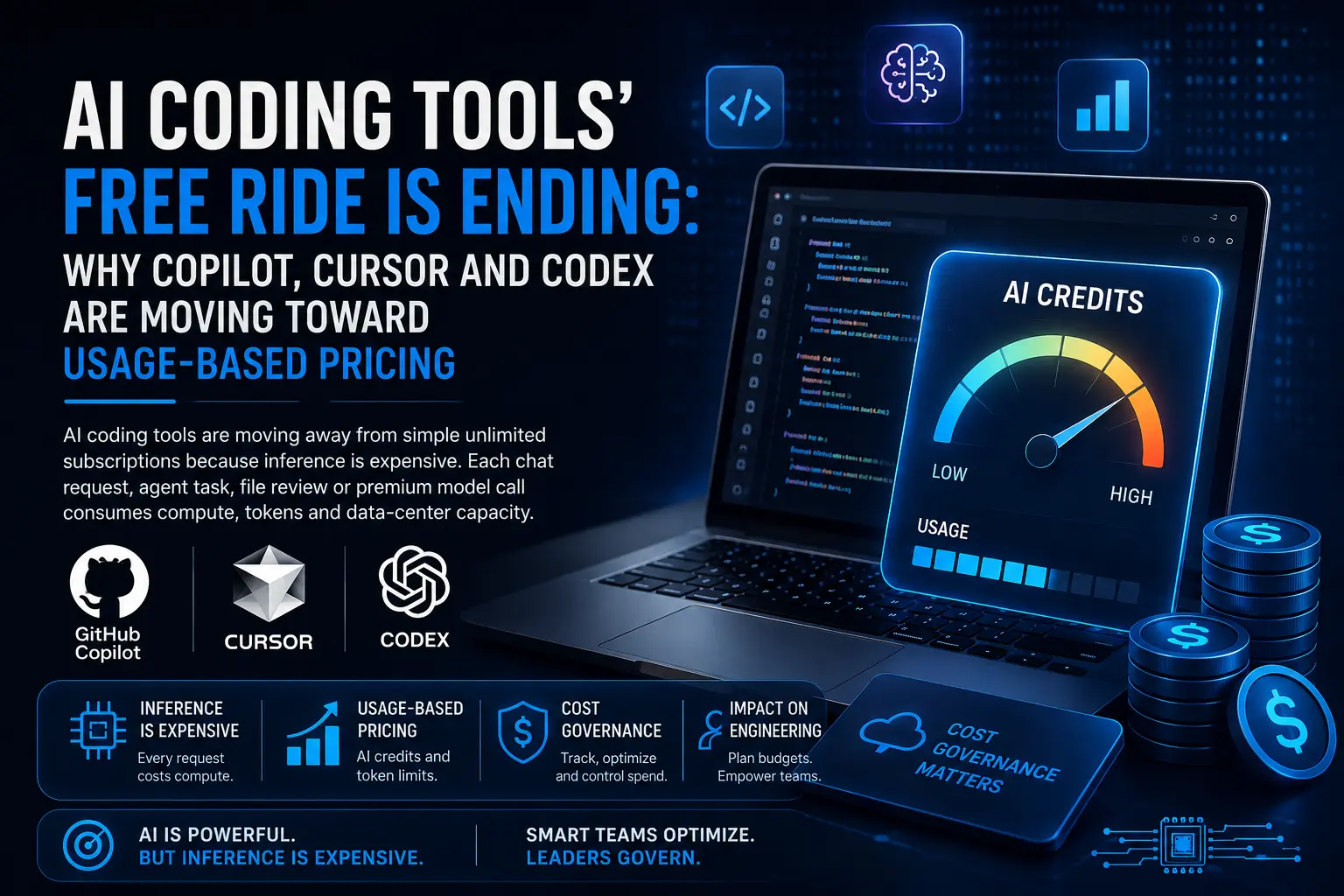
Direct Answer: AI coding tools are moving away from simple unlimited subscriptions because inference is expensive. Each chat request, agent task, file review or premium model call consumes compute, tokens and data-center capacity. GitHub Copilot now uses AI credits for many advanced features, and other providers also price around token or usage limits. Companies need AI cost governance, not blind dependency on one coding assistant.
AI coding tools were never truly cheap. They were subsidized. For the past few years, developers and engineering teams have enjoyed a golden era of AI coding assistants. Tools like GitHub Copilot, Cursor, and OpenAI’s Codex offered seemingly limitless capabilities for a predictable, flat monthly fee. You could generate thousands of lines of code, refactor massive files, and engage in endless chat sessions with the AI - all without worrying about the underlying costs.
But the landscape is rapidly shifting. The era of the "all-you-can-eat" AI buffet is coming to a close. We are witnessing a fundamental transition in how these tools are monetized, moving steadily away from flat-rate subscriptions toward usage-based models, AI credits, and token-metered billing.
AI coding is no longer just a productivity booster; it is becoming a significant cloud cost category. In this comprehensive analysis, we will explore why GitHub Copilot is moving to AI credits, why unlimited AI coding tools are ending, how this impacts enterprise cost management, and why companies need FinOps for AI developer tools.
1. What Changed in AI Coding Tool Pricing?
Initially, the pricing strategy for AI coding tools was about market penetration and user acquisition. Tech giants and startups alike absorbed the massive inference costs to get developers hooked on AI-assisted workflows. A $10 or $20 monthly subscription rarely covered the true cost of heavy users who relied on the AI for every function, test, and debugging session.
Now, the reality of unit economics is catching up. Inference - the computational process of running an AI model to generate a response - is incredibly expensive. As developers demand more sophisticated capabilities like multi-file context, whole-codebase analysis, and autonomous agentic loops, the compute required per interaction has skyrocketed.
Consequently, providers are adjusting their billing models. They are introducing usage caps, tiering systems based on model complexity, and, most notably, AI credits. This shift means that while basic features might remain covered under a base subscription, advanced, compute-heavy tasks will cost extra.
This is a paradigm shift. Companies can no longer treat AI coding tools as a fixed, predictable software license cost. Instead, it must be managed dynamically, much like AWS or Azure cloud spend.
2. Why GitHub Copilot’s Credit Model Matters
GitHub Copilot, as the dominant player in the market, sets the standard for how AI coding tools are priced and consumed. Recently, GitHub announced changes to its Copilot plans, introducing the concept of AI credits for certain interactions.
According to GitHub Docs, while the base subscription still exists, Copilot plans now include monthly AI credits. For enterprise and business users, these credits are pooled at the organization or enterprise level. This is a critical development because it signals a departure from the "unlimited" promise for all features.
When the market leader shifts to a metered approach, it validates the usage-based model for the entire industry. It forces engineering leaders to rethink how they deploy and monitor Copilot across their teams. If a few developers heavily utilize advanced, credit-consuming features, they could drain the pooled resources, leading to unexpected overages or throttled access for the rest of the team.
3. What Counts Toward AI Credits?
Not all AI interactions are created equal. The shift to credits is specifically targeted at the most expensive compute operations.
Typically, AI credits are consumed when users engage with premium models (like OpenAI's GPT-4 or Anthropic's Claude 3.5 Sonnet) or utilize advanced interactions that require processing massive amounts of context. For example:
Large Context File Reviews: Asking the AI to analyze multiple files simultaneously or deeply inspect a large monolithic file.
Agentic Tasks: When the AI operates autonomously to plan, write, and test a feature across the codebase.
Complex Chat Queries: Long, multi-turn conversations that require the AI to maintain substantial state and history.
These operations require the underlying LLMs to process significantly more tokens, drastically increasing the inference cost.
4. What Still Remains Unlimited?
It is important to note that not everything is moving to a metered model. Providers understand that the core value proposition - speeding up everyday coding - must remain frictionless.
For GitHub Copilot, inline code completions are generally not billed against AI credits. The autocomplete suggestions that appear as you type rely on smaller, faster, and cheaper models optimized for low latency. These continue to be part of the unlimited base offering because their inference costs are manageable and predictable.
However, as soon as a developer opens the chat panel, asks for a comprehensive code review, or triggers a complex refactoring task, they cross the boundary from the "free" zone into the metered, credit-consuming territory.
5. Why Pooled Credits Create Team-Level Risk
The decision to pool AI credits at the organizational or enterprise level introduces a new layer of risk and complexity for engineering management.
In a pooled model, a team of 100 developers might share a bucket of, say, 10,000 AI credits per month. In an ideal world, each developer uses 100 credits. However, in reality, usage follows a power law. A small percentage of "power users" who rely heavily on AI chat, agentic loops, and deep codebase analysis might consume 80% of the pooled credits in the first two weeks of the month.
This creates several issues:
Budget Unpredictability: It becomes difficult to forecast monthly costs when usage is highly variable and concentrated among a few users.
Resource Starvation: Once the pool is depleted, the entire team might lose access to advanced features, impacting overall productivity, or the company might automatically incur expensive overage charges.
Lack of Accountability: Without granular tracking, it is hard to identify which workflows or users are driving the costs and whether that spend is generating a positive ROI.
6. Why Unlimited AI Was Never Economically Sustainable
To understand why this shift is happening, we must look at the economics of Generative AI. Unlike traditional SaaS, where the marginal cost of serving an additional user is near zero, AI has a very real, very high marginal cost of goods sold (COGS).
Every prompt sent to an LLM requires the model to process the input tokens, perform billions of calculations across its neural network, and generate output tokens. This requires massive arrays of specialized hardware (GPUs) running at high power.
When an AI coding tool was offered for $20 a month with "unlimited" usage, a developer doing heavy refactoring or agentic loops could easily consume $50 or $100 worth of compute on the backend. The providers were subsidizing this difference.
As the capabilities of these tools grew, so did the size of the context windows (from 4k tokens to 128k, 200k, and even 1M+ tokens). Processing a 100k token codebase for a single query costs exponentially more than completing a single line of code. The "unlimited" model simply broke under the weight of its own success and the expanding ambitions of developers.
7. The Real Cost: Inference, GPUs, Electricity and Data Centers
The underlying driver of these pricing changes is the physical reality of AI infrastructure. It’s not just about software; it’s about silicon and electricity.
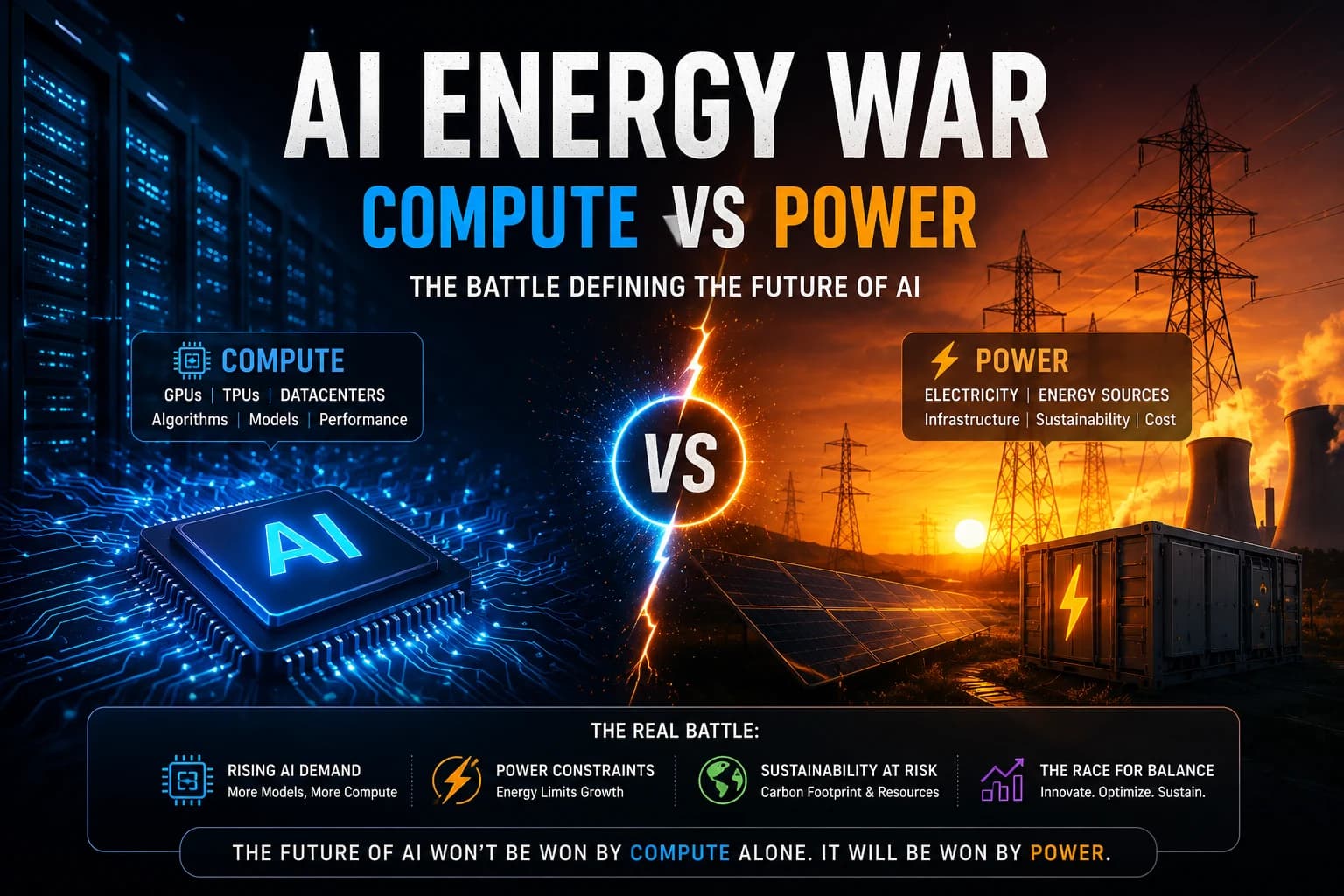
According to a report by the International Energy Agency (IEA), data centers consumed about 415 TWh of electricity globally in 2024. Due to the explosive growth of AI and the massive expansion of data center infrastructure required to support it, that number is projected to reach around 945 TWh by 2030.
This immense energy consumption, coupled with the capital expenditure (CapEx) required to purchase advanced GPUs (like NVIDIA H100s or Blackwells) and build the necessary cooling and networking infrastructure, creates a massive financial burden. These costs are passed down from hardware manufacturers to cloud providers, then to AI tool developers, and finally to the end user - the enterprise.
8. Why Developers Are Testing Cursor, Codex and Claude Code
As Copilot adjusts its pricing and introduces limits, developers are naturally exploring alternatives, looking for better value, stronger capabilities, or more favorable economics.
Cursor: This AI-first code editor has gained massive popularity for its deep integration and powerful AI features. However, even Cursor operates on a usage-based tiering system, distinguishing between "fast" and "slow" premium requests, and imposing limits on the most powerful model calls.
Claude Code: Anthropic’s offerings are highly regarded for their coding capabilities, especially with the Claude 3.5 Sonnet model. Interestingly, Anthropic notes that its newer tokenizer produces approximately 30% more tokens on average for non-English languages, while keeping the same price per token. This highlights how technical nuances like tokenization directly impact effective costs.
OpenAI Codex & API: Many advanced users are bypassing packaged tools and building custom integrations using the OpenAI API. However, OpenAI's pricing is already strictly token/usage-based. While ChatGPT Business plans include credit-based expansions, raw API usage is a direct pay-as-you-go model.
9. Why Switching Tools Does Not Remove the Cost Problem
It is tempting for CTOs to look at Copilot’s new credit limits and think, "We'll just switch to Cursor or Claude." While exploring different tools is a healthy practice, it does not solve the fundamental cost problem.
Every single AI coding assistant relies on the same underlying physical infrastructure and faces the same inference costs. Whether you are paying Microsoft, Anthropic, OpenAI, or a specialized startup, the bill for GPU cycles and electricity must be paid.
Switching tools might offer a temporary pricing arbitrage or a slightly better workflow for specific tasks, but the long-term trajectory for all these tools is toward strict usage-based billing and token metering. The economics of AI dictate it.
10. The Risk of Over-Relying on One AI Coding Assistant
The shift in pricing highlights a significant operational risk: vendor lock-in and over-reliance on a single AI tool.
If an engineering team becomes completely dependent on one specific AI assistant to maintain their velocity, they are vulnerable to arbitrary pricing changes, feature deprecations, or service outages. When the tool's pricing model changes from unlimited to metered, the company might suddenly face a choice between a massive, unbudgeted expense or a sudden drop in developer productivity as they enforce strict usage limits.
This is why we advocate for a multi-tool strategy and building internal resilience, a concept we explore further in Context Engineering: The Future of AI.
11. What This Means for Engineering Teams
For the individual developer and the engineering team, this transition requires a shift in behavior.
Context Discipline: Developers can no longer lazily dump entire codebases into the chat window for every minor question. They must learn "context discipline" - providing only the strictly necessary files and snippets to the AI to minimize token usage and inference costs.
Managing Agent Loops: Agentic coding tools that autonomously iterate on a problem are powerful but dangerous for budgets. Repeated failed attempts by an AI agent in a loop burn through usage rapidly. Teams must implement approval checkpoints and monitor agent behavior closely.
Retaining System Knowledge: AI cannot replace deep system knowledge. Relying on AI to explain the architecture every time a change is made is highly inefficient. Teams must maintain strong internal documentation and ensure senior engineers retain a deep understanding of the core systems.
Understanding the Shift: Old vs. New Reality
Tool / Model
Old User Expectation
New Reality
GitHub Copilot
Fixed monthly subscription
Credits for premium/advanced AI usage
Cursor
Fast AI coding workflow
Usage and model limits still matter
Codex
Agentic coding help
Compute-heavy tasks cost more
Claude Code
Powerful development agent
Token and usage economics apply
OpenAI API
Pay per API call/token
Direct usage-based billing
12. What This Means for CTOs and CFOs: AI FinOps
The most critical takeaway for leadership is this: AI coding is becoming a cloud cost category. Companies need FinOps for AI developer tools.
Just as organizations implemented Cloud FinOps practices to manage and optimize their AWS or Azure spend in the 2010s, they must now adopt AI FinOps. You can no longer treat AI coding tools as a predictable line item under "software licenses." It is a dynamic, usage-driven operational expense (OpEx).
CTOs and CFOs must collaborate to establish budgets, monitor usage at a granular level, and ensure that the spend on AI tools is actually yielding a proportional increase in engineering output and business value.
Enterprise Risk Management for AI Coding Tools
Risk
Why It Matters
Fix
Pooled credits
One heavy user can affect team budget
Set strict usage policies and alerts
Tool dependency
Workflow breaks if pricing changes
Implement a multi-tool strategy
Hidden token growth
Long context/file review costs more
Train teams on context discipline
Layoff-driven overreliance
AI cannot replace system knowledge
Keep senior review and robust docs
Agent loops
Repeated failed attempts burn usage
Add human approval checkpoints
13. How to Control AI Coding Tool Costs
To navigate this new reality, companies must take proactive steps to govern their AI usage. Here are our core business recommendations:
Set Dedicated AI Budgets: Treat AI coding tools as a distinct budget category with monthly limits, separate from traditional SaaS licenses.
Enable Team-Level Monitoring: Do not rely on high-level enterprise dashboards. Implement tools to monitor credit and token usage at the team and individual user level.
Track Heavy Users & Agent Workflows: Identify the developers or automated agent loops that are consuming the most resources. Analyze their workflows to ensure the spend is justified.
Limit Long Context Reviews: Establish guidelines on when it is appropriate to use massive context windows. Encourage developers to scope their queries narrowly.
Maintain Human Review: AI should assist, not replace, the engineering process. Maintain strict human review protocols, especially for architectural changes and security-critical code.
Adopt a Multi-Tool Stack: Do not blindly commit to just Copilot, Cursor, Codex, or Claude. Build a use-case-based stack where different tools are used for different tasks to optimize cost and performance.
Track "AI Saved Time" vs. "AI Spend": Implement KPIs to measure the actual ROI of the tools. Is the $1,000 spent on AI credits this month actually saving $5,000 in engineering time?
To learn more about optimizing your broader cloud and infrastructure spend, explore our Cloud Consulting Services.
14. AI Coding Tool Governance Checklist
Before scaling AI coding tools across your enterprise, ensure you have addressed the following:
Has a monthly budget ceiling been established for AI inference/credits?
Are alerting systems in place for when pooled credits reach 50%, 75%, and 90% utilization?
Have developers been trained on token efficiency and context discipline?
Is there a policy governing the use of autonomous AI agents in the codebase?
Are we monitoring which specific AI models (e.g., standard vs. premium) are driving the most cost?
Do we have a fallback plan or alternative tool if our primary AI provider drastically changes pricing?
Are security and architectural reviews strictly enforced independently of AI suggestions?
Inference is expensive. Advanced features like large-context file reviews and premium model usage consume significant compute, making a flat unlimited subscription economically unsustainable. AI credits allow GitHub to meter and charge for this heavy compute usage.
Does every Copilot action consume credits?
No. Generally, basic inline code completions - the suggestions that appear as you type - rely on smaller models and do not consume the AI credits allocated for advanced features.
Are Copilot code completions still unlimited?
For the most part, yes. Standard inline completions are optimized for low latency and low cost, so they remain largely unlimited under the base subscription, while chat and agentic features draw from the credit pool.
Why is AI inference expensive?
Inference requires powerful, specialized hardware (GPUs) that consume massive amounts of electricity. Processing large context windows (thousands of lines of code) requires billions of calculations per request, driving up the underlying infrastructure costs.
Will Cursor, Codex and Claude face the same pricing pressure?
Yes. Every AI tool relies on similar underlying compute infrastructure. Whether they use a credit system, token metering, or strict usage caps, all providers must eventually align their pricing with the physical costs of AI inference.
How should companies control AI coding tool costs?
Companies must adopt AI FinOps: setting monthly budgets, monitoring team-level credit usage, training developers on context discipline (not dumping the whole codebase into chat), and implementing approval checkpoints for autonomous agent loops.
Is usage-based AI pricing bad for developers?
Not necessarily, but it requires a change in habits. It encourages developers to be more precise and efficient with their prompts and context, rather than relying on brute-force AI analysis for every minor issue.
What is AI FinOps for engineering teams?
AI FinOps is the practice of bringing financial accountability to the variable, usage-based costs of AI tools. It involves monitoring token usage, tracking AI credits, predicting costs, and ensuring that AI spend delivers positive ROI in engineering velocity.
Should companies depend on one AI coding assistant?
No. Relying solely on one tool creates vendor lock-in and vulnerability to pricing changes or outages. A multi-tool strategy ensures resilience and allows teams to use the most cost-effective tool for specific tasks.
Can Intellectual Clouds help manage AI developer workflows?
Yes. We help enterprises design efficient AI development workflows, implement FinOps governance, and optimize their cloud and AI infrastructure to maximize productivity while controlling costs.
16. How Intellectual Clouds Can Help
Control AI Tool Costs Before They Control Your Engineering Budget
The transition to usage-based AI pricing is inevitable. If your organization continues to treat AI coding assistants as a flat-rate license, you risk budget overruns, unpredictable costs, and inefficient engineering practices.
Intellectual Clouds helps teams design AI development workflows, tool governance, cloud cost controls, automation pipelines, and AI adoption strategies that improve productivity without creating unpredictable operating costs. We bring the discipline of FinOps to the era of Generative AI.
Ready to optimize your AI infrastructure and engineering workflows? Contact our experts today.
Asim Ansari is the Founder of Intellectual Clouds and a Certified Salesforce Administrator and Pardot Specialist with 17+ years of experience across Salesforce CRM, AI automation, cloud infrastructure (AWS), and digital transformation. He writes on AI agents, Salesforce delivery, Answer Engine Optimisation (AEO), and AI-accelerated business operations.