HomeBlogAI Capital Strategy: IPOs, CapEx and the Race to Fund Compute
AI Engineering
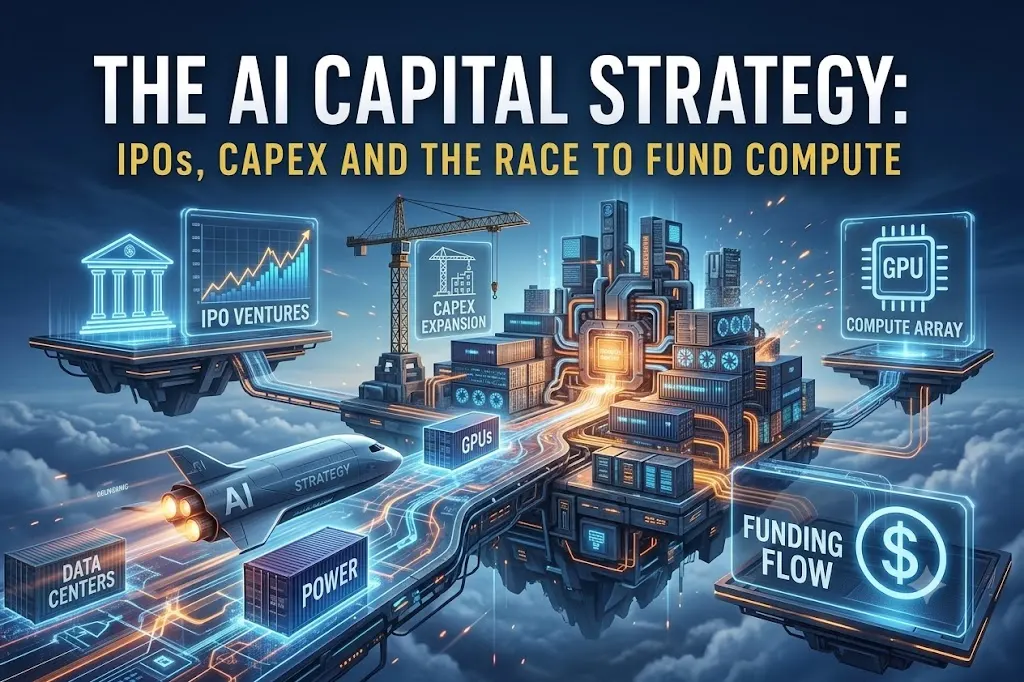
AI Capital Strategy: IPOs, CapEx and the Race to Fund Compute
Asim Ansari
June 24, 2026
28 min read
Explore how AI companies are using IPOs, CapEx, cloud contracts, private capital and energy deals to fund the compute infrastructure behind frontier AI.
Quick Answer
AI capital strategy is the way frontier AI companies fund the compute infrastructure needed to train and run advanced models. It includes IPOs, CapEx, debt, cloud contracts, GPU supply agreements, data centers, power procurement and private infrastructure financing. In the next AI phase, the winner may be the company that converts compute into profitable revenue fastest.
Disclaimer: This article is strategic analysis intended for business leaders and technology executives. It is not investment, financial, or legal advice.
Frontier AI used to look like a software story: better models, faster products, and rapid user growth. For years, the narrative was driven by algorithmic breakthroughs, novel neural architectures, and software engineering. But the economics have fundamentally changed. The biggest AI companies are now competing for physical compute, massive GPU clusters, multi-gigawatt data centers, secure power grids, and the long-term capital required to finance them all. This is the rise of AI capital strategy: the financial and infrastructure playbook behind the next generation of artificial intelligence.
In this deep dive, we explore how AI has transitioned from an asset-light software business into a heavy-industry capital race, why CapEx is the new competitive moat, and what this structural shift means for enterprise IT, investors, and the global cloud ecosystem.
The Infrastructure Pipeline: How Capital Becomes Intelligence
Before we unpack the strategies, it is critical to understand the lifecycle of AI capital. Money does not simply buy software; it buys physical hardware and energy, which then produce intelligence.
The AI Capital-to-Revenue Pipeline
Capital
IPOs, Debt, Private Credit
→
↓
GPUs & Hardware
H100s, Blackwell, Custom Silicon
→
↓
Data Centers & Power
Megawatt Sites, Cooling, Grid
→
↓
Models & Products
Training Runs, AEO, SaaS
→
↓
Revenue
Inference Margins, API Calls
What Is AI Capital Strategy?
At its core, AI Capital Strategy refers to the comprehensive financial and operational roadmap that artificial intelligence organizations execute to acquire, manage, and optimize the underlying physical infrastructure required for machine learning at scale.
This strategy goes far beyond simple cloud billing optimization. It encompasses securing billion-dollar debt facilities, going public (IPOs) specifically to fund data center expansions, signing decade-long energy procurement contracts (PPA—Power Purchase Agreements), and structuring highly complex capacity commitments with GPU cloud providers.
If software strategy is about the speed of writing code and product distribution, AI capital strategy is about mastering the velocity of converting structured finance into raw intelligence.
Why AI Is No Longer Just a Software Business
Traditionally, the beauty of the software-as-a-service (SaaS) industry has been its near-zero marginal cost. You build a piece of software once, and distributing it to the next thousand users costs almost nothing. This led to an era of "asset-light" tech giants characterized by incredibly high gross margins and very few physical assets on their balance sheets.
Frontier AI companies, however, operate under an entirely different set of economic laws. The deployment of a frontier generative AI model incurs significant marginal costs. Every API call, every query to an Answer Engine, and every image generation requires physical silicon crunching numbers in a cooled, power-hungry facility.
Metric
Old Software Model (SaaS)
Frontier AI Model
Marginal Cost
Near zero (highly scalable)
High compute cost per query (inference)
Business Structure
Asset-light, code-driven
Infrastructure-heavy, physical assets
Infrastructure Approach
On-demand cloud usage (elastic)
Long-term capacity commitments (reserved)
Competitive Moat
Proprietary code, network effects
Compute scale + Proprietary Data + Distribution
Revenue Dynamics
Scales easily with high margins
Revenue must aggressively cover CapEx depreciation
To train a state-of-the-art Large Language Model (LLM) today requires clusters of tens or even hundreds of thousands of advanced GPUs (like Nvidia’s H100s or newer Blackwell architectures), running continuously for months. This means frontier AI companies are behaving more like oil refineries, telecom giants, or heavy manufacturers than traditional agile software shops. Their success hinges not just on brilliant research scientists, but on aggressive, perfectly timed capital expenditure (CapEx) cycles.
Compute Is the New Bottleneck
Historically, tech progress was gated by human talent—how many 10x engineers you could hire. In the era of Generative AI, the absolute bottleneck is Compute.
"Compute" refers to the processing power required for both the training phase (teaching the model patterns across vast datasets) and the inference phase (generating a response when a user prompts the model). Models are scaling by an order of magnitude with every generation. If a GPT-3 class model required thousands of GPUs, the next generation requires clusters approaching or exceeding 100,000 GPUs.
There are physical, logistical limits to this expansion. You cannot simply log into a cloud console and spin up 100,000 interconnected H100s. The supply chain constraints are severe: TSMC fabrication limits, advanced packaging constraints (CoWoS), high-bandwidth memory (HBM) shortages, optical networking limitations, and profoundly, the sheer unavailability of megawatt data center space with sufficient power allocation.
Whoever can secure, finance, and deploy compute the fastest controls the pacing of AI advancement. This reality has forced AI companies into high-stakes financing strategies just to secure their place in line.
The AI Infrastructure Financing Timeline
To understand the sheer velocity of capital deployment in the AI sector, we must look at how infrastructure deals and public market events have escalated. The numbers have quickly moved from millions to billions, and now to hundreds of billions.
The Compute Capital Timeline
January 2025: Stargate Revealed
OpenAI and Microsoft effectively define the "infrastructure era" with the announcement of the Stargate project. Stargate is an unprecedented $500 billion infrastructure blueprint spanning four years, aimed at building the physical foundation for Artificial General Intelligence (AGI), with over $100 billion planned for immediate, accelerated deployment.
May 2025: The CoreWeave IPO
Demonstrating the public market's insatiable appetite for AI infrastructure, specialized GPU cloud provider CoreWeave goes public. The company priced 37.5 million shares at $40 each, successfully raising $1.5 billion. This marks a major pivot where "cloud infrastructure" becomes a standalone, highly valued asset class independent of legacy hyperscalers.
May 2026: The Cerebras Mega-IPO
Signaling that the infrastructure boom is accelerating, Cerebras (a leader in massive, wafer-scale AI processors) hits the public markets. Driven by extreme institutional demand for AI compute alternatives, the IPO prices at $185 per share, raising an estimated $5.55 billion. This validates the strategy of using public equities to finance massive, capital-intensive silicon fabrication.
Mid 2026: Private Infrastructure Financing Peaks
Frontier labs and cloud providers shift heavily into structured debt and infrastructure project financing, bypassing traditional venture capital to secure tens of billions from sovereign wealth funds, private equity, and energy firms to build multi-gigawatt sovereign AI data centers.
Why IPOs Are Becoming Funding Tools for AI Infrastructure
The examples of CoreWeave and Cerebras highlight a critical shift in capital markets. Traditionally, a technology IPO was an exit event—a way for early venture capitalists and employees to liquidate their shares after a decade of building software, while providing the company with a modest cash cushion for geographic expansion or strategic acquisitions.
In the AI era, the IPO has reverted to its original, industrial purpose: capital formation for heavy infrastructure.
Venture capital, even at its most aggressive, struggles to write the single-check sizes ($5B to $10B) required to build modern AI training clusters. Private markets are vast, but they demand liquidity events. The public markets provide the deepest, most liquid pools of capital on the planet. By going public, AI infrastructure companies (and eventually, perhaps the frontier labs themselves) can tap into retail and institutional capital to directly purchase GPUs, build cooling towers, and secure nuclear or renewable energy contracts. The IPO is no longer the finish line; it is the starting gun for the CapEx race.
CapEx as the New AI Moat
Capital Expenditures (CapEx) represent the money spent to acquire, upgrade, and maintain physical assets. In AI, CapEx translates directly to chips, networking gear, servers, and the concrete structures that house them.
We are witnessing an environment where CapEx is being wielded as an aggressive competitive moat. If Hyperscaler A announces a $40 billion annual CapEx budget primarily directed at AI compute, Hyperscaler B must match it or risk losing the ability to train the next generation of foundational models.
The Economics of the CapEx Moat
By heavily front-loading CapEx, market leaders make it prohibitively expensive for new entrants to compete at the frontier level. A startup might raise $100 million and build a great software wrapper, but they cannot afford the $5 billion supercomputer required to train a base model from scratch. CapEx effectively crowds out competition, narrowing the frontier AI race to a handful of hyper-capitalized players.
However, CapEx is a double-edged sword. Physical hardware depreciates aggressively. An H100 cluster bought today will be massively outperformed by hardware released 24 months from now. Therefore, the company making the CapEx investment must have absolute confidence that they can generate sufficient revenue from that hardware before it becomes obsolete. This demands relentless, hyper-efficient hardware utilization.
Compute Contracts Are the New Supply Chain
Because raw compute is scarce, AI companies have had to innovate in how they procure it. Enter the long-term compute contract.
Instead of traditional cloud usage where an enterprise pays by the hour for what they use, AI companies are signing massive, multi-year capacity reservations. They commit to spending hundreds of millions of dollars over three to five years to guarantee that a specific block of GPUs will be available exclusively to them.
AI Capital Layer
What It Means
Why It Matters
IPOs
Accessing public market funding
AI infra companies need billions in liquid capital rapidly.
CapEx
Purchasing GPUs, servers, physical facilities
Creates an insurmountable compute moat against competitors.
Cloud Contracts
Long-term, binding capacity commitments
Guarantees predictable, uninterrupted compute supply for training.
Private Credit
Debt financing and project-based finance
Allows massive buildouts without aggressively diluting equity.
Energy Deals
Power Purchase Agreements, grid modernization, nuclear
Data centers are entirely useless without guaranteed, stable power.
Utilization
Optimized hardware usage rates
The primary driver of ROI and operational profitability.
These contracts act as collateral. When an AI company signs a $500M contract with a specialized GPU cloud provider, that cloud provider can take that contract to a bank to secure the debt financing needed to actually buy the GPUs from Nvidia. It is a highly intertwined financial ecosystem where future software revenue is collateralized to build current physical infrastructure.
Data Centers, GPUs and Power: The Physical AI Stack
To execute an AI capital strategy, executives must manage the physical AI stack, which consists of three highly volatile commodities:
Silicon (GPUs and Accelerators): You need the absolute latest architecture to train models efficiently. Relying on old architecture means your training runs will take too long, costing more in power and engineering time, and leaving you behind the innovation curve.
Data Center Real Estate: AI data centers are fundamentally different from traditional web-hosting data centers. They require vastly reinforced floors to hold heavy server racks, entirely different spatial layouts for optical networking cables, and advanced liquid cooling systems because standard air conditioning cannot handle the heat output of concentrated AI clusters.
Power (The Final Boss): You can raise the money and buy the chips, but if you cannot plug them in, you have a multi-billion dollar paperweight. The electrical grid in many regions simply cannot handle the sudden, massive load requests of 500MW to 1GW data centers.
Energy Is Now Part of AI Strategy
According to the International Energy Agency (IEA), data centers consumed around 415 TWh of electricity globally in 2024 (about 1.5% of global electricity demand). Driven by AI, this is projected to soar to around 945 TWh by 2030.
Because of this, AI strategy is now inextricably linked to energy strategy. We are seeing cloud providers investing directly in nuclear power plants (like Amazon AWS's acquisition of a data center campus adjacent to the Susquehanna nuclear plant), funding geothermal energy startups, and signing massive renewable energy PPAs. An AI company without a credible, long-term power strategy is functionally an AI company without a future.
Why Frontier AI Companies Look Like Infrastructure Giants
When you combine aggressive CapEx, long-term supply chain contracts, and power grid investments, frontier AI companies start to look less like Google circa 2004 and more like ExxonMobil, AT&T, or a major railroad operator from the 20th century.
They are building the literal tracks of the future economy. This requires a different type of executive leadership—CFOs who understand structured finance and project debt, COOs who know how to navigate global supply chain geopolitics, and infrastructure leaders who can oversee the construction of multi-billion dollar physical assets.
The Role of Private Credit and Infrastructure Funds
Because the capital requirements are so vast, traditional venture capital is no longer sufficient. Enter Private Credit and Infrastructure Funds.
Firms like Blackstone, Brookfield, and major sovereign wealth funds—institutions that historically financed toll roads, airports, and power plants—are now the primary financiers of AI data centers. They like these investments because the cloud contracts signed by the AI companies provide guaranteed, predictable yield over 10 to 15 years, which perfectly matches their investment profile.
The Risk of Overbuilding AI Infrastructure
With any massive capital deployment cycle, the primary risk is overbuilding. If the demand for AI inference (users paying for AI outputs) does not scale as fast as the supply of AI compute, the industry faces a potential localized collapse.
Risk
Explanation
Mitigation Strategy
Overbuilding
Inference demand grows slower than new data center capacity.
Secure customer contracts first; build in modular, phased expansions.
GPU Obsolescence
Chips age incredibly fast, destroying the value of early CapEx.
Flexible procurement, rapid hardware amortization, and leasing options.
Energy Bottleneck
Sufficient power is completely unavailable for new data centers.
Strategic site selection, private grid planning, and co-locating with power generation.
Margin Pressure
The cost of inference is too high to generate a software-like profit.
Aggressive model optimization, quantization, and specialized inference silicon.
Debt Load
Too much financing cost sinks the company if AI growth stalls.
Maintain strict utilization discipline; do not borrow ahead of confirmed demand.
What This Means for Enterprises
For enterprise leaders, the AI capital race means you must be strategic about where and how you deploy AI.
Cost Discipline is Mandatory: Because the underlying compute is so expensive, enterprises cannot afford inefficient, poorly coded AI applications.
Hybrid is the Future: Enterprises will likely rely on hyperscalers for massive foundational models, but utilize localized, on-premise, or sovereign AI infrastructure for sensitive, specialized tasks to control costs.
Vendor Lock-in is Real: As you integrate deeply with an AI vendor's ecosystem, migrating off their proprietary compute stack becomes increasingly difficult.
What This Means for Investors
For investors, the AI story has bifurcated. There are the "application layer" companies (SaaS wrappers) which still operate on traditional venture metrics. Then there is the "infrastructure layer," which requires deep pockets, high risk tolerance for rapid depreciation, and an understanding of project finance. The winners in the infrastructure space will be those who can lock in the cheapest power and the most efficient hardware utilization.
What This Means for Cloud and AI Vendors
For the vendors themselves, the race is existential. They must continually raise billions of dollars to build the next cluster, knowing that if they pause for even one generation, they will lose their competitive edge. The transition from software agility to industrial-scale logistics is complete. The companies that survive will be those that master the supply chain, the capital markets, and the power grid as effectively as they mastered the neural network.
AI Compute Economics Checklist
Is your organization prepared for the reality of AI infrastructure costs? Download our comprehensive checklist to evaluate your compute strategy.
Are you tracking inference cost per query vs. revenue generated?
Do you have a strategy for handling sudden cloud capacity shortages?
Is your infrastructure optimized for your specific model size (quantization)?
Have you evaluated sovereign AI or on-premise solutions for cost control?
FAQs
What is AI capital strategy?
AI capital strategy is the strategic financial approach used by AI companies to fund the massive physical infrastructure (GPUs, data centers, power) required to build and run advanced AI models. It involves utilizing IPOs, CapEx, debt, and cloud contracts.
Why do AI companies need so much compute?
Training generative AI models involves processing trillions of parameters across massive datasets. This requires extreme parallel processing that only massive clusters of specialized hardware (like GPUs) running continuously can achieve.
Why is CapEx important in AI?
CapEx (Capital Expenditure) acts as a competitive moat. By investing billions in physical infrastructure upfront, market leaders make it nearly impossible for new, underfunded startups to compete at the frontier model level.
How are IPOs connected to AI infrastructure?
IPOs are increasingly used as direct funding mechanisms for infrastructure. Companies like CoreWeave and Cerebras go public to tap into massive pools of retail and institutional capital, using the raised funds to buy chips and build data centers.
What is compute economics?
Compute economics is the study and management of the costs associated with running AI models. It balances the high fixed costs of hardware acquisition against the variable costs of energy and the revenue generated from inference (API calls).
Why are data centers important for AI?
Data centers are the physical homes of AI. Modern AI data centers require specialized, reinforced structures, extreme liquid cooling systems, and massive power allocations that standard IT data centers simply cannot support.
How does energy affect AI growth?
Energy is the hard physical limit to AI scaling. Training clusters draw hundreds of megawatts. Without grid capacity or dedicated power sources (like nuclear or geothermal), companies cannot turn on the GPUs they have purchased.
Can AI companies overbuild infrastructure?
Yes. The primary risk is building massive data centers based on projected demand that fails to materialize. If user adoption slows, the debt and depreciation from idle hardware can quickly crush profit margins.
What should enterprises learn from the AI compute race?
Enterprises must understand that AI is not cheap software. They need to prioritize strict cost-control, optimize their model usage, and consider sovereign or hybrid infrastructure to avoid massive, unpredictable cloud bills.
How can Intellectual Clouds help with AI infrastructure planning?
Intellectual Clouds helps businesses design scalable AI architecture, optimize compute costs, deploy MLOps pipelines, and formulate long-term capital and infrastructure strategies before compute costs become a bottleneck.
Intellectual Clouds helps businesses plan scalable AI infrastructure, cloud architecture, MLOps, compute optimization, cost control and AI deployment strategy before infrastructure costs become a bottleneck.
Asim Ansari is the Founder of Intellectual Clouds and a Certified Salesforce Administrator and Pardot Specialist with 17+ years of experience across Salesforce CRM, AI automation, cloud infrastructure (AWS), and digital transformation. He writes on AI agents, Salesforce delivery, Answer Engine Optimisation (AEO), and AI-accelerated business operations.