HomeBlogHow We Test Our Salesforce AI Development Agent Against Real-World Problems
Salesforce
How We Test Our Salesforce AI Development Agent Against Real-World Problems
Asim Ansari
September 30, 2026
16 min read
See how Intellectual Clouds evaluates a Salesforce AI Development Agent using real-world problem patterns, expert review, practical testing, and responsible AI controls.
Executive Summary
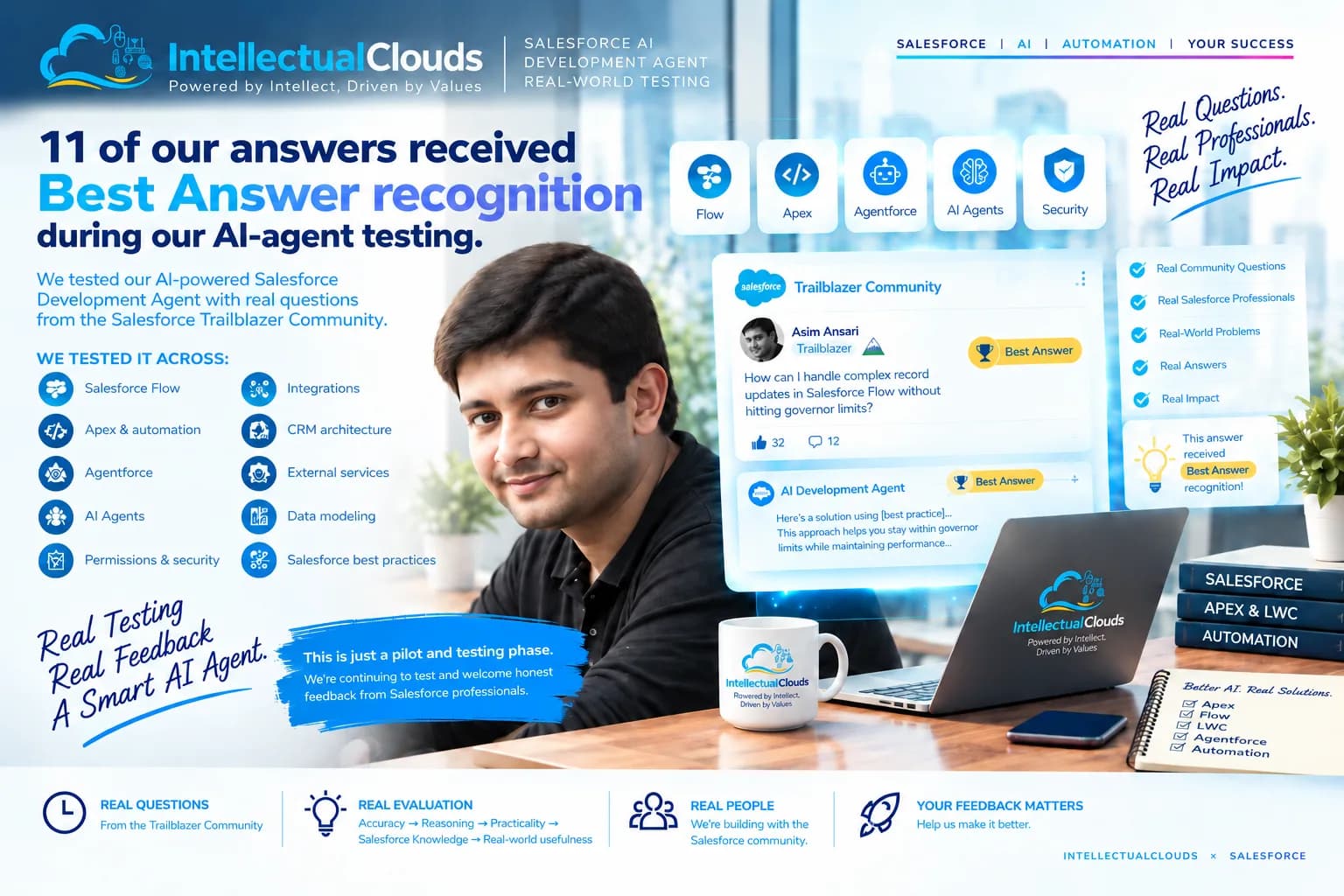
AI demos are easy; enterprise Salesforce delivery is not. Intellectual Clouds evaluates our Salesforce AI Development Agent against unscripted, real-world community problem patterns across Flow, Apex, Agentforce, security, and integrations. During our September 2026 evaluation cycle, 11 published community responses achieved official Best Answer recognition—providing empirical evidence that AI paired with accountable human review delivers measurable, production-grade problem-solving.
Demos vs. Reality: Controlled prompts and synthetic benchmarks fail to capture the complexity of layered permissions, legacy automation, and platform governor limits.
Empirical Community Signal: 11 community solutions received Best Answer recognition during September 2026, validating reasoning quality across Flow, Agentforce, external services, and validation logic.
Community Acceptance ≠ Salesforce Certification: Best Answer marks signify peer-validated usefulness on real edge cases, not a vendor accreditation of autonomous software.
The Four Evaluation Pillars: Our pilot assesses accuracy, causal reasoning, practical implementation, and proactive safety escalation.
Human-in-the-Loop Governance: AI acts as an accelerator for investigation and synthesis, while experienced architects remain accountable for sandbox validation and production deployment.
Build Enterprise-Grade Salesforce AI Workflows
Discover how Intellectual Clouds bridges autonomous AI reasoning with strict engineering governance.
A clean prompt, a polished answer, and a carefully prepared workflow can make almost any AI system look impressive. But anyone who works with Salesforce every day knows that production environments are nothing like canned demonstrations.
Salesforce professionals deal with incomplete requirements, complex permissions, legacy automation, integrations, Flow execution nuances, Apex governor limits, security constraints, data-model decisions, and business rules that rarely fit neatly into a pre-packaged prompt.
That is why Intellectual Clouds is developing and testing a Salesforce AI Development Agent built around real-world problem patterns, not synthetic benchmarks.
Our foundational research question is straightforward:
Can an AI development agent help Salesforce professionals reason through practical, unstructured problems without replacing expert judgement, disciplined sandbox testing, or responsible governance?
What We Are Testing
Our Salesforce AI Development Agent is evaluated across the core technical areas where real-world Salesforce work happens every day:
Salesforce Flow and automation – Testing record-triggered execution, loop handling, recursion traps, and migration away from legacy rules.
Apex and asynchronous processing – Governor limit safety, Queueable vs. Batch design, and bulkified execution.
Agentforce and AI-agent design – Topic classification, prompt grounding, deterministic action boundaries, and CRM reasoning models.
Permission sets and security controls – Field-Level Security (FLS), sharing rules, object permissions, and user-mode execution.
Integrations and external services – OpenAPI schemas, Named Credentials, and Model Context Protocol (MCP) connectivity.
CRM architecture and data modelling – Relationship design, polymorphic fields, junction objects, and schema integrity.
Validation rules and error diagnosis – Cross-object formula debugging, exception log analysis, and root-cause tracing.
Salesforce best practices – Platform standards, code maintainability, and clean technical architecture.
Salesforce development and deployment workflows – Sandbox validation, change sets, DevOps pipelines, and regression testing.
The Purpose of Our Agent
The purpose is not to create a system that confidently answers everything.
The purpose is to build a system that can help a Salesforce professional investigate issues, surface relevant technical considerations, recommend a safer next step, and recognize when expert review is required.
Synthetic benchmarks are helpful for baseline evaluations, but they have distinct blind spots. A standard coding benchmark usually presents a cleanly specified problem with a known unit-test suite in a sterile sandbox. Real Salesforce work almost never looks like that.
In enterprise production environments, an issue typically involves messy, intersecting dependencies:
A record-triggered Flow that works fine in isolation but triggers recursion when combined with a legacy Apex trigger.
A permission error triggered by a combination of Permission Set Group mutation, custom metadata sharing, and implicit parent-record ownership.
A legacy Process Builder or Workflow Rule that quietly overrides values downstream.
An external integration callout that fails intermittently due to token expiration under high concurrency.
An Apex design decision that functions cleanly on single records but explodes with governor limit exceptions during large data loads.
An Agentforce custom agent action that requires deterministic boundary controls rather than unconstrained LLM generation.
The true test of an AI development agent is not whether it generates a grammatically articulate paragraph. It is whether it helps an engineer identify the precise line of code, the specific Flow element, or the exact permission assignment causing the breakdown.
Community Recognition Is a Signal, Not a Certification
During a September 2026 review period, 11 published responses associated with Asim Ansari's Trailblazer Community activity received Best Answer recognition.
The notification record shows Best Answer recognition across active, unscripted community questions involving:
Salesforce Flow and automation logic
Agentforce topics and action configurations
External services and integration schemas
Validation rules and formula troubleshooting
Object permissions and Field-Level Security
Data modelling and custom object architecture
Manufacturing workflows and industry-specific processes
This recognition matters because it comes from real people dealing with real production problems.
✓
Live Proof & Verification
You can directly review all 11 community solutions and active Trailblazer recognition records here:
What This Recognition Means — And What It Does Not Mean
However, this milestone must be described with complete accuracy and transparency:
What It Means
Real Community Acceptance
Eleven published community responses received Best Answer recognition during our evaluation period. Real Salesforce administrators and developers verified that these answers directly unblocked their technical issues.
What It Does NOT Mean
No Artificial Claims
It does not mean: Salesforce certified our AI agent.
It does not mean: The AI independently solved 11 Salesforce problems without human review.
Best Answer recognition is community acceptance of a helpful response. Salesforce community guidance describes Best Answer as a way for question authors to mark helpful answers and help other Trailblazers find useful information. Read the official Salesforce community answer guidance.
Our Responsible Evaluation Method
Our pilot is designed around four essential evaluation areas:
1
Accuracy
Does the proposed response reflect current Salesforce behavior, documented limits, and supported implementation patterns?
Salesforce evolves across three annual releases. Our testing checks that the agent does not suggest deprecated components (such as Process Builder or legacy Workflow Rules), respects current API versions, and adheres to official platform limits.
2
Reasoning
Does the agent identify the important technical constraints, or does it jump to an answer without understanding Flow behavior, permissions, integrations, security, or data context?
A useful answer must evaluate order of execution, Before vs. After triggers, formula evaluations, and security layers. We test whether the agent reasons through the complete lifecycle of a record change rather than offering superficial code.
3
Practicality
Can a Salesforce administrator, developer, architect, or consultant use the answer to make real progress?
Theoretical advice does not resolve deployment blockers. Solutions must provide actionable, step-by-step guidance, exact field and formula references, and clear verification steps that can be applied immediately in an org.
4
Safety and Escalation
Does the agent know when it needs more information, sandbox testing, official documentation, or expert review?
The most dangerous AI is one that pretends certainty with incomplete data. The agent is strictly evaluated on its ability to flag risks, request missing schema details, mandate sandbox testing, and suggest human architect sign-off.
Key Principle: The ideal agent does not pretend certainty when it does not have enough context.
Human Review Remains Essential
A Salesforce AI Development Agent should support professionals, not bypass accountability.
Before any AI-assisted recommendation is used in a client environment or deployed to production, teams should validate:
Pre-Deployment Validation Checklist
01
Salesforce Release & VersionConfirm syntax and features match your active org release.
02
Object & Field PermissionsVerify Field-Level Security and avoid unintended privilege escalation.
03
Flow Execution ContextCheck Before-Save vs. After-Save order and recursion triggers.
04
Apex Governor LimitsTest SOQL, DML, and CPU time limits under 200-record batch conditions.
05
Integration AuthenticationValidate Named Credentials, endpoint tokens, and error payloads.
06
Data Quality and OwnershipEnsure record sharing and data skew will not trigger lock errors.
07
Security ImplicationsAudit compliance, data residency, and sensitive field masking.
08
Sandbox Test ResultsExecute regression test suites and end-to-end flows in a full sandbox.
09
Business-Process RequirementsConfirm the technical implementation meets the true user acceptance criteria and business goals.
AI can accelerate research, troubleshooting, documentation, and solution design. It cannot safely replace responsibility for production changes.
What We Are Learning From Real-World Testing
Our ongoing evaluation cycle continues to reinforce several foundational principles:
Context Is More Critical Than Prompt Engineering
A generic prompt like "How do I fix my Flow?" produces generic, ineffective advice. A high-leverage Salesforce answer requires specific org topology: the object schema, relationship cardinality, existing trigger frameworks, sharing models, and business process constraints. Context engineering beats clever prompting every time.
Deterministic Logic Still Rules Enterprise CRM
AI excels at processing ambiguity, analyzing error logs, exploring alternative patterns, and synthesizing documentation. However, core financial transactions, regulatory compliance checks, audit trail logging, and record approvals must remain strictly deterministic. Pairing probabilistic AI agents with deterministic Flow and Apex controls yields the highest reliability. See our guide on how to automate Salesforce workflows with AI.
A development assistant should never possess unconstrained access to production environments, metadata deployments, or raw credentials. Secure implementations operate through approved action catalogs, scoped read-only query capabilities, structured pull-request reviews, and explicit human confirmation gates for impactful steps.
Continuous Evaluation Is Mandatory
Salesforce is not static. Platform updates, new Agentforce releases, and shifting best practices mean an agent trained on yesterday's documentation will give yesterday's answers. Continuous evaluation against live community questions and partner edge cases keeps the system grounded in current reality.
How Intellectual Clouds Can Help
Intellectual Clouds helps forward-looking enterprises integrate AI into their Salesforce lifecycle without compromising security, engineering standards, or data privacy.
Our Salesforce and AI consulting offerings include:
Salesforce AI Strategy & Roadmap: Identify high-ROI use cases across Sales Cloud, Service Cloud, and Revenue Cloud.
Agentforce Architecture & Rollout: Design custom agents with robust topics, deterministic action guards, and Einstein Trust Layer integration.
AI-Accelerated Flow & Apex Development: Build, modernize, and refactor automation suites with AI-assisted delivery workflows.
External Services & MCP Connectivity: Safely connect Salesforce to external systems, data warehouses, and custom LLM microservices.
Security & Trust Boundary Audits: Ensure your AI implementations comply with strict enterprise data governance standards.
Accelerate Your Salesforce Engineering
Whether you are looking to pilot Agentforce, build custom AI automations, or adopt AI-accelerated delivery for your next major release, our team is ready to assist.
A Salesforce AI Development Agent is an AI-assisted system designed to assist engineers with technical investigation, troubleshooting, solution design, Flow and Apex planning, Agentforce action authoring, external service integrations, test generation, and architecture documentation.
Can an AI agent replace a Salesforce developer or architect?
No. While AI significantly accelerates research, syntax generation, and error diagnosis, enterprise Salesforce solutions require human judgement to evaluate business context, govern release cycles, design secure data models, and take ownership of production changes.
What does Trailblazer Community Best Answer recognition mean?
Best Answer recognition indicates that the author of a technical question selected a specific response as the single most helpful and accurate solution for their issue. It reflects peer acceptance in real-world problem-solving scenarios, rather than a commercial software certification from Salesforce.
How should AI-assisted Salesforce solutions be tested?
Teams should evaluate AI solutions against unscripted, anonymized edge cases. Rigorous testing benchmarks must measure code correctness, governor limit efficiency, security permissions compliance, execution safety, and how accurately the system identifies its own operational boundaries.
Can AI assist with both declarative Flow and programmatic Apex?
Yes. An effective development agent helps evaluate when a declarative Flow is sufficient versus when programmatic Apex is required for bulk data volumes. In both scenarios, all metadata recommendations must be validated in a dedicated sandbox before deployment.
Recommended Transparency Statement
Intellectual Clouds employs AI-assisted research, automated synthesis, and empirical evaluation methods in its Salesforce development-agent pilot. All published technical recommendations and client implementations are reviewed and verified by accountable Salesforce professionals prior to deployment. Community recognition reflects the independent evaluation of Trailblazer Community members and does not constitute an official endorsement or product certification by Salesforce Inc.
Asim Ansari is the Founder of Intellectual Clouds and a Certified Salesforce Administrator and Pardot Specialist with 17+ years of experience across Salesforce CRM, AI automation, cloud infrastructure (AWS), and digital transformation. He writes on AI agents, Salesforce delivery, Answer Engine Optimisation (AEO), and AI-accelerated business operations.