HomeBlogWhat Is MANGOS? The 6 AI Giants Redefining Big Tech After FAANG
Artificial Intelligence
What Is MANGOS? The 6 AI Giants Redefining Big Tech After FAANG
Asim Ansari
July 3, 2026
23 min read
Learn what MANGOS means, how Meta, Anthropic, Nvidia, Google, OpenAI and SpaceX represent the new AI economy, and why this acronym is replacing FAANG.
⚠️ Important Disclosure
Disclaimer: MANGOS is not an official stock index or ETF. It is a market narrative and acronym used to describe the companies leading the AI infrastructure era. This article is for informational and business strategy purposes only and does not constitute investment advice.
Quick Answer
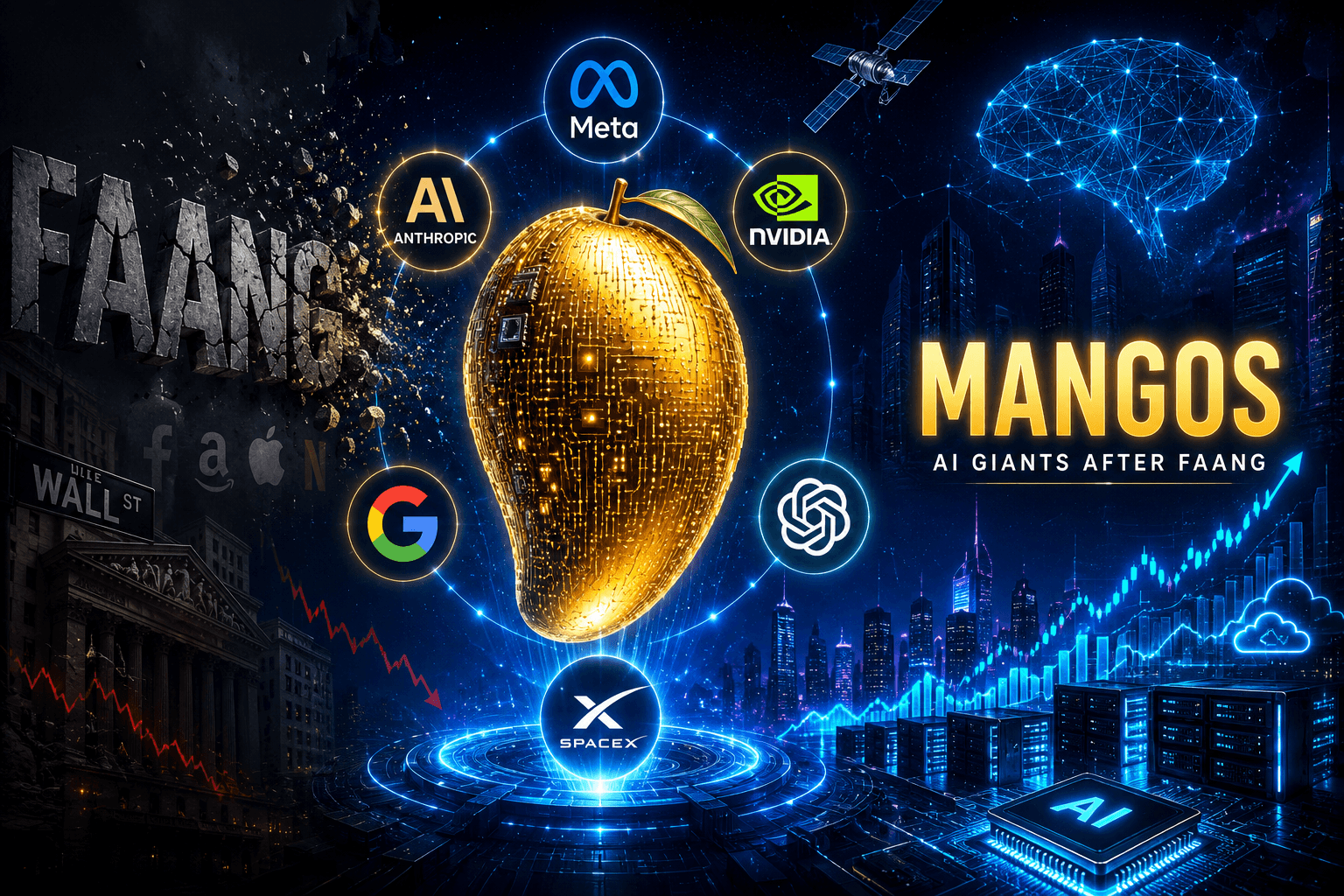
MANGOS stands for Meta, Anthropic, Nvidia, Google, OpenAI and SpaceX. It is an unofficial market acronym used to describe companies shaping the AI economy through consumer distribution, frontier AI models, GPUs, cloud infrastructure, search, data centers, connectivity and space-linked infrastructure. Unlike FAANG, MANGOS is about AI capability and infrastructure, not only consumer internet platforms.
FAANG explained the internet era. MANGOS explains the AI infrastructure era.
For over a decade, investors and business strategists used "FAANG" (Facebook, Amazon, Apple, Netflix, Google) as shorthand for the dominant tech giants. But the shift from software to artificial intelligence has fractured that old paradigm. We are no longer living in an era dominated purely by consumer internet platforms, ad networks, and streaming subscriptions. We are entering an era dictated by raw compute, frontier models, massive data centers, and the energy required to run them.
Enter MANGOS: an emerging market acronym that groups the defining companies of the AI era—Meta, Anthropic, Nvidia, Google/Alphabet, OpenAI, and SpaceX.
In this comprehensive guide, we will break down what MANGOS means, how it differs from FAANG, why certain companies made the list while traditional giants were left out, and most importantly, what businesses can learn from the new AI stack.
1. What Is MANGOS?
MANGOS is a financial and technological acronym that groups together six companies considered to be at the absolute bleeding edge of the artificial intelligence revolution:
Meta
M
Anthropic
A
Nvidia
N
Google
G
OpenAI
O
SpaceX
S
Unlike FAANG, which primarily represented publicly traded companies that dominated the consumer internet, MANGOS is a mix of public megacaps and private heavyweights. It is not an official stock index. Instead, it is a narrative framework used to explain who controls the critical bottlenecks of the AI economy: the models, the chips, the data centers, the energy, and the infrastructure.
Sources & Origin of MANGOS
Roger Montgomery initially explained an earlier MANGO version (Meta, Apple, Nvidia, Google, OpenAI) as a move from FAANG’s consumer internet model to foundational AI, semiconductors, and cloud.
Fast Company reported that MANGO became viral as a new AI-era acronym, updating it to include Anthropic alongside Meta, Nvidia, Google, and OpenAI.
EBC uses the expanded six-company MANGOS version—adding SpaceX—while clearly stating it represents a shift in market paradigm rather than a tradable index.
2. MANGO vs MANGOS: Why Definitions Differ
Because this is a grassroots market acronym rather than an official index (like the S&P 500), you will see different variations in financial media.
The addition of the "S" for SpaceX is crucial. As AI scales, the constraints are no longer just software code; they are physical. AI requires massive data centers, localized energy generation, and global connectivity. SpaceX (and its associated ventures like xAI and Starlink) represents the physical infrastructure layer required to globally deploy AI.
3. Why FAANG No Longer Explains Big Tech
FAANG made perfect sense for the 2010s. The bottlenecks of that era were user acquisition and consumer attention. Facebook, Amazon, Apple, Netflix, and Google won by building massive, scalable software platforms that aggregate users at near-zero marginal cost.
The AI era is fundamentally different. It is constrained by physical resources: GPUs, energy, and cooling.
Category
FAANG Era (2010s)
MANGOS Era (2020s+)
Core Focus
Consumer internet platforms
AI infrastructure and intelligence
Business Models
Ads, streaming, ecommerce
Models, chips, cloud, agents
Growth Mechanic
Software-heavy scaling
CapEx-heavy scaling
The Economy
Attention economy
Compute economy
Strategic Moat
App/platform dominance
AI stack dominance
Distribution
Web and mobile networks
Agents, data centers, satellites, GPUs
To understand AI Capital Strategy today, you have to look past the App Store and look at the companies pouring billions into building AGI (Artificial General Intelligence) facilities.
4. The 6 Companies in MANGOS
To grasp why MANGOS is the acronym of the future, we need to understand the AI stack. The AI economy is built on layers:
Connectivity/Energy: The physical infrastructure required to power and link massive computing systems.
Compute: The specialized silicon (GPUs/TPUs) used to train models.
Cloud/Data: The environments where data is stored and models are trained.
Models: The foundational "brains" (LLMs) that process information.
Distribution: The consumer and enterprise interfaces that deploy the models to humans.
Here is how the MANGOS companies map to these critical bottlenecks:
Company
AI Role
Main Bottleneck Controlled
Meta
Social distribution + open-source AI platforms
Users, ad distribution, open model standards
Anthropic
Claude + enterprise AI alignment
Frontier model safety and enterprise adoption
Nvidia
GPUs + AI compute chips + CUDA software
Compute supply and hardware layer
Google/Alphabet
Search, Cloud, TPUs, DeepMind
Search dominance, proprietary data, cloud, research
OpenAI
ChatGPT + foundational models
Consumer AI mindshare and model leadership
SpaceX
Starlink, connectivity, infrastructure, xAI ties
Global connectivity and physical tech infrastructure
Let's break down exactly why each company makes the MANGOS list.
5. Meta: AI Distribution Through Social Platforms
Meta is uniquely positioned because of its absolute dominance over consumer distribution. With billions of daily active users across Facebook, Instagram, and WhatsApp, Meta does not need to build a new app to deploy an AI agent—it simply updates an app already on your phone.
Furthermore, Meta's release of the Llama series of open-weights models changed the AI economy forever. By open-sourcing foundational models, Meta commoditized the model layer, forcing competitors to compete on compute and distribution rather than pure IP. Meta uses its AI to drive engagement algorithms and ad targeting, turning advanced AI directly into revenue.
6. Anthropic: Enterprise AI and Claude
Anthropic represents the rise of the specialized, private AI titan. Founded by former OpenAI researchers, Anthropic focuses heavily on AI safety, alignment, and enterprise reliability.
Their Claude family of models has consistently rivaled or beaten GPT-4 in independent benchmarks, particularly in coding, reasoning, and long-context windows. Because Anthropic has positioned Claude as the safe, "steerable" model, they have become the darling of enterprise integrations and B2B workflows, proving that you don't need a consumer chatbot to be a vital pillar of the AI ecosystem.
Note: For businesses looking to utilize Anthropic, learning Claude AISEO tasks is a powerful way to increase productivity.
7. Nvidia: The Compute Layer
Nvidia is the undisputed king of the AI gold rush. They are the company selling the picks and shovels. Foundational AI models require thousands of GPUs (Graphics Processing Units) to train, and Nvidia's H100 and Blackwell chips are the industry standard.
Nvidia’s moat isn't just hardware; it’s software. Their CUDA software layer makes it incredibly difficult for developers to switch to competing chips from AMD or Intel. By controlling the compute supply, Nvidia acts as the toll booth for the entire MANGOS ecosystem.
8. Google/Alphabet: Search, Cloud, TPUs and DeepMind
Google is the only company that controls every layer of the AI stack. They design their own chips (TPUs), they own the cloud infrastructure (Google Cloud), they have world-class research labs (Google DeepMind), they build frontier models (Gemini), and they have unparalleled consumer distribution (Search, Android, YouTube).
Google's transition from traditional search to AI Overviews is fundamentally changing SEO into Answer Engine Optimization (AEO). Google remains in MANGOS because they own the web's index and are actively redefining how humanity retrieves knowledge.
9. OpenAI: Frontier AI and ChatGPT
OpenAI kicked off the generative AI boom with the launch of ChatGPT. As a private company (with heavy Microsoft backing), OpenAI holds the defining consumer mindshare for AI.
They are the pacing mechanism for the industry. Whenever competitors seem to catch up, OpenAI releases a new reasoning model, voice capability, or video generator (Sora) that moves the goalposts. OpenAI controls the largest dedicated consumer AI platform on the planet, making them an indispensable part of the MANGOS acronym.
10. SpaceX: Connectivity, Infrastructure and xAI
SpaceX might seem like the odd one out in a list of AI companies. However, artificial intelligence requires massive physical infrastructure. As AI data centers require gigawatts of power, they must be built in increasingly remote areas, requiring robust, non-terrestrial connectivity like Starlink.
Furthermore, SpaceX is part of the broader Elon Musk tech empire, which includes xAI (Grok). The inclusion of SpaceX in MANGOS acknowledges that the future of tech isn't just code in the cloud—it involves deploying hardware into orbit, building specialized data centers, and redefining the physical constraints of computing. For more on this, read about the AI Energy War.
11. Why Microsoft, Amazon and Apple Are Missing
A critical caveat to the MANGOS acronym is that it is an incomplete list. The most glaring omissions are three of the most valuable companies on earth: Microsoft, Amazon, and Apple.
So, why are they missing?
The "Invisible" Partners
MANGOS often highlights the pure-play innovators and foundational builders, but the traditional tech giants are heavily intertwined in the ecosystem.
Microsoft: Microsoft's AI strategy is deeply tied to its massive investment in OpenAI. By providing Azure cloud infrastructure to OpenAI, Microsoft effectively monetizes OpenAI's success.
Amazon: Similarly, Amazon Web Services (AWS) is the backbone for countless AI startups (who must build and scale efficiently, as we discuss in our guide on tech for startups), and Amazon has invested billions into Anthropic.
Apple: Apple was famously slow to roll out Generative AI, focusing instead on "Apple Intelligence" which leverages partnerships (like integrating ChatGPT) into their ecosystem. Apple owns the consumer device bottleneck, but they are not (yet) the primary engine of frontier model research.
MANGOS is useful as a narrative tool to highlight the new specific bottlenecks of AI, rather than just listing the companies with the highest market capitalization.
12. What MANGOS Reveals About the AI Economy
At Intellectual Clouds, we view MANGOS not as a stock portfolio, but as a map of the future business landscape. MANGOS shows that the AI economy is controlled by companies that own one of five layers: distribution, models, compute, cloud/data, or physical infrastructure.
If your business relies on AI, you are renting capabilities from these six giants. Understanding their trajectory is crucial for cloud strategy and digital transformation.
13. The CapEx Problem: AI Growth Is Expensive
The most terrifying thing about the MANGOS era is the Capital Expenditure (CapEx). During the FAANG era, software margins were famously high. Once an app was built, serving it to one more user cost almost nothing.
In the MANGOS era, serving an AI query requires vast amounts of compute. The companies in MANGOS are spending hundreds of billions of dollars collectively on Nvidia chips, data centers, and nuclear power contracts just to train the next generation of models. This infrastructure constraint means that the barrier to entry for building a foundational AI company is practically insurmountable for startups.
14. Is MANGOS a Bubble or a Real Shift?
Every time a new tech acronym is born, analysts scream "bubble." The reality is nuanced.
While valuations for AI hardware companies (like Nvidia) are historically high, the revenue generated by these companies is real. Cloud providers are buying chips as fast as they can be manufactured.
However, the shift is very real. The way software is built, the way consumers search for information, and the way businesses automate workflows has fundamentally changed. Whether the MANGOS stock prices hold is a question for Wall Street; whether the technology they are building will redefine your industry is an absolute certainty.
15. What Businesses Can Learn From MANGOS
You don't need to be a trillion-dollar tech company to apply the lessons of the MANGOS era to your own business strategy:
AI Winners Own Infrastructure, Not Just Apps: Don't just build a thin wrapper around ChatGPT. Build proprietary datasets and robust knowledge graphs.
Compute is a Strategic Advantage: Processing power and cloud efficiency will dictate your margins. Optimize your AI architecture early.
Distribution Still Matters: Having the best AI model means nothing if you can't put it in front of users. Meta and Google prove that audience ownership is king.
Prepare for AI Search: As Google and OpenAI shift toward answer engines, businesses must invest in AI SEO (AEO) to ensure their brand is cited by LLMs.
Private Companies Change the Math: The heavy influence of private entities like Anthropic and OpenAI means you must monitor private partnerships, not just public earnings calls.
16. FAQs
What does MANGOS stand for?
MANGOS stands for Meta, Anthropic, Nvidia, Google, OpenAI, and SpaceX. It groups the dominant players in the AI and infrastructure economy.
Is MANGOS replacing FAANG?
Yes, as a narrative tool. FAANG (Facebook, Amazon, Apple, Netflix, Google) defined the consumer internet and mobile app era. MANGOS defines the capital-intensive AI and infrastructure era.
Is MANGOS an official stock index?
No. It is an unofficial acronym used by market analysts and tech strategists to group companies driving AI innovation. Furthermore, Anthropic, OpenAI, and SpaceX are private companies.
What companies are in MANGOS?
The companies are Meta, Anthropic, Nvidia, Google (Alphabet), OpenAI, and SpaceX.
Why is SpaceX included in MANGOS?
SpaceX represents the massive physical infrastructure and connectivity (Starlink) required for global deployment of next-generation technologies. It also ties into Elon Musk's broader tech network, including xAI.
Why are Microsoft, Amazon and Apple missing?
MANGOS is an incomplete narrative acronym designed to highlight pure-play AI bottlenecks. Microsoft and Amazon are absolutely critical to AI via their cloud platforms and investments (OpenAI and Anthropic), but the acronym specifically highlights the foundational creators (OpenAI/Anthropic) directly.
What is the difference between MANGO and MANGOS?
MANGO typically refers to Meta, Anthropic, Nvidia, Google, and OpenAI. MANGOS adds SpaceX to the list to account for the physical infrastructure and connectivity required for the AI ecosystem. Some earlier versions of MANGO included Apple instead of Anthropic.
Is MANGOS an AI bubble?
While valuations for AI hardware companies are historically high, the revenue generated by these companies is very real, driven by massive cloud provider CapEx. It is a genuine paradigm shift, though financial markets may experience volatility.
What does MANGOS mean for businesses?
It signals that AI adoption is no longer a luxury; it is the core operating system of the modern economy. Businesses must invest in clean data, optimize their brand for AI Search, and streamline their cloud infrastructure.
Can Intellectual Clouds help companies adopt AI like the MANGOS leaders?
Yes! Intellectual Clouds specializes in enterprise AI strategy, cloud architecture, and AI SEO (AEO) to help businesses build scalable, intelligent infrastructure that rivals the efficiency of the tech giants.
18. Build Your AI Strategy Before the Market Moves Again
The transition from FAANG to MANGOS isn't just a stock market narrative; it represents a tectonic shift in how the internet operates. As AI engines replace traditional search and AI agents replace manual workflows, your digital strategy must evolve.
Build Your AI Strategy Before the Market Moves Again
Intellectual Clouds helps businesses prepare for the AI economy with AISEO, cloud strategy, automation, AI agents, data infrastructure and enterprise AI adoption roadmaps.
Asim Ansari is the Founder of Intellectual Clouds and a Certified Salesforce Administrator and Pardot Specialist with 17+ years of experience across Salesforce CRM, AI automation, cloud infrastructure (AWS), and digital transformation. He writes on AI agents, Salesforce delivery, Answer Engine Optimisation (AEO), and AI-accelerated business operations.