HomeBlogAI Data Centers as Virtual Power Plants? OpenAI's Grid Protectors Strategy Explained
AI Infrastructure
AI Data Centers as Virtual Power Plants? OpenAI's Grid Protectors Strategy Explained
Asim Ansari
November 27, 2026
28 min read
OpenAI's Grid Protectors plan uses flexible data-center demand to support the grid. Learn how it works, what the Georgia deal promises, and what remains unproven.
Quick Answer
OpenAI's Grid Protectors programme is a plan to make future compute campuses more flexible electricity users. When the grid is under strain, a participating campus can reduce or shift some of its demand. That can help free grid capacity - but reducing consumption is not the same as generating electricity.
⚡
Demand Response Only
Reduces consumption - does not generate new electricity for the grid
🏗️
Georgia 1,000 MW
Future commitment - campus is not yet built or operating today
🔄
Workload Flexibility
Shifts deferrable compute jobs to other times or geographic sites
✅
Verification Needed
Performance must be measured after campuses are built and operating
Core Insight: The stated 1,000 MW should not be described as one gigawatt of power supplied by the data center. It is a maximum demand reduction - and the campus is still being developed.
What OpenAI's programme actually commits to and how it differs from past data-center energy announcements.
02
5-Mechanism Comparison
Demand response, workload flexibility, battery, on-site generation, and virtual power plants explained side by side.
03
Georgia Agreement Details
What the 1,000 MW commitment means, what it does not mean, and three important caveats before quoting the number.
04
VPP Terminology Clarity
Why "virtual power plant" is not automatically the right term for a data center that curtails load.
05
IEA Demand Statistics
17% global growth in 2025, 485 to 950 TWh projected by 2030, and why grid infrastructure lags behind.
06
Prove-It Scorecard
Nine performance measures that should be disclosed before any campus is called a proven grid resource.
Overview: Why This Matters Now
AI data centers are often discussed as enormous new electricity loads. OpenAI is proposing a second part to that story: if campuses can adjust when and how they use power, they may also become a resource for grid operators during peak demand.
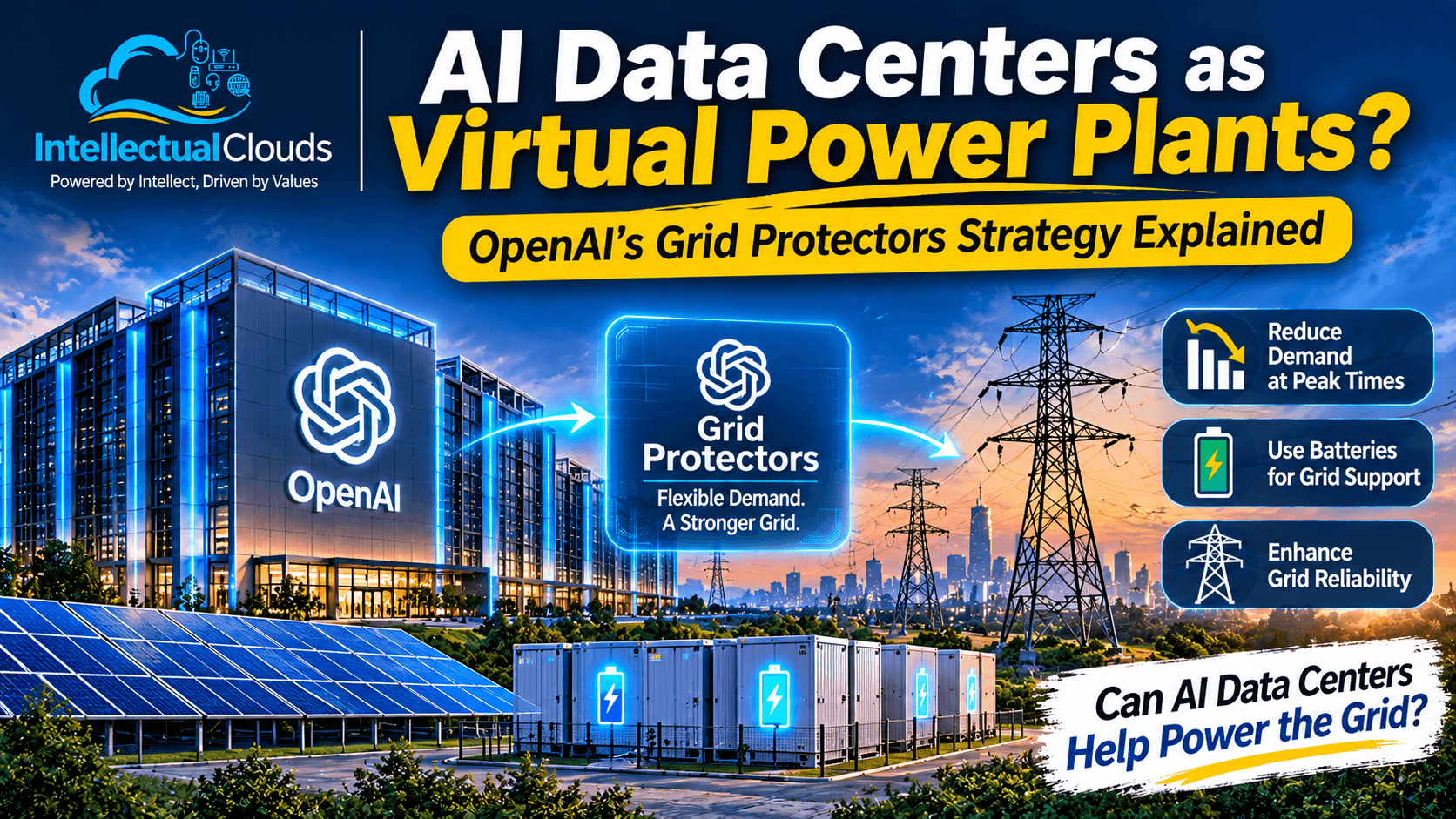
OpenAI announced its Grid Protectors Program on November 2, 2026. The company says it will work with utilities, regulators, and policymakers on arrangements for future compute campuses to reduce electricity use when the local grid is under pressure. OpenAI also points to batteries, power controls, and on-site generation as options where local needs and equipment make them appropriate.
A data center that turns down its load can make capacity available to other users - but it is not automatically a power plant, and not necessarily a virtual power plant in the formal grid-services sense. Whether the programme benefits nearby customers will depend on contracts, measured performance, local grid conditions, and who pays for the infrastructure.
What is OpenAI's Grid Protectors Program?
Grid Protectors is OpenAI's stated effort to make future compute campuses more responsive to local electricity-system needs. The company says it intends to agree with utilities on how much demand a campus can reduce, how quickly, and how long it can sustain the reduction. Future arrangements will differ by location.
The programme combines several ideas that are related but distinct:
Grid Measure
What It Does
Generates Electricity?
Demand response
Reduces or shifts a customer's electricity use when the system is constrained
No
Workload flexibility
Moves eligible computing jobs to another time or site, or delays them
No - changes when and where electricity is consumed
Battery storage
Stores electricity and discharges it later
Supplies stored electricity; does not create primary energy
On-site generation
Produces electricity at or near the campus
Yes - subject to fuel, emissions, permits, and grid rules
Virtual power plant
Coordinates multiple distributed resources so they can provide grid services as an aggregated resource
Potentially, depending on the resources included
OpenAI's announcement includes flexible demand and says it may also work with grid operators on storage or on-site supply. That makes "virtual power plant" a useful analogy - but it should not be presented as a confirmed technical classification of the Georgia campus. The U.S. Department of Energy describes virtual power plants as aggregations of distributed energy resources; a single large facility agreeing to curtail load is more precisely described as demand response.
How Can a Data Center Help the Grid Without Being a Power Plant?
The simplest mechanism is to consume less during a specific period. If a utility has the right to reduce a large customer's electricity delivery during a peak, that demand reduction can leave more capacity available elsewhere - or reduce pressure on additional generation.
For a compute campus, that flexibility could come from more than one operational lever:
01
Schedule Deferrable Jobs
Batch training, offline evaluation, backups, and some data-processing tasks may be shifted to another time if deadlines and system design allow.
02
Route Eligible Workloads
Some jobs may move to another facility or region, but only if that destination has available power and moving the workload does not simply transfer the grid impact.
03
Reduce or Ramp Power Use
Facility controls can lower demand in a contracted window, subject to equipment and service limits.
04
Use Batteries
Storage may cover part of a short peak or smooth changes in demand, while keeping the campus within operational constraints.
05
Use On-Site Generation Where Appropriate
This can support a campus or potentially the grid under approved arrangements, but the generation source and emissions need to be disclosed.
The IEA identifies demand flexibility, workload shifting, storage, and grid-interactive on-site assets as possible ways to manage data-center demand. The IEA also emphasizes that the scale and impact depend on implementation and incentives. A grid benefit should be measured at the relevant location and time - not inferred from a press-release commitment.
What Does the Georgia Agreement Actually Promise?
OpenAI's planned Effingham County, Georgia campus is the initial example highlighted in its Grid Protectors announcement. Georgia Power says the facility is expected to require approximately 3,200 megawatts and that the 25-year agreement includes up to 1,000 megawatts of flexible demand response.
Three qualifications are important before quoting the 1,000 MW figure:
⚠️
"Up to" is a Maximum
The amount available during a specific event will depend on operating conditions and the contract's rules. It is not a guarantee of continuous availability.
🏗️
Campus Not Yet Operating
The agreement describes a future capability; it does not show that a one-gigawatt reduction has already happened during a real grid emergency.
🔋
Reduction, Not Generation
The stated 1,000 MW should not be described as one gigawatt of power supplied by the data center. It is a maximum demand reduction commitment.
OpenAI says it has committed to pay the full infrastructure and electric-service costs required to serve the project. Georgia Power also says the utility will have the ability to reduce energy delivered under the 25-year agreement. These commitments matter, but their effects on other customers should be assessed using actual tariffs, costs, dispatch records, and grid outcomes once the project is operating.
Georgia Power's projection of approximately $950 million in annual customer savings beginning in 2029 is tied to the broader portfolio of large-load agreements and expected growth - not a verified saving caused solely by the OpenAI campus. Report these as projections, not as results already delivered to households.
Is an AI Data Center Really a Virtual Power Plant?
Not automatically. In common energy-sector usage, a virtual power plant coordinates multiple distributed resources - such as batteries, controllable loads, and local generation - so they can act together to provide grid services. A data center that agrees to reduce demand is participating in demand response.
This distinction is more than terminology. If an operator says a campus can "support the grid," readers should be able to tell whether that means:
When someone says a campus "supports the grid," ask which mechanism is involved:
A.The campus will consume less electricity during a peak period
B.A battery will discharge stored electricity back to the facility
C.On-site generation will serve the facility or export electricity to the grid
D.Computing work will be delayed or relocated to another site
E.Multiple resources will be aggregated and dispatched under a grid-services arrangement
Each mechanism has different reliability, cost, emissions, and regulatory implications. A clear description prevents a demand-reduction commitment from being mistaken for a new generating plant.
Why Is Grid Flexibility Becoming Important?
The AI buildout is arriving faster than some electricity infrastructure can be planned and constructed.
17%
Global data-center demand growth in 2025
IEA
485 TWh
Global data-center electricity demand in 2025
IEA
~950 TWh
Projected demand by 2030 - roughly double
IEA
Grid infrastructure is also slower to build than data-center projects. The IEA says planning, permitting, and completing grid infrastructure can take 5 to 15 years, compared with 1 to 3 years for data centers. Flexible or non-firm connections can make more efficient use of existing grid capacity, but they require rules that specify when and how consumption may be limited.
In the United States, the Federal Energy Regulatory Commission (FERC) has directed regional grid operators to justify or reform rules for connecting data centers and other large loads. Its June 2026 orders included attention to flexible large loads, co-located generation, transparency in transmission costs, and preventing cost shifting.
What Would Prove That Grid Protectors Works?
The programme should be judged by performance data after campuses operate - not by the size of an announced commitment alone.
Measure to Disclose
Why It Matters
Baseline demand and verified reduction in MW
Shows the difference between normal consumption and actual curtailment
Response time, duration, and event frequency
Establishes whether the resource is useful for the grid condition it is meant to address
Notice and recovery requirements
Shows how much warning is needed and how quickly demand returns after an event
Local grid conditions during dispatch
Helps determine whether the reduction benefited the constrained area and time
Battery and generation dispatch
Distinguishes demand reduction from stored or on-site electricity supply
Workload moved or deferred
Reveals whether computing demand was genuinely reduced or shifted to another constrained location
Infrastructure and energy costs paid by the campus
Helps assess whether costs were shifted to residential or other business customers
Reliability and service impact
Shows whether curtailment affected critical workloads or customer-facing services
Emissions and fuel use
Makes the climate trade-off visible, especially when on-site generation is used
Independent verification would make these disclosures more useful. It should be possible to compare an agreed baseline with metered performance, account for changes in facility operations, and distinguish a technical maximum from a delivered reduction.
Benefits and Risks of Flexible AI Data Centers
✓Potential Benefits
Peak relief
A large load that can reduce demand during a constrained period may free capacity for other grid users.
Better use of existing infrastructure
Flexible consumption may help utilities use available capacity at different times, though it cannot eliminate the need for new supply and transmission investment.
More predictable planning
Contracts can clarify curtailment terms, cost responsibility, and operational expectations before a campus is built.
Workload efficiency
Moving deferrable compute to times or locations with more available power can improve operational flexibility when done without exporting the problem elsewhere.
⚠Risks and Open Questions
Promised reduction may be unavailable when called
Reliability depends on the contract, actual equipment, workload mix, and testing.
Grid benefit may be overstated
A stated maximum is not the same as a measured peak reduction.
Costs can be allocated unevenly
The rate design and infrastructure agreement determine whether the project pays the costs it creates.
Backup generation can increase local pollution
On-site power may improve resilience but its fuel and emissions profile matters.
Compute may shift rather than disappear
Workload relocation can transfer electricity demand to another region or hour.
Local impacts remain broader than electricity
Water, land use, transmission construction, air quality, and community consent are not resolved by demand response alone.
OpenAI itself says flexibility cannot replace investment in new energy supply and transmission. Flexible demand can complement infrastructure buildout - it cannot substitute for it.
A Practical Checklist for Utilities and Data-Center Operators
Before treating a campus as a grid resource, the parties should establish:
Phase 1A Measurable Baseline
Tangible Output: Define normal and peak demand, including how the baseline changes as the facility grows.
Phase 2A Workload Map
Tangible Output: Classify which compute jobs can be deferred, shifted, or reduced and what service-level impact is acceptable.
Phase 3Dispatch Terms
Tangible Output: Specify notice, response time, minimum and maximum reduction, duration, event frequency, recovery, compensation, and penalties for non-performance.
Phase 4Electrical and Cyber Controls
Tangible Output: Define who can issue a dispatch signal, how it is authenticated, what fails safely, and how actions are logged.
Phase 5Cost Allocation
Tangible Output: Clarify who funds substations, transmission upgrades, generation, storage, and ongoing grid services.
Phase 6Environmental Disclosure
Tangible Output: Report energy sources, water implications, local emissions, and whether backup generation runs during grid events.
Phase 7Independent Verification
Tangible Output: Use metering and an auditable method to confirm that promised reductions occurred at the required place and time.
Phase 8Community Communication
Tangible Output: Publish understandable reports and provide a channel for residents to raise reliability, affordability, and environmental concerns.
What This Strategy Means for AI Infrastructure Leaders
Grid flexibility is becoming a design consideration for AI infrastructure, not just a utility-side issue. Organizations planning high-density computing need to think about power availability, workload orchestration, cooling, storage, grid connections, service reliability, and community obligations as one system.
For technology companies, the practical questions include which workloads can tolerate delay, how multi-region routing affects latency and data residency, what an interruption does to customer commitments, and how energy costs are exposed in unit economics. Those decisions should be made before the infrastructure is locked in, not after a utility announces a curtailment event.
OpenAI's Grid Protectors is an ambitious proposal with a concrete Georgia demand-response agreement behind it. The next stage is evidence: the campus must be built, curtailment terms must be exercised, costs must be transparent, and independent data must show whether the grid and other customers benefited.
It is OpenAI's programme to work with utilities, regulators, and policymakers on making future compute campuses more flexible electricity users, including reducing demand when local grids are under strain. The programme was announced on November 2, 2026, and the Georgia campus is the first specific example cited.
Are AI data centers virtual power plants?
Not by default. A data center that reduces electricity use is providing demand response. It may be part of a virtual power plant if it is coordinated with other distributed resources and meets the applicable grid-service requirements. A single large facility agreeing to curtail load is more precisely described as demand response unless it is integrated into a broader coordinated resource arrangement.
Does demand response mean the data center supplies electricity?
No. Demand response reduces or shifts electricity consumption. Batteries can discharge stored electricity, and on-site generators can produce power, but these are separate mechanisms with their own technical, environmental, and regulatory considerations. A demand reduction frees up grid capacity - it does not add new generating capacity to the system.
What does OpenAI's 1,000 MW Georgia commitment actually mean?
Georgia Power says the planned Effingham County campus agreement includes up to 1,000 MW of flexible demand response under a 25-year agreement. Three things matter: "up to" is a maximum, not a guarantee; the campus is still being developed so no curtailment has yet been demonstrated; and demand response means less consumption, not new electricity generation. It should not be described as one gigawatt of power supplied by the data center.
Will OpenAI's campus reduce household electricity bills?
That outcome is not yet demonstrated. Georgia Power projects approximately $950 million in annual customer savings beginning in 2029 from its broader portfolio of large-load agreements and expected growth - but that projection is not a measured saving attributable only to OpenAI's campus. It should be reported as a utility projection, not as a result already delivered to households.
Can data-center workload shifting replace grid expansion?
No. Flexibility can help make better use of existing capacity and may defer some upgrades, but it cannot replace investment in new generation, transmission, and distribution infrastructure where that investment is needed. OpenAI itself acknowledges this: flexibility complements infrastructure buildout, it does not substitute for it.
AI Infrastructure Planning
Planning AI Infrastructure for Your Business?
AI infrastructure decisions involve more than selecting a model or cloud provider. They require a clear view of workload requirements, integrations, data governance, reliability, and the operating model around the technology. Intellectual Clouds supports startups and growing businesses with technology planning and implementation.
Asim Ansari is the Founder of Intellectual Clouds and a Certified Salesforce Administrator and Pardot Specialist with 17+ years of experience across Salesforce CRM, AI automation, cloud infrastructure (AWS), and digital transformation. He writes on AI agents, Salesforce delivery, Answer Engine Optimisation (AEO), and AI-accelerated business operations.