HomeBlogBenefits of Salesforce Commerce Cloud for B2B and B2C Ecommerce
Salesforce
Benefits of Salesforce Commerce Cloud for B2B and B2C Ecommerce
Asim Ansari
June 24, 2026
22 min read
Explore the key benefits of Salesforce Commerce Cloud for B2B and B2C ecommerce, including AI personalization, CRM integration, order management, scalability and lower TCO.
Direct Answer: Salesforce Commerce Cloud benefits businesses by connecting ecommerce, CRM, AI, order management, payments, personalization, and customer data on one unified platform. It helps B2B and B2C brands improve customer experience, automate merchandising, personalize shopping journeys, manage orders across channels, scale globally, and significantly reduce operational complexity.
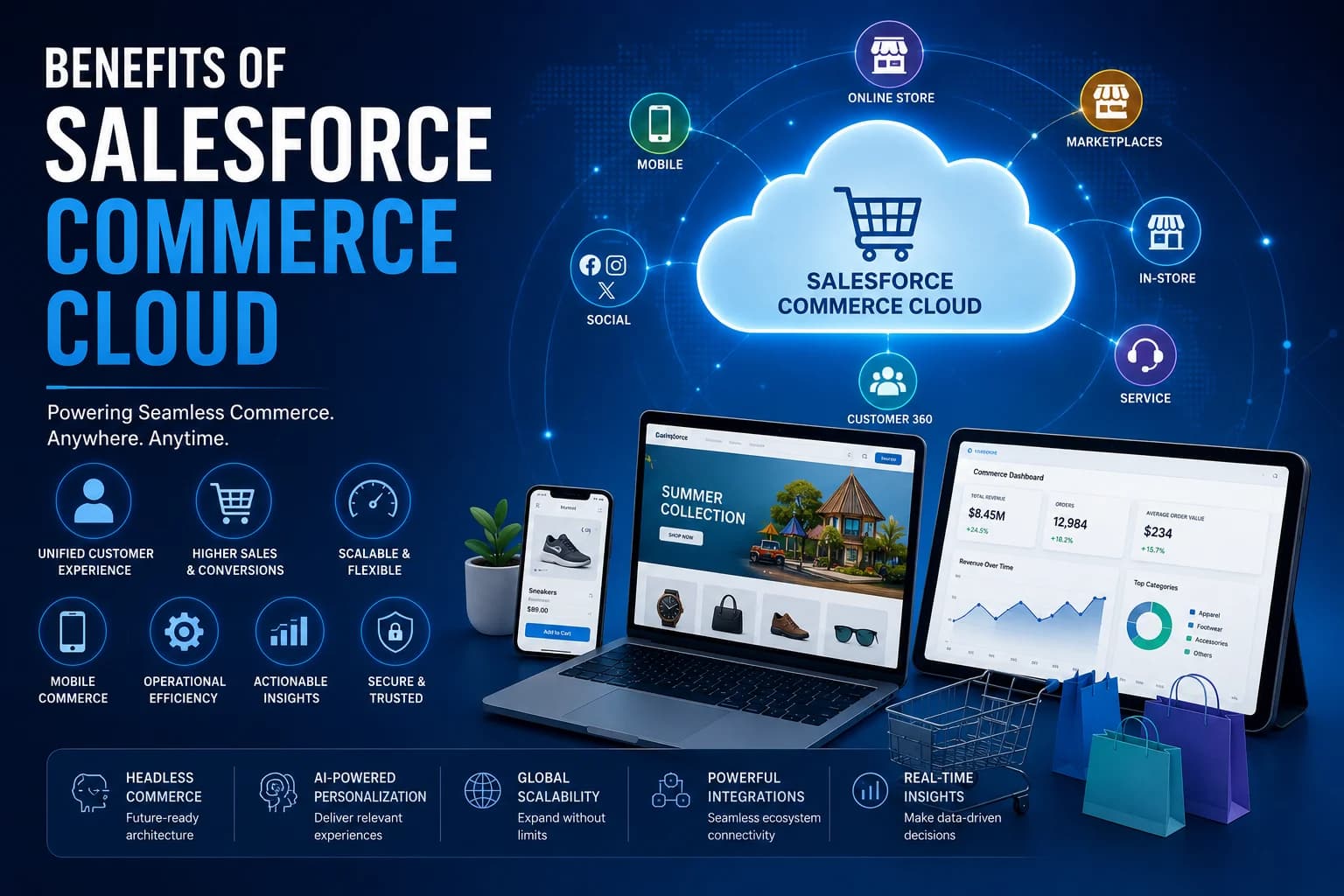
Salesforce Commerce Cloud is an industry-leading, cloud-based ecommerce platform designed to handle complex, high-volume retail and wholesale operations. Salesforce frames Commerce Cloud as an integral part of Agentforce Commerce, connecting ecommerce storefronts, Point of Sale (POS) systems, and order management on a single, unified platform powered by native AI.
Unlike standalone shopping cart software, Commerce Cloud is deeply integrated with the broader Salesforce ecosystem. It brings together B2C Commerce, B2B Commerce, Order Management, POS, Composable (Headless) Commerce, Payments, and Agentforce Guided Shopping. This ecosystem approach allows enterprise brands to deliver seamless buying experiences across digital, mobile, social, and physical channels.
Why Salesforce Commerce Cloud Matters for Modern Ecommerce
The modern ecommerce landscape is no longer just about listing products online; it is about creating interconnected, personalized customer journeys. The primary reason Salesforce Commerce Cloud stands out is its ability to bridge the gap between transactional data and customer relationship data.
For a B2C retailer, this means showing a shopper product recommendations based on their past support tickets logged in Service Cloud. For a B2B wholesaler, it means allowing a procurement officer to reorder heavy machinery parts with custom contract pricing pulled directly from Sales Cloud.
The integration of CRM and AI transforms ecommerce from a simple catalog into a smart, revenue-generating engine.
Intellectual Clouds helps ecommerce, retail, B2B and enterprise teams implement Salesforce Commerce Cloud with CRM integration, AI personalization, order management, automation and scalable storefront architecture.
Benefit 1: Unified Customer Data and CRM Integration
The most powerful benefit of Salesforce Commerce Cloud is its native connection to Salesforce CRM. Most ecommerce platforms operate in a silo; Commerce Cloud does not. By integrating with Sales Cloud, Service Cloud, and Marketing Cloud, businesses gain a 360-degree view of the customer. Marketing can trigger abandoned cart campaigns natively, and customer service agents can process returns or issue discounts directly from their service console without logging into a separate ecommerce backend.
Benefit 2: AI-Powered Personalization and Product Discovery
Salesforce Commerce Cloud utilizes Einstein AI (and Agentforce integrations) to automate merchandising and personalize the shopping journey. It tracks consumer behavior across the site to deliver predictive product recommendations, tailored search results, and personalized sorting. This removes the manual burden from merchandising teams and has been proven to significantly boost average order value (AOV) and conversion rates (learn how we implemented a similar custom solution in our AI-Powered Shopping Assistant Case Study).
Benefit 3: B2B and B2C Commerce on One Ecosystem
Whether you are selling fast fashion to teenagers or industrial equipment to procurement teams, Commerce Cloud handles both. It offers specific solutions tailored for B2C (promotions, fast checkout, visual merchandising) and B2B (custom price books, account hierarchies, approval workflows, reorder logic). Running both on the same Salesforce architecture drastically reduces technical debt.
Benefit 4: Omnichannel Shopping Across Web, Mobile, Store and Social
Consumers do not shop in a straight line. They discover a product on Instagram, research it on a mobile web browser, and buy it in a physical store. Commerce Cloud provides the architecture to unify these touchpoints. With native mobile-first templates, social commerce integrations, and unified POS data, brands can deliver a consistent experience everywhere the customer is.
Benefit 5: Order Management and Inventory Visibility
Salesforce Order Management natively connects with Commerce Cloud to provide a single source of truth for inventory. It intelligently routes orders to the most efficient fulfillment center or retail store, enables "Buy Online, Pick Up In-Store" (BOPIS) capabilities, and allows customers to easily track or cancel orders via self-service portals.
Is Your Architecture Ready for Headless Commerce?
Decoupling your frontend from your backend can unlock massive speed improvements. Let us audit your current setup.
Benefit 6: Headless and Composable Commerce Flexibility
For enterprise brands that want total control over the frontend user experience, Salesforce supports Composable Commerce. By decoupling the frontend presentation layer from the backend commerce engine via robust APIs, development teams can build progressive web apps (PWAs), voice-activated shopping tools, or custom mobile apps while still leveraging Salesforce's secure checkout and backend logic.
Benefit 7: Faster Campaigns and Merchandising
Commerce Cloud includes drag-and-drop Page Designer tools that empower marketing and merchandising teams to build new landing pages, launch promotions, and update content without writing code or waiting on IT. This drastically improves speed-to-market for seasonal campaigns and flash sales.
Benefit 8: Better Checkout, Payments and Conversion Rate
A clunky checkout process kills conversions. Commerce Cloud offers streamlined, mobile-optimized checkout flows. Furthermore, with Salesforce Payments, businesses can quickly activate digital wallets (Apple Pay, Google Pay), handle complex tax calculations, and process transactions securely, reducing cart abandonment rates.
Benefit 9: Global Scalability
Scaling an ecommerce business internationally often requires launching entirely new websites. Commerce Cloud simplifies global expansion by allowing brands to manage multiple languages, multiple currencies, and localized site structures from a single administrative backend. You can deploy a new regional site in a fraction of the time it takes on legacy platforms.
Benefit 10: Lower Operational Complexity and TCO
While the upfront implementation of Salesforce is significant, the Total Cost of Ownership (TCO) over time is often lower for enterprise brands. Because it is a SaaS platform, Salesforce handles the hosting, security, patches, and feature upgrades. You do not need to maintain server farms or worry about your website crashing during Black Friday traffic spikes.
Table 2: B2B vs B2C Commerce Cloud Features
Area
B2B Commerce
B2C Commerce
Buyers
Companies, accounts, procurement teams
Individual shoppers
Pricing
Contract pricing, account-specific catalogs
Promotions, discounts, flash sales campaigns
Checkout
Approval flows, PO numbers, bulk ordering
Fast consumer checkout, digital wallets
Main Goal
Efficiency, self-service, and repeat orders
Conversion, brand engagement, and loyalty
Salesforce Commerce Cloud vs Shopify Plus vs Magento
When enterprise brands outgrow standard shopping carts, they usually evaluate these three platforms.
Table 3: Platform Comparison
Platform
Best For
Strength
Limitation
Salesforce Commerce Cloud
Enterprise B2B/B2C
Native CRM + AI + deep omnichannel integration
Higher implementation complexity & upfront cost
Shopify Plus
Fast DTC launch
Speed to market and simplicity of use
Less enterprise CRM depth and complex B2B capabilities
Magento (Adobe Commerce)
Highly Custom Commerce
Extreme flexibility and customization
Heavier IT maintenance, hosting burden, and technical debt
Who Should Use Salesforce Commerce Cloud?
Salesforce Commerce Cloud is an enterprise-grade platform. It is not designed for small mom-and-pop stores or bootstrapped dropshippers. It is the optimal choice for:
High-Volume Retailers: Processing thousands of transactions per day, especially during peak seasons like Black Friday.
Complex B2B Manufacturers & Distributors: Companies that need portal-based buying, custom negotiated price books, and massive SKU counts.
Global Brands: Companies operating across multiple geographies, requiring localized languages, currencies, and tax compliance.
Brands Already Using Salesforce CRM: If you already rely on Sales, Service, or Marketing Cloud, adding Commerce Cloud is a massive operational advantage.
Ready to unify your digital commerce strategy?
Intellectual Clouds helps you plan the roadmap, avoid implementation pitfalls, and launch a storefront that converts.
Implementing Commerce Cloud successfully requires strategic alignment before a single line of code is written. A standard enterprise implementation follows this roadmap:
Discovery and Architecture Design: Mapping the data flows between the ecommerce frontend, the Salesforce CRM, the ERP, and the Order Management System (OMS).
Platform Setup and Configuration: Establishing the environments, setting up the B2B or B2C data models, and configuring payment gateways.
Frontend Development: Designing the user interface, whether using standard Salesforce Reference Architecture (SFRA) or a custom headless approach.
Data Migration: Securely transferring existing customer, product, and historical order data into the new ecosystem.
Integration Testing: Rigorously testing API connections to ensure inventory syncs correctly and support tickets log properly in Service Cloud.
Training and Launch: Training merchandising teams on Page Designer and launching the platform with a dedicated hypercare support window.
Common Mistakes to Avoid
When replatforming to Commerce Cloud, enterprise teams often stumble on the following:
Lifting and Shifting Bad Data: Do not migrate dirty data. Cleanse your product catalogs and customer records before migrating.
Over-Customizing the Frontend: Stick to out-of-the-box configurations where possible. Heavy custom code makes future Salesforce upgrades painful.
Ignoring the Post-Purchase Journey: Commerce does not end at checkout. Ensure your Order Management and Service Cloud integrations are bulletproof so returns and tracking are seamless.
Operating in Silos: Merchandising, IT, and Customer Service teams must collaborate during the build, not just after launch.
How Intellectual Clouds Can Help
Replatforming to an enterprise commerce solution is high-stakes. A botched implementation can result in lost revenue, frustrated customers, and bloated IT costs.
At Intellectual Clouds, we provide expert Salesforce Consulting and implementation services. We help B2B and B2C organizations unlock the full benefits of Salesforce Commerce Cloud by ensuring tight integration with your existing CRM, optimizing your architecture for speed, and deploying Custom AI Agents to automate customer support.
From initial architecture audits to full-scale Cloud Consulting deployments, our team ensures your commerce platform scales efficiently and drives real ROI.
Frequently Asked Questions
What is Salesforce Commerce Cloud?
Salesforce Commerce Cloud is an enterprise-grade ecommerce platform that unifies customer data, integrates natively with Salesforce CRM, and powers personalized B2B and B2C shopping experiences across all digital and physical channels.
What are the main benefits of Salesforce Commerce Cloud?
The main benefits include seamless CRM integration, AI-powered personalization, centralized order management, support for headless architecture, global scalability, and lower IT maintenance costs compared to self-hosted platforms.
Is Salesforce Commerce Cloud good for B2B ecommerce?
Yes, it is highly optimized for B2B. It handles complex account hierarchies, negotiated contract pricing, purchase order (PO) approvals, and fast reordering flows essential for wholesale and manufacturing operations.
Is Salesforce Commerce Cloud good for B2C ecommerce?
Absolutely. It powers some of the world's largest retail brands, offering rapid checkout, advanced merchandising tools, social commerce integrations, and predictive AI product recommendations.
How does Salesforce Commerce Cloud use AI?
It utilizes Salesforce Einstein and Agentforce to automate personalized product sorting, deliver predictive search results, and provide guided shopping experiences without requiring manual rule-setting by merchandisers.
Does Salesforce Commerce Cloud support headless commerce?
Yes, through its Composable Commerce architecture, it provides robust APIs that allow development teams to decouple the frontend presentation layer from the backend commerce engine.
What is the difference between Salesforce Commerce Cloud and Shopify Plus?
Shopify Plus is great for fast DTC launches and simplicity. Salesforce Commerce Cloud is built for complex, enterprise-level B2B/B2C operations that require deep integration with a CRM, advanced order routing, and complex multi-region scalability.
Is Salesforce Commerce Cloud expensive?
It has a higher upfront implementation cost compared to basic platforms. However, because it is a managed SaaS platform that handles security and hosting, its Total Cost of Ownership (TCO) is often lower for high-volume enterprise brands.
How long does Salesforce Commerce Cloud implementation take?
An enterprise implementation typically takes between 4 to 8 months, depending on the complexity of the data migration, third-party integrations, and whether a headless architecture is chosen.
Can Intellectual Clouds implement Salesforce Commerce Cloud?
Yes. Intellectual Clouds provides expert end-to-end implementation services, ensuring your commerce platform is correctly integrated with your CRM, Order Management System, and AI tools for maximum business impact.
Asim Ansari is the Founder of Intellectual Clouds and a Certified Salesforce Administrator and Pardot Specialist with 17+ years of experience across Salesforce CRM, AI automation, cloud infrastructure (AWS), and digital transformation. He writes on AI agents, Salesforce delivery, Answer Engine Optimisation (AEO), and AI-accelerated business operations.