HomeBlogRockstar's Business Model: How GTA Turns a Game into a Long-Term Business
Startups
Rockstar's Business Model: How GTA Turns a Game into a Long-Term Business
Asim Ansari
November 18, 2026
24 min read
Explore Rockstar's business model, from premium GTA sales and GTA Online to recurring spending, GTA+, launch marketing and lessons for product teams.
Quick Answer: Rockstar's GTA Business Engine
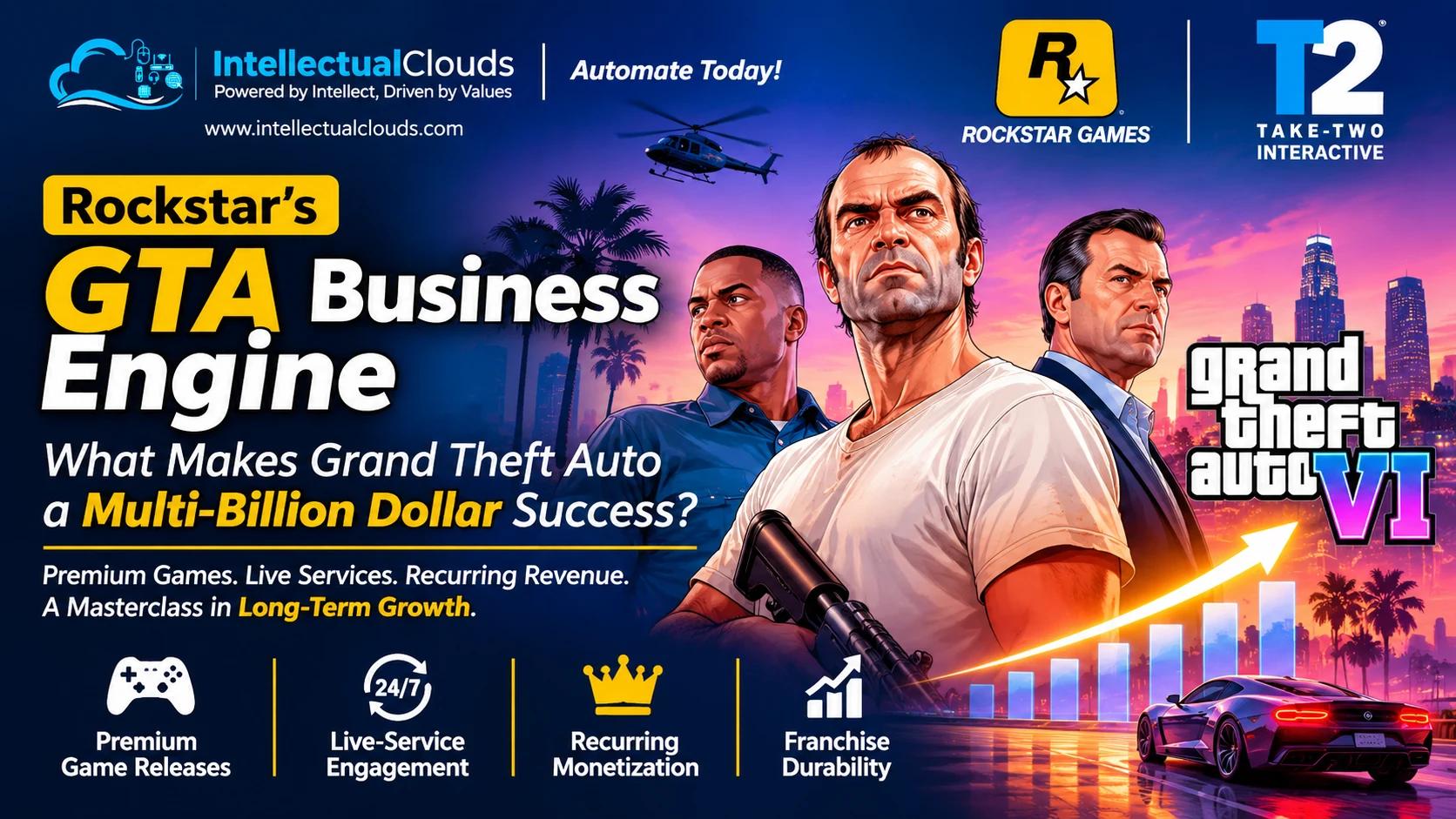
How does Rockstar turn Grand Theft Auto into an enduring, multi-billion-dollar business? Rockstar Games does not simply sell a video game - it operates an integrated, 4-pillar commercial ecosystem:
1Premium Flagship Releases
Upfront capital recovery through high-margin launch editions ($79.99 - $99.99 base prices).
2Durable Franchise Moat
235M+ units sold across generations, compounding brand equity and lowering ongoing acquisition costs.
3Persistent Live Sandbox
GTA Online provides continuous zero-barrier expansions, events, and community roleplay that retain players for years.
4Value-Led Recurring Loops
GTA+ monthly memberships and optional virtual items convert active engagement into predictable cash flow.
Core Insight: While parent company Take-Two reports that 81% of its Q2 FY2027 net bookings stem from recurrent consumer spending across its whole portfolio, the essential takeaway for founders is that recurring revenue only works when it follows recurring customer value.
The Corporate Structure: Why Take-Two's 81% recurring bookings metric is portfolio-wide, not GTA-only.
The Premium Launch Engine: How tiered editions ($79.99 Standard vs $99.99 Ultimate) anchor initial capitalization.
Franchise Durability: How GTA V built a 235M-unit footprint and what it means for customer acquisition cost (CAC).
The Live-Service Flywheel: The 4-phase mechanism converting one-time players into years-long active participants.
Asymmetric Media Partnerships: Why the 27-minute Netflix preview achieved 31.1M views and reshaped product distribution.
Founder & Startup Playbook: 5 concrete product, SaaS, and AI lessons to build durable retention and recurring monetization.
Rockstar's business model is not just about selling a blockbuster game. It combines premium releases with long-lived franchises, continued content and services, and launches designed to reach audiences well beyond traditional entertainment marketing.
Grand Theft Auto V and GTA Online demonstrate how a singular, high-craft release can continually engage millions of users across more than a decade. Simultaneously, the pre-launch campaign for GTA VI offers an unprecedented modern masterclass in transforming an entertainment property into a global cultural and media event.
However, an important distinction is necessary: not every commercial detail is public. Take-Two Interactive, Rockstar's publicly traded parent company, reports financial metrics across its whole portfolio rather than for Rockstar or GTA in isolation.
This deep dive separates verified corporate disclosures from market speculation, dissects the mechanics of Rockstar's commercial flywheel, and translates these insights into actionable product and business strategies for founders, software teams, and digital operators.
The Rockstar Long-Term Monetization Architecture
Layer 01
Premium Blockbuster
High-conviction product craft, upfront capital recovery, and tiered SKUs ($79.99 / $99.99).
➔
⬇
Layer 02
Cultural Distribution
Non-traditional media syndication (Netflix premiere, global reach) lowering external CAC.
➔
⬇
Layer 03
Live-Service Sandbox
Continuous content expansions, seasonal events, and social loops driving organic return visits.
➔
⬇
Layer 04
Recurring Value Flywheel
GTA+ membership subscriptions, optional add-ons, and utility-driven recurrent consumer spend.
1. Rockstar is Part of a Larger Publishing Business
To understand Rockstar's financial mechanics, one must first look at the corporate hierarchy. Rockstar Games operates as a publishing label under its parent company, Take-Two Interactive Software, Inc. (NASDAQ: TTWO).
That relationship is essential when parsing financial press releases: Take-Two owns several other major publishing labels and studios, including 2K (publishers of NBA 2K and Borderlands), Private Division, and mobile gaming titan Zynga. Consequently, Take-Two's top-line revenue, net bookings, and recurring spending percentages cannot be blindly attributed to Rockstar Games or Grand Theft Auto alone.
Take-Two Interactive Q2 FY2027 Disclosures (Quarter Ended September 30, 2026)
Take-Two categorizes Recurrent Consumer Spending (RCS) as purchases driven by ongoing consumer engagement, which includes:
Virtual currencies (e.g., Shark Cards)
Add-on content and expansions
In-game microtransactions
In-game advertising
Ongoing subscriptions (such as GTA+)
Take-Two explicitly highlighted the Grand Theft Auto series alongside NBA 2K as key drivers of this 81% share. For financial analysts and tech operators, this provides a vital lesson in financial literacy: large percentage shares cited at the holding-company level illustrate an overarching business model transformation toward recurring cash flow, rather than an isolated balance sheet for a single title.
2. Premium Releases Create the Commercial Foundation
The bedrock of Rockstar's model remains the premium blockbuster release. Rockstar has repeatedly resisted the industry's rush toward free-to-play (F2P) at launch. Instead, the company charges full retail value upfront, establishing high perceived brand equity and funding multi-year research and engineering cycles.
For GTA VI, Rockstar initiated its commercial rollout with official pre-orders commencing June 25, 2026, targeting next-generation console hardware: Sony PlayStation 5 and Microsoft Xbox Series X|S.
Product SKU
Announced List Price
Key Deliverables & Bundled Utility
Strategic Commercial Role
Standard Edition
$79.99
Base game access on PS5 or Xbox Series X|S.
Mass market adoption, establishing maximum player base volume.
Ultimate Edition
$99.99
Base game, Vintage Vice City Pack bonus content, plus 1 free month of GTA+ membership for digital pre-orders.
ARPU expansion; acts as a free trial funnel directly into recurring subscription loops.
Data Precision Check: While Take-Two executives publicly characterized pre-orders as running at "unprecedented levels" and significantly outperforming initial internal forecasts (Take-Two Investor Remarks), the company has not published certified unit volume counts. Figures circulating on social media claiming exact multimillion-unit numbers should be categorized as analyst estimates rather than verified corporate disclosures.
From a unit economics standpoint, list prices ($79.99 and $99.99) do not translate directly to gross profit. Platform holder royalties (the 30% console platform cut), physical retail distribution margins, VAT/sales taxes, localized currency differentials, and potential digital returns all impact net revenue realization.
3. A Durable Franchise Can Extend Value Beyond Launch Week
In consumer software, customer acquisition cost (CAC) typically escalates as a product matures. For Rockstar, the opposite dynamic occurs: franchise durability compounds brand awareness, lowering long-term marketing costs and creating multi-decade lifetime value (LTV).
As disclosed in Take-Two's November 2026 investor updates, Grand Theft Auto V had surpassed nearly 235 million units sold worldwide.
The Compounding Franchise Moat: GTA V Lifecycle
235M+
Lifetime Units Sold
Spanning three console generations (PS3/Xbox 360, PS4/Xbox One, PS5/Xbox Series X|S) and PC.
13+ Years
Continuous Live Operations
Dozens of major free expansions, narrative heists, and content updates keeping players active.
GTA+
Subscription Growth
Consistent quarter-over-quarter expansion in average monthly paying membership accounts.
This longevity illustrates a profound principle for modern product engineering: launch day is merely Day 1 of customer acquisition.
When a company delivers high product craftsmanship that earns deep community trust, the initial release transforms from an ephemeral marketing event into a permanent platform. However, longevity cannot be willed into existence through branding alone - it requires consistent operational maintenance, meaningful feature updates, and respect for user time.
4. GTA Online Illustrates Recurring Engagement
GTA Online is one of the most commercially studied live-service ecosystems in software history. What started as an add-on multiplayer component attached to GTA V grew into an independent virtual economy generating substantial cash flow year after year.
The 4-Stage Live-Service Retention Flywheel
1
Large-Scale Initial Onboarding
A universally acclaimed single-player storyline drives millions of players into the ecosystem simultaneously, creating immediate network density.
2
Zero-Barrier Content Updates
Expansions and multiplayer updates are distributed without mandatory paid DLC gates, preventing player base fragmentation and keeping matchmaking pools liquid.
3
Frictionless In-Game Economy & Memberships
Players can progress purely through playtime or accelerate acquisition via Shark Cards and GTA+ monthly subscriptions, matching monetization to player preference.
4
Community-Driven Social Proof & Streaming
Roleplay servers (FiveM, acquired by Rockstar), YouTube creators, and Twitch streamers generate millions of hours of earned organic media between major game releases.
The Product Design Takeaway for Software & AI
For founders and software creators, Rockstar's mechanics offer a crucial guideline: recurring monetization is only defensible when it reflects recurring customer utility.
If a SaaS platform or AI agent forces users into recurring subscriptions without continuously improving workflow speed, expanding integrations, or providing reliable uptime, churn inevitably spikes. Sustainable subscription economics require genuine, continuous value creation.
5. Cross-Platform Promotion: Turning a Release into a Global Media Event
Traditional enterprise product launches rely on conventional industry channels: tech blogs, press releases, banner ads, and trade conferences. Rockstar demonstrated how to bypass traditional distribution silos by turning a product preview into an entertainment spectacle.
On August 27, 2026, Rockstar premiered a 27-minute extended first look on Netflix, securing a 6-hour exclusive premiere window before releasing the media to global public video platforms.
Verified Official Data
31.1 Million Global Views
In its published Top 10 rankings for the week of August 24, 2026, Netflix confirmed the 27-minute preview generated 31.1 million views, securing the #1 position across 87 of 93 countries tracked.
Independent analysis firm Ampere Analysis estimated that the 6-hour exclusive window drove over 100,000 new Netflix subscriber acquisitions in the United States alone on day one.
This collaboration is a textbook example of asymmetric partnership value:
Rockstar's Advantage: Gained direct, frictionless access to Netflix's hundreds of millions of global entertainment subscribers, introducing the game to casual consumers who do not follow video game media.
Netflix's Advantage: Captured cultural gravity and immediate paid account registrations driven by fans seeking the earliest possible high-fidelity viewing.
For startups, this highlights the power of non-linear distribution. Partnering with complementary enterprise software ecosystems, marketplace distributors, or content platforms can unlock growth channels that competitors relying purely on paid ads cannot access.
6. Platform Availability is a Business Decision: Separating Facts from Speculation
One of the most debated aspects of Rockstar's commercial playbook is its staggered platform rollout. Official announcements confirm GTA VI for PlayStation 5 and Xbox Series X|S at launch, without announcing a simultaneous PC launch date.
In tech commentary, this decision frequently generates speculative narratives:
"Rockstar delays PC to eliminate piracy."
"Console makers paid massive exclusivity fees."
"Rockstar deliberately forces double-dipping so players buy the game twice."
Fact vs. Market Speculation Matrix
Topic
Verified Corporate Record
Unverified Market Rumor / Speculation
Console Availability
PS5 and Xbox Series X|S explicitly confirmed.
Rumors of temporary PlayStation hardware exclusivity.
PC Release Timeline
No PC launch date officially announced or published.
Claims that PC was delayed specifically to curb piracy.
Pre-Order Volume
Take-Two described demand as "unprecedented."
Specific multi-million unit claims without verified audit.
Online Monetization
Current GTA Online and GTA+ models documented.
Unannounced GTA VI Online mechanics presented as fact.
From an engineering and product perspective, focusing on consoles first has rational technical explanations:
Target Hardware Homogeneity: Optimizing physics, graphics pipelines, and memory allocation for two fixed hardware profiles (PS5 and Xbox Series X|S) is exponentially simpler than supporting the infinite combination of PC GPUs, CPUs, drivers, and display configurations.
Quality Assurance Concentration: Engineering teams can focus all QA and performance tuning on fixed hardware before expanding bandwidth to PC optimization.
Sequential Commercial Peaks: Rolling out platforms sequentially allows a product to generate distinct PR and revenue cycles over multiple financial years.
7. Delays are Not Proof of a "Hype Strategy"
When flagship software experiences release calendar adjustments, market observers often claim the delays are calculated marketing ploys to build anticipation.
In enterprise software engineering, the reality is far more practical: complex, ambitious digital systems routinely encounter development bottlenecks. GTA VI's announced release schedule shifted prior to establishing its current launch window.
The Engineering Reality of Software Delays
Schedule adjustments carry heavy penalties: partner contracts must be renegotiated, retail logistics shifted, quarterly investor guidance updated, and operational burn rates absorbed. Assuming a delay is an intentional marketing stunt ignores the realities of software engineering at scale.
For technology founders and engineering leads, the key lesson is transparent expectations management. When deadlines must change, communicate clearly, manage partner requirements directly, and refuse to sacrifice foundational software stability for arbitrary calendar dates. High-craft execution protects long-term brand equity; premature launches destroy it.
8. What Founders and Product Teams Can Learn from the GTA Model
While most tech startups do not operate with Rockstar's hundred-million-dollar budgets, the fundamental business principles of the GTA model provide a masterclass for digital product leaders, SaaS founders, and AI developers:
01
Build the Core Product First
Tiered pricing, enterprise upsells, and subscriptions are completely useless if the underlying core experience does not solve a primary user need with extraordinary quality. Never confuse monetization design with product-market fit.
02
Design for Recurring Utility, Not Repeat Invoicing
Recurring revenue must follow ongoing value. For B2B SaaS and AI products, that means automated workflows, deeper integrations, reliable model latency, and tangible ROI rather than artificial feature lockouts.
03
Community is Core Infrastructure
Rockstar embraced roleplay servers, modding tools, and content creators. Tech startups should empower their power users with developer APIs, integrations, and active feedback loops that transform customers into vocal advocates.
04
Leverage Asymmetric Distribution
Do not rely solely on traditional advertising. Seek out strategic integration partners, complementary platform ecosystems, and media channels where your ideal customer base already spends attention.
05
Data Precision Protects Brand Authority
Separating verified financial metrics from market speculation is what distinguishes industry leaders from hype-chasers. In customer communications and technical whitepapers, precision builds enduring enterprise trust.
Building a Scalable Digital Product or Startup Platform?
Intellectual Clouds helps startup founders and enterprise product leaders architect scalable cloud backends, deploy autonomous AI agent workflows, and engineer high-retention software platforms built for sustainable monetization.
1. How does Rockstar make money from Grand Theft Auto?
Rockstar monetizes the Grand Theft Auto franchise through two primary mechanisms: (1) Upfront premium game sales across console and PC platforms with differentiated tiers ($79.99 Standard, $99.99 Ultimate), and (2) Ongoing recurrent consumer spending generated via GTA Online virtual currencies (Shark Cards), optional downloadable content, and monthly GTA+ subscription memberships.
2. What is Take-Two's recurrent consumer spending?
Take-Two Interactive uses "Recurrent Consumer Spending" (RCS) to designate revenue generated from ongoing player engagement. This category encompasses virtual currency, in-game items, add-on expansions, digital memberships (like GTA+), and in-game advertisements. In Q2 FY2027, RCS represented 81% of Take-Two's total net bookings ($1.60B) across all corporate franchises.
3. What are the confirmed GTA VI launch pricing and platforms?
According to Rockstar's official June 25, 2026 pre-order announcement, the base Standard Edition is listed at $79.99 and the Ultimate Edition at $99.99. The officially confirmed launch platforms are Sony PlayStation 5 and Microsoft Xbox Series X|S. No official PC launch date or pricing has been announced.
4. Has Rockstar disclosed official GTA VI pre-order unit totals?
No. While Take-Two executives highlighted in quarterly investor commentary that pre-order figures reached "unprecedented levels" and exceeded internal expectations, the company has not published an audited unit count. Unverified numbers circulating on social channels are third-party analyst estimates.
5. Why is GTA VI not releasing on PC at launch?
Rockstar has not published a formal technical or commercial explanation for the initial console exclusivity. Industry engineering standards indicate that targeting fixed console architectures (PS5/Xbox Series X|S) simplifies graphics optimization and QA testing before expanding development resources to address the infinite hardware and driver combinations of the global PC gaming market.
6. How does the GTA business model apply to SaaS and AI startups?
The GTA model proves that sustainable recurring subscriptions cannot survive on artificial friction or lock-in; they require persistent, visible customer utility. Digital products must focus on perfecting core problem-solving capability before introducing monetization tiers, while leveraging community ecosystems and strategic distribution partnerships to sustain long-term retention.
Closing Perspective: Craftsmanship as a Business Strategy
Rockstar's business model stands as an undeniable benchmark in the entertainment and software industries. It proves that combining uncompromising product craftsmanship with strategic distribution and community-centric live services can transform a single digital property into a multi-decade revenue engine.
The core lesson for modern technology founders is not to copy gaming microtransactions. Rather, it is to build something people genuinely love, continually reward their ongoing attention, and align every commercial tier with undeniable customer value.
Asim Ansari is the Founder of Intellectual Clouds and a Certified Salesforce Administrator and Pardot Specialist with 17+ years of experience across Salesforce CRM, AI automation, cloud infrastructure (AWS), and digital transformation. He writes on AI agents, Salesforce delivery, Answer Engine Optimisation (AEO), and AI-accelerated business operations.