HomeBlogGPT-6 Astra Explained: Benchmarks, Pricing, Computer Use and Safety
AI Technology
GPT-6 Astra Explained: Benchmarks, Pricing, Computer Use and Safety
Asim Ansari
September 7, 2026
23 min read
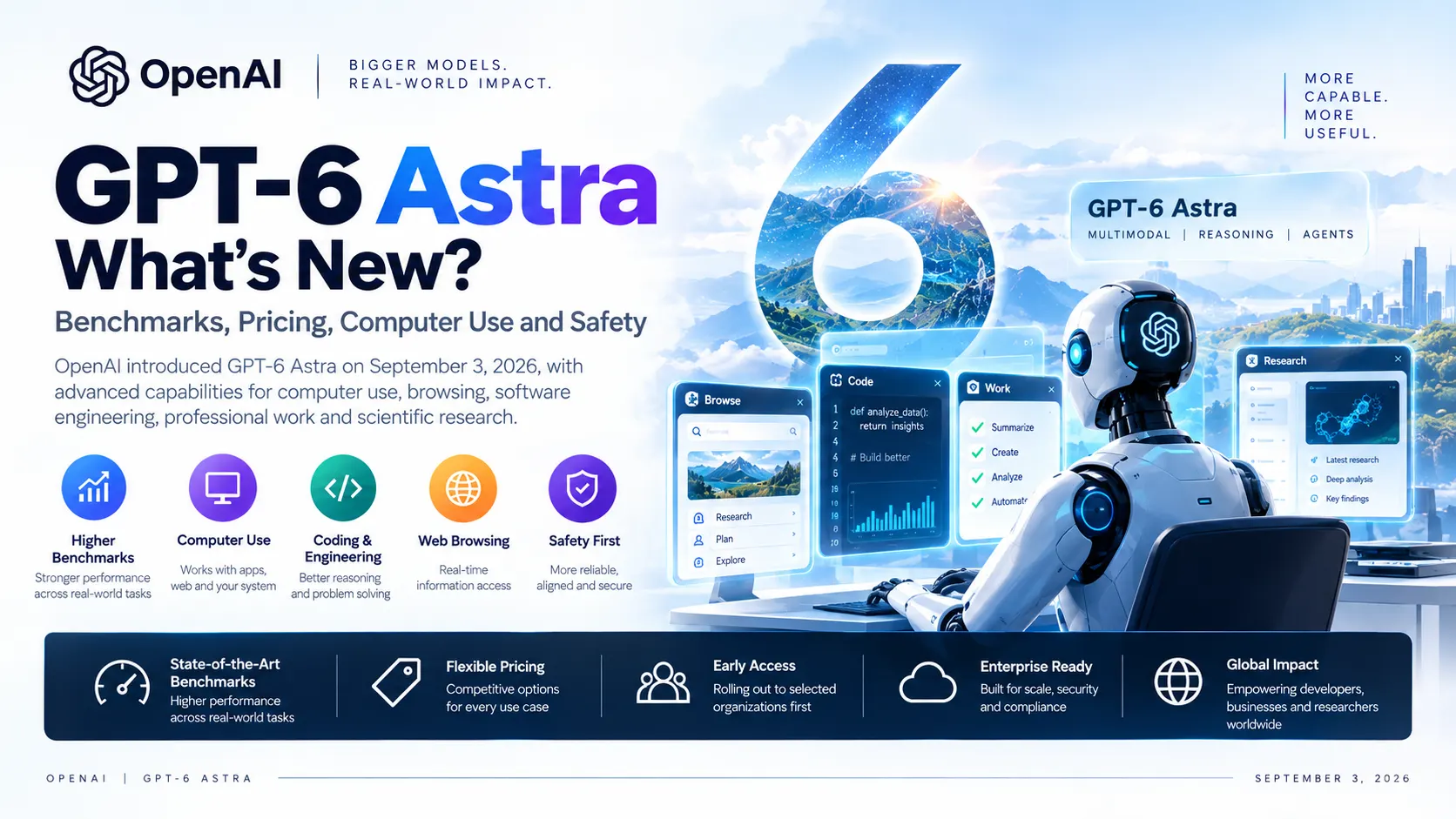
GPT-6 Astra explained: official benchmarks, API pricing, computer-use capabilities, safety safeguards, and an enterprise rollout checklist.
Quick Answer: GPT-6 Astra is OpenAI's flagship model for difficult end-to-end work involving complex reasoning, coding, research, documents, browsing, computer use, and tool-based workflows. For businesses, the real decision is not simply whether the model is capable. It is whether the workflow has the right permissions, cost controls, evaluations, human approvals, and monitoring before it reaches production.
By Asim Ansari|Published: September 7, 2026|Last verified: September 7, 2026|8 min read
Executive Summary & Key Takeaways
Frontier Agent Architecture: GPT-6 Astra is built specifically for autonomous agents that reason, plan, operate software interfaces via computer use, and interact with tools across complex environments.
1,050,000 Token Context Window: Massive 1M+ context with up to 128,000 output tokens and native support for Model Context Protocol (MCP), Skills, and code interpreter.
Standard API Pricing: $10/M input tokens, $1/M cached input, and $50/M output tokens, with 50% discounts available for Batch and Flex modes.
Computer Use & Visual Grounding: Scores 72.6% on OSWorld 2.0 and 92.7% on ScreenSpot-Pro, enabling native desktop and browser navigation.
Mandatory Enterprise Governance: With Critical-tier cybersecurity capabilities and reduced internal monitorability in adversarial settings, external least-privilege guardrails and human-in-the-loop approvals are essential.
GPT-6 Astra is positioned as a major step forward in AI agents: systems that can reason through a task, use tools, work across browser or software interfaces, and deliver a finished outcome rather than only generate text.
That makes it relevant to enterprises, startups, software teams, sales operations, customer support teams, and any business exploring AI workflows. But stronger capability also raises the standard for implementation. A model that can inspect files, call tools, browse websites, update records, or operate software needs a carefully designed boundary around what it is allowed to do.
What Is GPT-6 Astra?
GPT-6 Astra is OpenAI's most capable model for complex reasoning and end-to-end workflows. According to OpenAI, it is designed for coding, computer use, research, professional document creation, browsing, and multistep work across software environments.
The official API model identifier is:
gpt-6-astra
OpenAI documents a 1,050,000-token context window and a maximum output of 128,000 tokens. It supports key production features including structured outputs, function calling, web search, file search, code interpreter, hosted shell, computer use, Skills, and Model Context Protocol (MCP) connections. For complete technical specs, reference the OpenAI model documentation.
For an enterprise or high-growth startup, Astra can be deployed across workflows such as:
Researching, synthesizing, and summarizing internal and external knowledge repositories
Drafting, reviewing, and validating technical documentation and system architectures
End-to-end software development, automated test generation, and QA regression pipelines
Controlled browser-based business automation and repetitive back-office operations
Advanced data analysis, financial modeling, and executive KPI reporting
CRM, customer support, and commerce workflows executed through narrowly scoped tools
Enterprise AI agents connected to approved internal systems through standard MCP servers
GPT-6 Astra: Key Specifications
Here is the verified breakdown of GPT-6 Astra technical specifications and current API economics:
API Model ID
gpt-6-astra
Active Frontier Flagship
Context Window
1,050,000 Tokens
~4,000 pages of text context
Maximum Output
128,000 Tokens
Long-form synthesis & code
Input / Output Rate
$10 / $50 per 1M
$1.00 cached (90% off)
Capability & Dimension
Official Specification & Limits
Reasoning Levels
LowMediumHighXHighMax
Native Tooling Stack
Web search, file search, code interpreter, hosted shell, computer use, and Model Context Protocol (MCP)
Standard Input Pricing
$10.00 / 1,000,000 tokens
Cached Input Pricing
$1.00 / 1,000,000 tokens (90% cost reduction)
Cache Write Pricing
$12.50 / 1,000,000 tokens
Standard Output Pricing
$50.00 / 1,000,000 tokens
Knowledge Cutoff
April 30, 2026
Source: OpenAI GPT-6 Astra model page. Note: Availability, rate limits, and pricing tiers can adjust over rollout phases.
GPT-6 Astra Benchmarks: What the Numbers Mean
OpenAI reports strong Astra performance across computer use, coding, science, long-context reasoning, professional work, and cybersecurity. These figures are useful indicators, but they must be interpreted in business context.
A benchmark measures performance in an isolated, controlled evaluation harness. Your actual operational environment will be vastly different.
Enterprise Reality Check
The Salesforce & Production Data Gap
Salesforce Org Architecture
In benchmark suites, models operate on sterile, synthetic datasets. In reality, your Salesforce organization is filled with intricate custom objects, legacy validation rules, Apex triggers, strict Field-Level Security (FLS), and hundreds of interrelated pipeline records.
1. Permissions & FLS
Astra cannot bypass Salesforce sharing hierarchies or field-level permissions without governed tool mediation.
2. Custom Logic & Triggers
Direct record writes trigger automations that can crash unconstrained agent workflows if not tested in sandboxes.
Here are the official evaluation scores across key engineering, reasoning, and computer-use benchmarks:
Computer Use72.6%
OSWorld 2.0
Evaluates autonomous multi-application workflows and task completion across native desktop operating systems.
Visual Grounding92.7%
ScreenSpot-Pro
Measures visual element detection, button localization, and pixel-precise UI screen navigation.
Mathematical Reasoning97.6%
FrontierMath Tier 4
State-of-the-art performance on research-level mathematics and rigorous quantitative proof problems.
Scientific Reasoning96.0%
GPQA Diamond
Graduate-level scientific reasoning questions designed to be resistant to simple Google web search lookups.
Long Context (1M)96.3%
Long-Context MRCR (512K–1M)
Demonstrates high-fidelity needle-in-a-haystack retrieval and cross-document reasoning across 1M tokens.
Software Engineering74.1%
DeepSWE v1.1
End-to-end resolution of real-world GitHub issues, bug diagnosis, patch generation, and test verification.
OpenAI explicitly notes that evaluations may use research or API environments that differ from standard ChatGPT consumer interfaces. A high benchmark score does not automatically guarantee identical execution in your production environment without proper orchestration. Review the complete OpenAI benchmark results and methodology for detailed breakdown.
The Business Interpretation: Hybrid Tiering
The strategic takeaway from these benchmarks is clear: do not send every prompt to a frontier model. Instead, design a tiered architecture where models are matched to task difficulty and risk profiles:
Tier 1: Lightweight & Fast
Routing & Ingestion
Deploy smaller, cost-efficient models (e.g. GPT-5.6 Sol or lightweight micro-models) for high-frequency operations.
• Intent classification & triage
• Entity extraction & tagging
• Standard customer FAQ lookup
• Initial prompt sanitization
Tier 2: Frontier Intelligence
GPT-6 Astra Execution
Reserve Astra for high-complexity, high-stakes tasks that require deep reasoning and tool use.
• Deep architectural code synthesis
• Complex computer-use automation
• Multi-document RAG analysis (1M context)
• Autonomous agentic workflows via MCP
Tier 3: Deterministic Rules
Zero-Hallucination Guard
Hardcode mission-critical actions in deterministic software rather than delegating to probabilistic AI models.
• Financial transaction signoffs
• Database record deletions
• Production permission grants
• Human-in-the-loop approval gates
GPT-6 Astra Pricing and Cost Planning
OpenAI lists standard API pricing at:
Standard Input
$10.00
per 1 million tokens
Cached Input (Prompt Cache)
$1.00
90% Cost Reduction
Cache Writes
$12.50
per 1 million tokens
Output Generation
$50.00
per 1 million tokens
Discount & Latency Tiers: Prompts exceeding 272,000 input tokens have higher rates. Batch and Flex processing are priced at 50% of standard rates, while Fast mode is priced at 2x applicable rates. Refer to the official pricing documentation for complete guidelines.
Calculating Total Cost of Ownership (TCO)
The nominal per-token price is only one component of your monthly AI spend. For agent workflows, budget calculations must account for:
1. Reasoning Tokens
Hidden internal thinking tokens generated by Astra during deep problem solving count toward output billing.
2. Computer-Use Frames
Screen navigation sends multiple high-resolution screenshots into the model, adding substantial image token charges.
3. Agent Retry Loops
When an agent encounters a broken API tool or fails an execution step, recursive recovery attempts rapidly consume tokens.
A model that appears inexpensive per token but repeatedly hallucinates or fails tool executions can cost significantly more than a frontier model that reliably completes the task on the first pass. Always measure cost per successful, approved business outcome, rather than cost per raw prompt.
Computer Use: Where Astra Can Help
Computer use allows an AI model to interpret visual elements on screen (buttons, form fields, table cells, text blocks) and execute keyboard and mouse interactions within software interfaces. OpenAI describes Astra as capable of executing complex desktop and browser operations, including form completion, CRM updates, document reconciliation, competitive research, and automated QA regression testing.
This capability unlocks immense efficiency for teams juggling fragmented legacy enterprise software that lacks modern APIs. However, it should never mean handing an agent unrestricted system administrator rights.
A secure, production-grade pattern decouples requests through an intermediate gateway:
Governed Agentic Execution Pipeline
Step 1
User Intent
Prompt / Event
→
↓
Step 2
GPT-6 Astra
Reasoning & Plan
→
↓
Step 3
MCP Tool Gateway
Scoped Schemas
→
↓
Step 4
Enterprise System
Salesforce / ERP
→
↓
Step 5
Audit & Approval
Human-in-the-Loop
For example, rather than giving an agent direct, unconstrained access to your Salesforce instance, expose focused, permission-governed MCP actions:
retrieve_high_risk_opportunities()
summarize_pipeline_changes(timeframe: "7d")
draft_deal_follow_up(deal_id)
create_crm_task_after_confirmation()
export_deal_health_report()
This scoped design prevents context bloat, enforces role-based access control (RBAC), and produces an immutable audit trail for compliance.
GPT-6 Astra Safety: Why Governance Matters More Now
OpenAI states that GPT-6 Astra reaches the Critical threshold for cybersecurity capability under its Preparedness Framework. OpenAI also reports stronger resistance to jailbreaks and prompt injection than GPT-5.6 Sol, plus improved behavior in browsing and professional computer environments.
At the same time, OpenAI's safety disclosures highlight a critical trade-off: monitorability has decreased in some adversarial settings. In practical terms, an agent's internal reasoning trajectory can be harder to evaluate solely by inspecting chain-of-thought traces when handling complex or adversarial inputs.
Because of this, enterprises must never treat internal model safety checks as their sole security perimeter. Production deployments demand independent, multi-layered defensive controls.
Recommended Enterprise Guardrails
01
Principle of Least Privilege
Grant agents access only to the exact tables, files, and API endpoints strictly required for their specific role. Never grant global database or administrative privileges.
02
Narrow, Typed MCP Tools
Expose focused, task-specific micro-tools with strict parameter validation schemas (Zod/JSON Schema) rather than broad open-ended shell or query executions.
03
Mandatory Human Confirmation
Require explicit human approval before committing irreversible actions such as money transfers, bulk customer emails, record deletions, or access permission updates.
04
Isolate Secrets & Customer PII
Never feed API keys, database credentials, or sensitive personal identifiable information (PII) directly into prompts. Store secrets in secure server-side vaults.
05
Full-Stack Observability & Audit Logs
Record all prompts, reasoning steps, tool calls, return values, human approvals, latencies, and token costs in centralized, immutable observability stores.
06
Adversarial Injection & Red-Teaming
Routinely test system prompts against indirect prompt injection, data exfiltration attacks, and boundary escapes before promoting new agent versions to staging.
07
Real-World Enterprise Evaluation Sets
Construct custom benchmark suites using 50–100 anonymized real company tasks to continuously evaluate accuracy, refusal reliability, and unit economics.
08
Automated Escalation Ladders
Configure instant fallback routes to human specialists whenever an agent encounters ambiguous queries, repeated tool failures, or low confidence scores.
Explore OpenAI's GPT-6 Astra safety overview and review the associated system-card documentation when building high-stakes workflows.
A Practical GPT-6 Astra Rollout Plan
To take Astra from an experimental sandbox into enterprise production, adopt this phased rollout methodology:
1. Choose One High-Value Workflow
Target a process that is repetitive, document-heavy, and time-consuming, yet possesses clearly defined success metrics. Typical starting points include competitor intelligence gathering, technical support ticket triage, RFP proposal drafting, CRM data hygiene audits, or automated regression test creation.
2. Define Strict Permission Boundaries
Document precisely what files, tables, and endpoints the agent can read, create, or modify. Block write access to production databases during initial phases.
3. Build a Ground-Truth Evaluation Set
Assemble 50–100 real-world, anonymized task examples representing standard requests, tricky edge cases, tool failure scenarios, and malicious prompt injections. Establish benchmark thresholds for accuracy, latency, and refusal correctness.
4. Measure Unit Economics
Track the all-in cost per successful completion (including input tokens, reasoning tokens, cache hit rates, tool invocations, and human validation minutes). Validate that the cost per output delivers positive ROI compared to manual workflows.
5. Pilot With Human-in-the-Loop Approvals
Keep human operators in the loop to review and approve all outbound emails, CRM updates, financial records, and critical changes until the system demonstrates consistent reliability over thousands of runs.
6. Scale Gradually Through Governed MCP Infrastructure
Expand capabilities by introducing additional pre-tested tools one at a time. The most effective AI agent is not the one with unrestricted access to your systems, but the one that performs a specialized job flawlessly within a secure sandbox.
How Intellectual Clouds Can Help
Deploying frontier AI models like GPT-6 Astra requires more than an API key. It demands robust system architecture, enterprise security controls, custom tool interfaces, and measurable business outcomes.
As an AI-first technology partner, Intellectual Clouds helps enterprises, fast-growing startups, and software engineering teams turn generative AI into production-ready business value:
AI-Agent Architecture & MCP Integration: We build custom Model Context Protocol (MCP) servers and tool ecosystems that safely connect AI models with enterprise systems.
Salesforce Consulting: Seamlessly integrate conversational AI and intelligent agents into Sales Cloud, Service Cloud, and Data Cloud.
AI-Accelerated Development Services: Accelerate your software engineering pipelines, QA automation, and custom product builds using modern agentic development frameworks.
AI FinOps & Evaluation Harnesses: Design cost-optimized model-routing architectures and rigorous evaluation benchmarks to prevent budget overruns.
OpenAI documents the API model ID as gpt-6-astra. Access is being rolled out across tiered account levels and regions. Verify your organization's access status in the official OpenAI dashboard and API developer documentation.
How much does GPT-6 Astra cost?
Standard API pricing is $10.00 per 1 million input tokens ($1.00 for cached input) and $50.00 per 1 million output tokens. Additional factors like prompt caching, batch execution (50% discount), Fast mode (2x rate), and reasoning tokens affect overall operational cost.
Does GPT-6 Astra support computer use?
Yes. OpenAI lists computer use among the core supported features of GPT-6 Astra, backed by strong scores on OSWorld 2.0 (72.6%) and ScreenSpot-Pro (92.7%). Production deployments should always pair computer use with strict tool allowlists, session recording, and human verification for irreversible actions.
Does GPT-6 Astra support Model Context Protocol (MCP)?
Yes. OpenAI natively supports Model Context Protocol (MCP) connections with GPT-6 Astra. MCP enables agents to interface with external databases, APIs, CRM platforms, and developer tooling through structured, permissioned specifications.
Are GPT-6 Astra benchmark scores enough to choose the model?
No. While benchmarks such as DeepSWE (74.1%) and GPQA Diamond (96.0%) confirm state-of-the-art capability, they do not reflect your proprietary data structures, latency constraints, or security policies. Always test candidates against your internal task evaluation set before standardizing.
Is GPT-6 Astra safe for enterprise use?
GPT-6 Astra can be safely deployed within enterprise environments when wrapped in comprehensive external guardrails. Because internal monitorability can be challenged in adversarial settings, enterprises must implement role-based access control, prompt firewalls, secret sanitization, and human-in-the-loop signoffs.
Asim Ansari is the Founder of Intellectual Clouds and a Certified Salesforce Administrator and Pardot Specialist with 17+ years of experience across Salesforce CRM, AI automation, cloud infrastructure (AWS), and digital transformation. He writes on AI agents, Salesforce delivery, Answer Engine Optimisation (AEO), and AI-accelerated business operations.